Same-Niche vs Cross-Niche Link Exchange: Which One Backfires?

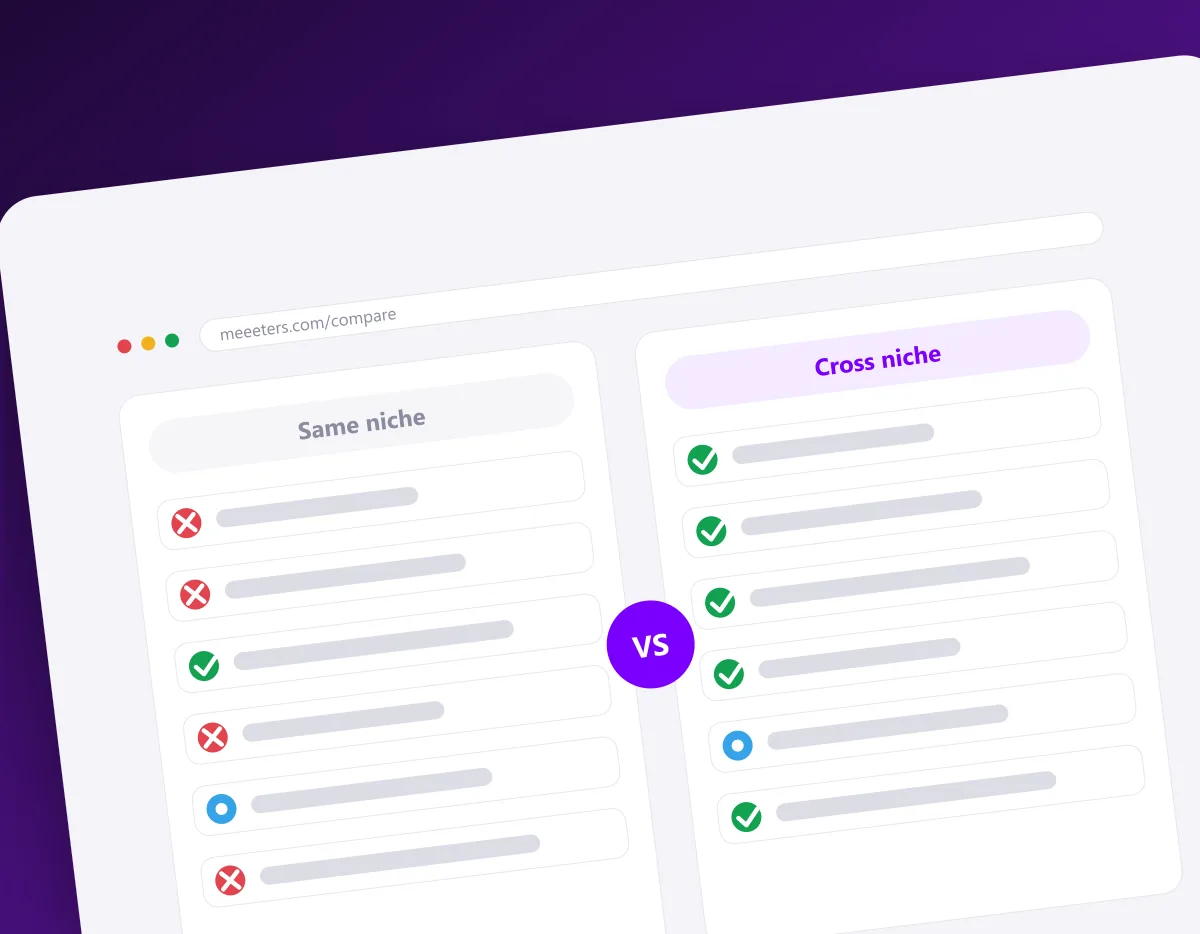
"Won't I end up linking to my competitors?" is the first objection anyone has to link exchanges, and it is a good one. If your exchange pool is your own niche, the answer is yes, and it gets worse from there. Here is why same-niche trading backfires twice, and why the adjacent-niche model is how exchanges should work.
Problem 1: every same-niche partner is a competitor
A dofollow link is a transfer of authority. If a fitness supplement store exchanges links with another fitness supplement store, each is strengthening a domain that competes for its own money keywords. Best case, the trade is a wash; realistically, the stronger site gains more, and you have paid to widen the gap. No other marketing channel would tolerate this, you would not fund a competitor's ad budget in exchange for them funding yours.
Problem 2: the pool runs dry
The second flaw is quieter. Any single niche contains a limited number of real, quality sites open to trading, often a few dozen. Users of niche-based exchange communities report the same arc: "useful for one or two months until you reach everyone in your niche." After that, the platform is a ghost town for you, whatever its total member count says.
The fix: adjacent niches, shared audience
Cross-niche does not mean random. A link from a knitting blog to a crypto exchange is incoherent and weak. The target is adjacent niches: sites whose audience overlaps yours but whose keywords do not.
- A bookkeeping SaaS ↔ freelancing blogs, invoicing guides, small-business newsletters
- A running shoe store ↔ marathon training sites, nutrition blogs, physiotherapy clinics
- A web agency ↔ hosting reviews, no-code tutorials, startup communities
Relevance survives because Google evaluates the context of the linking page, a paragraph about bookkeeping on a freelancing blog is a perfectly natural home for a bookkeeping link. What disappears is the competition problem: none of those partners bid on your keywords. And the pool problem inverts, adjacent niches multiply your partner pool instead of capping it.
Side by side
| Criteria | Same-niche exchange | Adjacent-niche exchange |
|---|---|---|
| Boosts your competitors | Yes, structurally | No |
| Partner pool | Dozens, exhausted in months | Effectively unlimited |
| Topical relevance | High | High via audience overlap |
| Footprint risk | Higher (small circular clusters) | Lower (diverse link graph) |
| Long-term viability | Poor | Good |
One more subtlety: small same-niche pools also create a pattern problem. When forty sites in one niche all trade among themselves, they form a dense, detectable cluster, the same reason reciprocal pairs fail, at community scale.
How Meeeters enforces this
Cross-category matching is a hard rule on Meeeters, not a suggestion: the platform never matches you with a site in your own category. Combined with the three-way structure, you get relevant links you could never get in a same-niche pool, without ever strengthening a rival, and without the pool drying up after month two.
Getting started
Run the free SEO analysis: it detects your site's category automatically, then matches you exclusively with adjacent-niche sites that share your audience, not your SERPs.
Frequently asked questions
Quick answers to the questions people ask most about this topic.
No, if they compete for your keywords. You would donate authority to the sites you are trying to outrank. Trade with adjacent niches that share your audience instead.
Random cross-niche links, yes. Adjacent-niche links, no. A link from a remote-work blog to a project management tool is topically coherent, and Google evaluates the context of the linking page, not just the site's category.
Pool exhaustion. In a single niche, the number of quality sites willing to trade is small, and once you have exchanged with them all, usually within one or two months, there is nobody left.

I built Meeeters to make link building safe and simple: real, relevant backlinks with no reciprocal footprint and no black-hat shortcuts. Questions about your site? Write to me directly.
Email us