Use case
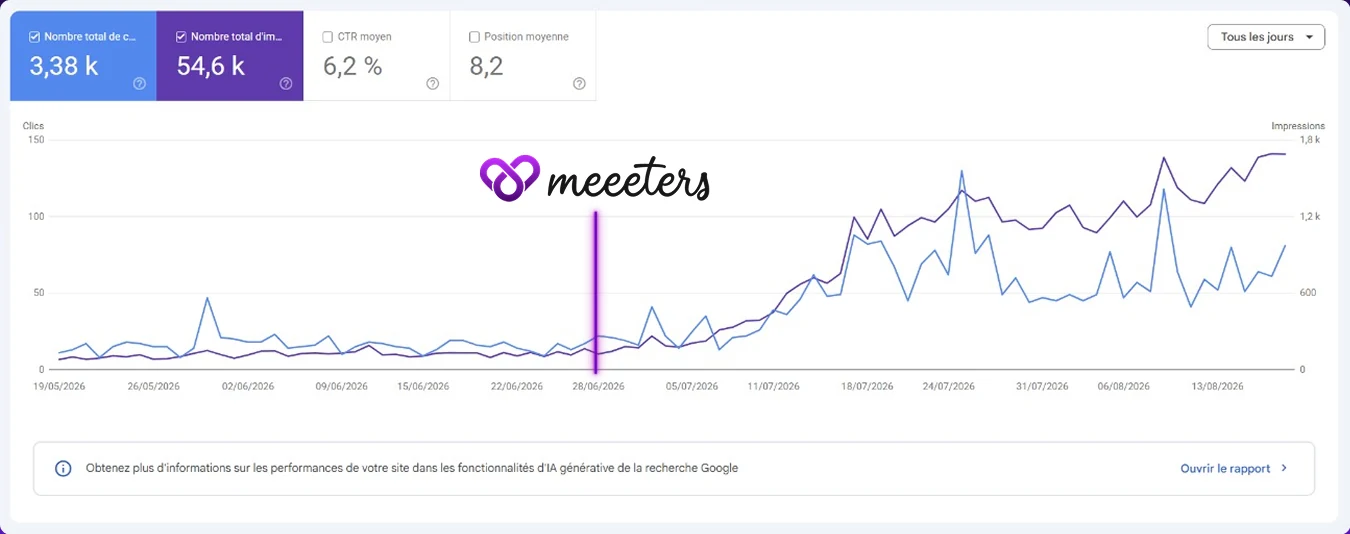
From 89 clicks a month to 3,380 in two months.
taada.top, run on Meeeters. The purple line is the day it switched on.
- 54.6k impressions
- 6.2% CTR
- Position 8.2
Your website SEO content, done for you with Meeeters, a powerful full AI SEO tool.
Works with
[ Results ]
Real sites running on Meeeters, with their own Search Console numbers. Same method for yours: scan, plan, articles, backlinks.
Use case
taada.top, run on Meeeters. The purple line is the day it switched on.
Use case
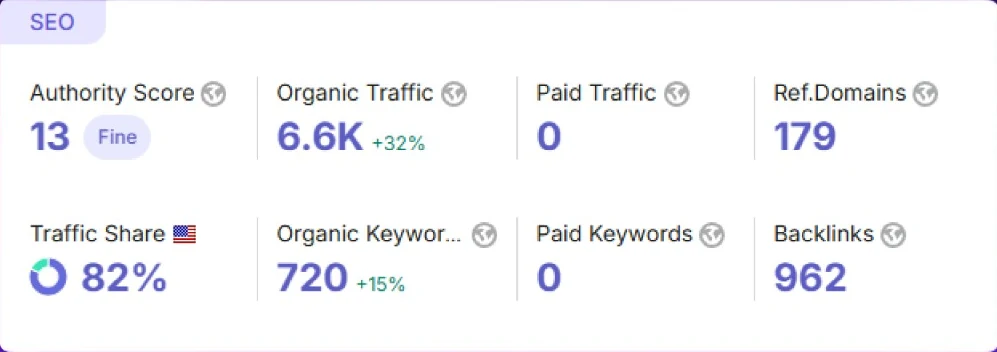
ferrstudio.ch, run on Meeeters. Organic traffic, referring domains and backlinks.
Use case
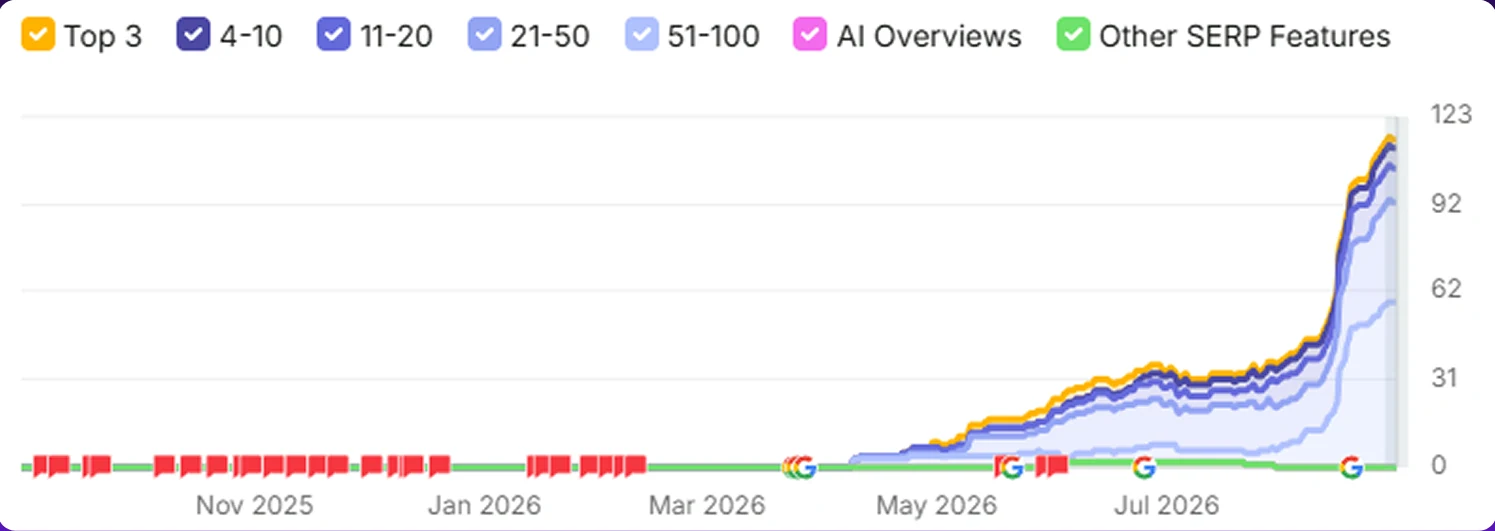
bereach.ai, run on Meeeters. Positions in Google and AI Overviews, month after month.
Use case
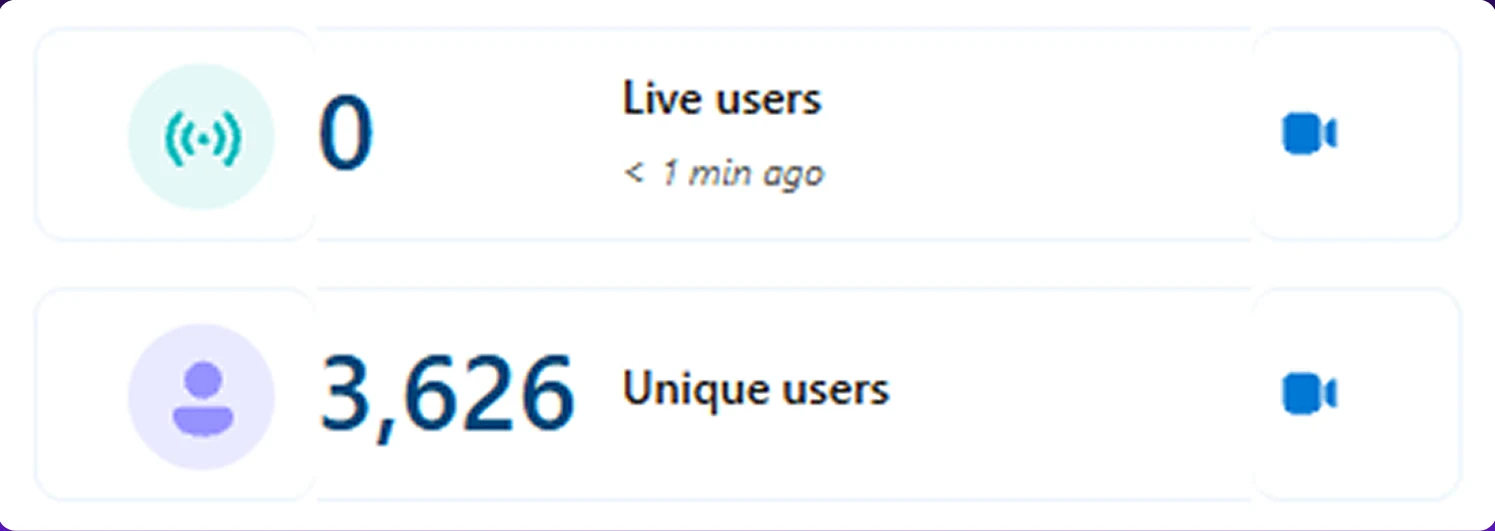
meeeters.com, our own site. Real users, counted live.
[ Problems & solution ]
Your problem
Our solution
[ Features ]
Articles, backlinks and live checks. You approve the drafts and place your links, and the same plan runs from Claude if you prefer a chat.
Headings, schema and internal links built to rank. You publish it yourself.
Member sites on your theme and language, matched with you. No reciprocal links, no chains, no PBNs.
A link counts once the page is up, the anchor is there and the rel is dofollow.
[ Reviews ]
Real Trustpilot reviews from early Meeeters members.
[ Guides ]
Everything we know about getting found on Google and in AI answers, organized into five deep guides.
Paste one address into Claude and ask in plain words, it reads your site and your Search Console.
In Claude
Start the Meeeters method[ Writing examples ]
Written for your niche and your prospects at the top of the funnel, with the facts an AI answer can quote and cite
Ask ChatGPT, Perplexity or Google a question in 2026 and you often get a written answer with a handful of citations instead of ten blue links. Generative engine optimization, GEO, is the discipline of making sure your site is one of those citations. This article is the plain-English definition: what GEO is, where the term comes from, how it relates to SEO and AEO, why it suddenly matters, and which levers actually move it.
Generative engine optimization is the practice of optimizing your content and your site so that AI systems cite, quote, paraphrase or recommend you inside the answers they generate. The "generative engine" is any system that answers a query by writing a response rather than listing links: ChatGPT with search, Perplexity, Google AI Overviews and AI Mode, Microsoft Copilot, and the growing set of AI assistants embedded in browsers and apps.
The goal shifts in one important way. Classic SEO optimizes for a position in a list, and the user chooses which result to click. GEO optimizes for inclusion in a synthesized answer, where the engine chooses which two to five sources to lean on and everyone else is invisible. A results page distributes attention across ten links; a generated answer concentrates it on the few sources it cites.
That concentration is why GEO gets discussed with such urgency, and it is also why the fundamentals have not changed as much as the hype suggests. The engines choose their sources from what they can retrieve, and what they can retrieve is largely what already ranks. Most assistants run a live search behind the scenes, read the top results, and write an answer grounded in them.
The term was coined in an academic paper titled "GEO: Generative Engine Optimization," published in November 2023 by researchers from Princeton University, Georgia Tech, IIT Delhi and the Allen Institute for AI, and later presented at KDD 2024. The paper is publicly available on arXiv.
Two things in that paper matter for practitioners. First, it formalized the idea of a generative engine: a system that ingests retrieved web sources and synthesizes an answer, citing some of them. Second, it ran experiments on which content modifications increased a source's visibility inside those answers. On their benchmark, changes like adding citations to credible sources, including quotations, and including statistics improved visibility substantially, with the paper reporting gains of up to roughly 40 percent for the best-performing methods on their test set.
Treat the exact numbers with care: the benchmark used specific engines and query sets, and real assistants have evolved since. But the direction of the finding has held up in practice. Content that carries evidence (numbers, quotes, named sources) and is structured so a model can lift a clean passage gets cited more than content that says the same thing vaguely. We see the same pattern on the sites we work with: the pages that earn citations are almost always the ones that state a checkable fact in a self-contained paragraph.
After the paper, the acronym escaped the lab. By late 2024, "GEO" had become the umbrella term in the industry for AI-answer visibility work, competing with a half-dozen other labels.
The terminology is genuinely messy, so here is the honest version: GEO, AEO and SEO are overlapping practices, not rival ones, and most of the work is shared.
SEO (search engine optimization) is the parent discipline: making pages crawlable, indexable, relevant and authoritative so they rank in search results. Every other acronym stands on top of it.
AEO (answer engine optimization) predates the current AI wave. It originally described optimizing to be the answer rather than a result: featured snippets, People Also Ask boxes, voice assistant responses. When AI chat answers arrived, many people stretched AEO to cover them too.
GEO (generative engine optimization) is the newest and most specific term: optimizing to be cited or recommended inside answers written by generative AI. In everyday use, GEO and AEO now describe mostly the same work, and you will also see LLMO, AI SEO and "LLM optimization" used interchangeably. Do not overthink the labels; the inputs matter more than the acronym.
| SEO | AEO | GEO | |
|---|---|---|---|
| Goal | Rank in a list of results | Be the direct answer | Be cited inside a generated answer |
| Surface | Search results pages | Featured snippets, PAA, voice assistants | ChatGPT, Perplexity, AI Overviews, AI Mode, Copilot |
| Key metric | Rankings, organic clicks | Snippet ownership, answer share | Citation frequency, AI referral traffic, share of voice in answers |
| Main levers | Crawlability, relevance, backlinks, content quality | Question-shaped content, concise answers, schema | Retrievability, quotable structure, entity clarity, authority |
Read the bottom row again and notice the overlap. Authority appears everywhere. Structure appears everywhere. That is the core insight of this whole field: most of what works in SEO transfers, and the budget question is where to put the rest.
The term is from 2023, but three product launches turned it from a paper into a budget line.
Google AI Overviews went mainstream. Google rolled out AI Overviews to US users in May 2024 and expanded them to more countries and more query types through 2024 and 2025, followed by AI Mode, a fully conversational search experience. When AI-written answers started appearing at the top of the world's largest search engine, every site owner suddenly had a stake in how those answers choose their sources. Google has stated that these AI features are built on its core ranking systems, and its guidance for AI features in Search says plainly that standard SEO best practices are the foundation.
More playbooks on the blog. Visit the blog
[ Pricing ]
The month's plan, 3 articles and up to 3 backlinks.
No credit card
Analyze my site10 articles and up to 10 backlinks for one site.
Card required · cancel anytime
Choose ProThe Pro plan across up to five sites.
Cancel anytime
Start nowQuick answers to the questions people ask most about this topic.
No. Meeeters reads your public pages and your Search Console. It has no access to your CMS: you copy each article and publish it yourself, so nothing on your site changes without you.
The analysis only reads your public pages, exactly like Google's crawler: no login, no admin access, no code added to your site. Articles and links need your Google Search Console: Meeeters reads it with access you can revoke at any time.
No. Nothing is installed on your site and Meeeters has no access to your CMS. You copy each article and publish it yourself.
Never. Meeeters has no access to your site. You read each article, copy it, edit it if you want, and you are always the one who clicks publish.
It is give and take, and we say so. Each month Meeeters gives you up to 3 links to place inside your own articles, toward members in your niche. Every link seen live earns you one back from a different site. Two sites never link to each other, so there are no reciprocal links and no PBNs. A site that stops placing stops receiving.
Yes, every placed link is checked automatically: the page is accessible, the link and its anchor text are present, and the rel attribute is dofollow. Nofollowed links never count toward your total, so a link only counts once all the checks pass.
Yes, on every plan. You paste one address into Claude as a custom connector and ask it to start the Meeeters method. Claude reads your site and your Search Console, drafts the month's article with its link to place, and checks the link once you have published.
No. Meeeters works on your website: articles and backlinks. For the Google Business Profile, we built a separate tool, Posipin. It drafts your review replies and posts, and lists what to fix on the profile (categories, description, hours). It runs in French and English.
Free to start, no card: 3 articles and up to 3 backlinks a month. Pro is $100 USD per month for 1 site, or $350 USD per month for up to 5 sites. Both can be canceled anytime.
SaaS, ecommerce stores, agencies, bloggers and founders. Matching pairs you with relevant sites of equivalent or higher authority.