What Is Generative Engine Optimization (GEO)? A Plain Definition

Ask ChatGPT, Perplexity or Google a question in 2026 and you often get a written answer with a handful of citations instead of ten blue links. Generative engine optimization, GEO, is the discipline of making sure your site is one of those citations. This article is the plain-English definition: what GEO is, where the term comes from, how it relates to SEO and AEO, why it suddenly matters, and which levers actually move it.
What generative engine optimization means
Generative engine optimization is the practice of optimizing your content and your site so that AI systems cite, quote, paraphrase or recommend you inside the answers they generate. The "generative engine" is any system that answers a query by writing a response rather than listing links: ChatGPT with search, Perplexity, Google AI Overviews and AI Mode, Microsoft Copilot, and the growing set of AI assistants embedded in browsers and apps.
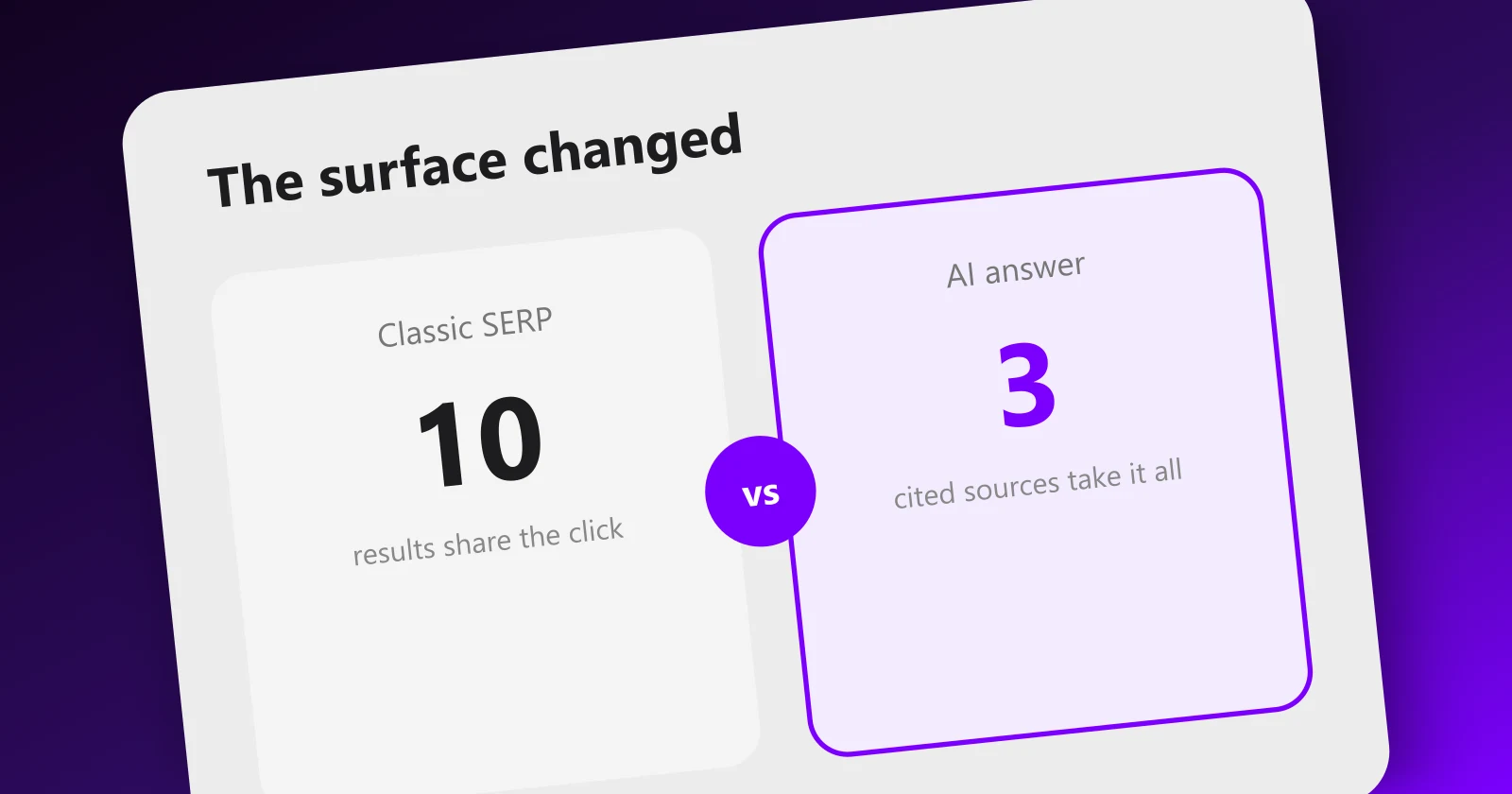
The goal shifts in one important way. Classic SEO optimizes for a position in a list, and the user chooses which result to click. GEO optimizes for inclusion in a synthesized answer, where the engine chooses which two to five sources to lean on and everyone else is invisible. A results page distributes attention across ten links; a generated answer concentrates it on the few sources it cites.
That concentration is why GEO gets discussed with such urgency, and it is also why the fundamentals have not changed as much as the hype suggests. The engines choose their sources from what they can retrieve, and what they can retrieve is largely what already ranks. If you want the full mechanics of how AI search retrieves and assembles answers, the pillar guide on how to rank in AI search covers that end to end; the short version is that most assistants run a live search behind the scenes, read the top results, and write an answer grounded in them.
Where the term comes from: the 2023 GEO paper
The term was coined in an academic paper titled "GEO: Generative Engine Optimization," published in November 2023 by researchers from Princeton University, Georgia Tech, IIT Delhi and the Allen Institute for AI, and later presented at KDD 2024. The paper is publicly available on arXiv.
Two things in that paper matter for practitioners. First, it formalized the idea of a generative engine: a system that ingests retrieved web sources and synthesizes an answer, citing some of them. Second, it ran experiments on which content modifications increased a source's visibility inside those answers. On their benchmark, changes like adding citations to credible sources, including quotations, and including statistics improved visibility substantially, with the paper reporting gains of up to roughly 40 percent for the best-performing methods on their test set.
Treat the exact numbers with care: the benchmark used specific engines and query sets, and real assistants have evolved since. But the direction of the finding has held up in practice. Content that carries evidence (numbers, quotes, named sources) and is structured so a model can lift a clean passage gets cited more than content that says the same thing vaguely. We see the same pattern across Meeeters audits: the pages that earn citations are almost always the ones that state a checkable fact in a self-contained paragraph.
After the paper, the acronym escaped the lab. By late 2024, "GEO" had become the umbrella term in the industry for AI-answer visibility work, competing with a half-dozen other labels.
GEO vs AEO vs SEO: same family, different surfaces
The terminology is genuinely messy, so here is the honest version: GEO, AEO and SEO are overlapping practices, not rival ones, and most of the work is shared.
SEO (search engine optimization) is the parent discipline: making pages crawlable, indexable, relevant and authoritative so they rank in search results. Every other acronym stands on top of it.
AEO (answer engine optimization) predates the current AI wave. It originally described optimizing to be the answer rather than a result: featured snippets, People Also Ask boxes, voice assistant responses. When AI chat answers arrived, many people stretched AEO to cover them too.
GEO (generative engine optimization) is the newest and most specific term: optimizing to be cited or recommended inside answers written by generative AI. In everyday use, GEO and AEO now describe mostly the same work, and you will also see LLMO, AI SEO and "LLM optimization" used interchangeably. Do not overthink the labels; the inputs matter more than the acronym.
| SEO | AEO | GEO | |
|---|---|---|---|
| Goal | Rank in a list of results | Be the direct answer | Be cited inside a generated answer |
| Surface | Search results pages | Featured snippets, PAA, voice assistants | ChatGPT, Perplexity, AI Overviews, AI Mode, Copilot |
| Key metric | Rankings, organic clicks | Snippet ownership, answer share | Citation frequency, AI referral traffic, share of voice in answers |
| Main levers | Crawlability, relevance, backlinks, content quality | Question-shaped content, concise answers, schema | Retrievability, quotable structure, entity clarity, authority |
Read the bottom row again and notice the overlap. Authority appears everywhere. Structure appears everywhere. That is the core insight of this whole field, and the comparison deserves its own decision-focused treatment, which is exactly what our guide to GEO vs SEO covers: what transfers, what is new, and where to put a limited budget.
Why GEO exploded in 2024 and 2025
The term is from 2023, but three product launches turned it from a paper into a budget line.
Google AI Overviews went mainstream. Google rolled out AI Overviews to US users in May 2024 and expanded them to more countries and more query types through 2024 and 2025, followed by AI Mode, a fully conversational search experience. When AI-written answers started appearing at the top of the world's largest search engine, every site owner suddenly had a stake in how those answers choose their sources. Google has stated that these AI features are built on its core ranking systems, and its guidance for AI features in Search says plainly that standard SEO best practices are the foundation.
ChatGPT got real-time search. OpenAI launched ChatGPT search at the end of October 2024 and extended it to free users shortly after. A chat product with hundreds of millions of weekly users could now browse the live web and cite sources, which meant being citable in ChatGPT became a measurable traffic channel rather than a curiosity.
Perplexity proved the answer-engine format. Perplexity built its product around cited answers from day one, running its own crawler (PerplexityBot) alongside partner indexes. Its growth demonstrated that a meaningful slice of users prefer a written, sourced answer over a results page.
The common thread: answers with citations became a default interface for finding information, and citations are a scarce resource. A typical generated answer cites a handful of sources where a results page listed ten and page two listed ten more. Fewer slots, higher stakes, new acronym.
The four levers of GEO
Strip away the vendor noise and GEO work reduces to four levers. Everything effective fits under one of them.
1. Retrievability: be in the pool
Generative engines ground their answers in retrieved documents, and they retrieve from search indexes: Bing's index for ChatGPT browsing, Google's index for AI Overviews and AI Mode, Perplexity's own crawl plus partners. If your page does not rank in the top handful of results for the underlying query, it is almost never read, let alone cited. This is the least glamorous lever and the most decisive one. Where each assistant actually gets its material, index by index, is mapped in our guide to where AI assistants get information.
2. Quotable structure: be liftable
Models extract; they do not admire. A page earns citations when it contains self-contained passages that directly answer a question: a definition in the first paragraph, H2 sections that each resolve one sub-question, comparison tables in real HTML, an FAQ block, and concrete evidence (numbers, named sources, dates) inside the passage itself. The GEO paper's finding lives here: citations, quotations and statistics make a passage more useful to a system assembling an answer, so passages that carry them get selected more often.
3. Entity clarity: be unambiguous
Engines assemble answers about entities: brands, products, people. If your brand is described one way on your site, another way in directories, and a third way in press coverage, the model hedges or cites a competitor with a cleaner story. The fix is boring and effective: one canonical one-line description, repeated verbatim across your site, your profiles and your outreach, backed by Organization schema. Consistency is also a component of the expertise and trust signals Google formalizes as E-E-A-T.
4. Authority: be trusted
Engines carry reputational risk when they cite a source, so they prefer sources the wider web already vouches for. That vouching is still expressed mostly through backlinks and brand mentions on trusted sites. This is the lever that gates the other three: a perfectly structured page on a domain nobody links to loses the citation to a rougher page on a domain everybody links to. AI visibility is downstream of search authority, which is why we built Meeeters to grow backlinks and the content that earns citations from the same dashboard rather than treating them as separate projects.
What GEO does not change
A definition is incomplete without its boundaries, and this is where a lot of GEO marketing quietly falls apart.
Crawling and indexing still gate everything. A page that is blocked, noindexed, or unrenderable is invisible to generative engines for the same reason it is invisible to search. No GEO tactic runs ahead of a crawler.
Authority is still the slow, deciding variable. No file you upload and no formatting trick substitutes for other sites linking to and mentioning yours. The citation threshold generally sits above the ranking threshold, because engines read only the top few results.
Content quality still wins ties. Thin, derivative pages do not become citable because they have an FAQ block. Engines synthesize from the most useful source available, and useful is earned the old way.
There is no submission pipeline. You cannot register your site with ChatGPT or pay for placement in AI Overviews. Anyone selling guaranteed citations is selling weather.
In other words: GEO is a layer on top of SEO, not an alternative to it. The sites that win AI citations in 2026 are overwhelmingly the sites that were already winning search in 2024, plus a newer cohort that did the fundamentals fast and structured their content for extraction from day one.
How to actually start
If GEO is new to you, the sequence matters more than the tactic list.
- Verify retrievability first. Check that your money pages are indexed and rank somewhere useful for the queries you care about. If they do not, you have an SEO problem wearing a GEO costume.
- Run a structured audit. Work through the GEO audit checklist to score your site on all four levers before spending on anything. A free SEO analysis will surface the retrievability and structure gaps in a few minutes.
- Restructure your highest-value pages. Answer-first paragraphs, one intent per section, evidence inside the passage, FAQ and schema.
- Standardize your entity. Write the one-liner, then repeat it everywhere for a year.
- Keep earning authority. Links and mentions remain the compounding asset; they were the moat in classic search and they are a taller moat in AI search.
- Measure it like a channel. Track AI referral traffic and citation share with your analytics and Search Console, and ignore tools that sell a proprietary score.
Working the four levers with Meeeters
The four levers are easy to list and slow to work by hand: an audit for retrievability, restructured pages for liftability, a consistent entity, and months of link earning for authority. Meeeters exists to run that workflow from one place instead of four tools.
- The free SEO analysis crawls your site, maps your structure and silos, checks your existing schema, and lists the missing cluster pages and quick wins. No card required.
- Article drafts are generated from that real audit, not from generic prompts: each one targets a gap in your structure and arrives as a draft in your CMS (native Webflow connector, or webhook via Make, Zapier or n8n) for you to review before anything publishes.
- Authority builds through a niche link network: give one verified link, the network owes you one back, and the links you receive are dofollow, from vetted sites, with no reciprocal footprint for Google to detect.
- Google Search Console integration tracks clicks, impressions and the almost-page-1 queries where a small push is most likely to earn the citation.
If you want to know which lever is currently limiting you, start with the free SEO analysis and read the answer off the report.
The takeaway
Generative engine optimization is a real discipline with a real origin (a 2023 research paper), a real cause (AI answers became a default search interface), and a small set of real levers: retrievability, quotable structure, entity clarity and authority. It is not a replacement for SEO, because generative engines eat what search indexes feed them. Learn the definition, ignore the acronym wars, and put your effort where the engines actually look: pages that rank, passages that lift cleanly, a brand that reads the same everywhere, and a domain the rest of the web vouches for.
Frequently asked questions
Quick answers to the questions people ask most about this topic.
GEO stands for generative engine optimization: the practice of optimizing content so that generative AI systems such as ChatGPT, Perplexity and Google AI Overviews cite or recommend it in their answers. It is the AI-answer counterpart to SEO, which optimizes for ranked lists of links.
SEO optimizes for ranking in a list of search results. AEO (answer engine optimization) optimizes for being the direct answer, a term that predates modern AI and originally covered featured snippets and voice assistants. GEO specifically targets citations inside AI-generated responses. In practice the three overlap heavily and share the same inputs: authority, structure and relevance.
The term comes from a November 2023 academic paper titled GEO: Generative Engine Optimization, written by researchers from Princeton University, Georgia Tech, IIT Delhi and the Allen Institute for AI. The paper defined generative engines and benchmarked which content changes increased visibility in their answers.
No. Generative engines retrieve their source material from search indexes, so crawling, indexing and authority still decide which pages are candidates for citation. GEO is a layer of optimization on top of SEO, not a substitute for it. Sites with weak SEO fundamentals rarely get cited regardless of how well their content is formatted.
Start by confirming your pages are indexed and ranking for the queries you want AI answers to cite you on, since retrieval draws from those results. Then restructure key pages so each section opens with a direct, liftable answer, standardize your brand description everywhere it appears, and keep building authority through backlinks and mentions. A structured audit is the fastest way to find the gaps.
The skepticism is earned. A large share of what gets sold as GEO is repackaged SEO advice with a new label, and some of it is invented technique sold on urgency. The reasonable position sits in between: the surface is real, because assistants do cite sources and do send traffic, but almost everything that earns a citation is ordinary good SEO done well. The tell is simple. A provider who says SEO is dead and only they hold the new secrets is selling the label. One who says GEO is mostly indexing, authority and clear structure is describing the actual mechanism.
There is no reliable evidence that either is decisive today. Adoption of llms.txt by the major assistants remains limited, and schema helps a machine parse a page rather than persuading a model to cite it. Both are cheap and worth having correct, but neither substitutes for being retrievable in the first place. The blunt version of this critique, common among practitioners, is that a page needing schema or llms.txt to be understood is a page that needs rewriting.
Much less than the citation count suggests, and that gap is the mechanism rather than a disappointment. An assistant can use your page as a source without the reader ever clicking through, so citations routinely outnumber visits several times over. Measure both: citation tracking tells you whether you are used as a source, referral traffic tells you what share of that becomes a visitor.

I built Meeeters to make link building safe and simple: real, relevant backlinks with no reciprocal footprint and no black-hat shortcuts.