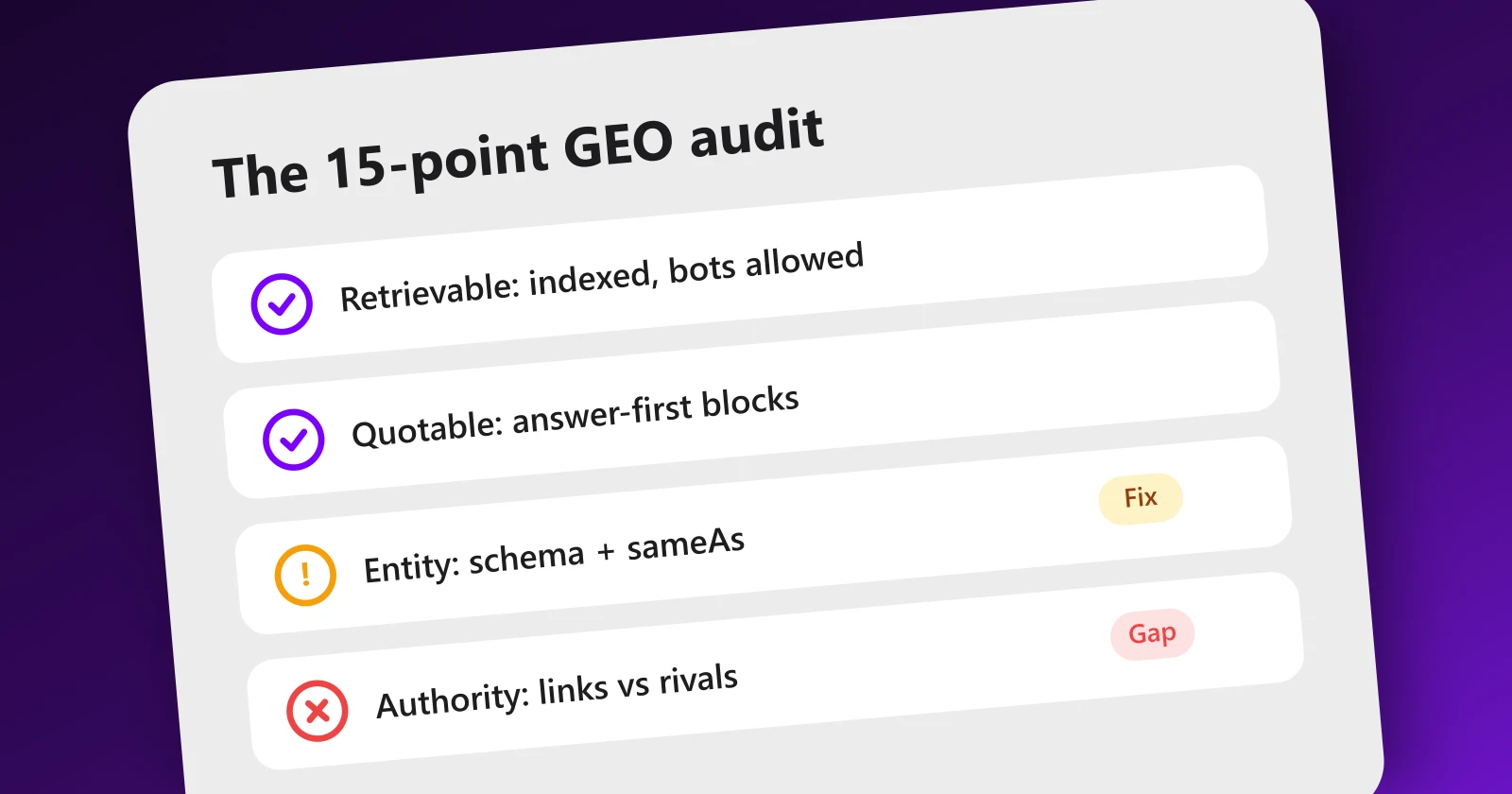
The GEO Audit Checklist: 15 Checks for AI Visibility

Every week someone asks us some version of "is my site ready for AI search," and the honest answer is that readiness is checkable. Not with a mystical AI visibility score, but with a finite list of concrete conditions: either GPTBot can fetch your pages or it cannot, either your brand description is consistent across the web or it is not, either assistants cite you for your money queries or they cite someone else.
This is the do-it-now article. Fifteen checks, four blocks, each with exactly how to run the check. The blocks follow the order an audit actually runs, because each layer is pointless without the one before it: an engine must be able to retrieve your content before it can quote it, it must understand who you are before it can recommend you, and it must trust you more than the alternatives before your name appears in the answer. The theory behind why these layers matter lives in our pillar on how to rank in AI search; this page is the checklist.
Block 1: Retrievability. Can AI engines get your content at all?
Everything downstream fails silently if this block fails, and it fails more often than people expect: a well-meaning robots.txt edit or an overzealous bot-protection rule can remove you from AI answers without a single alert firing.
| # | Check | How to check |
|---|---|---|
| 1 | Key pages are indexed in Google and Bing | site:yourdomain.com in both engines, then Search Console and Bing Webmaster Tools coverage reports for the pages that matter commercially |
| 2 | AI crawlers are not blocked in robots.txt or at the CDN | Open /robots.txt and look for GPTBot, OAI-SearchBot, PerplexityBot, Google-Extended; then grep server logs to confirm these bots get 200s, not 403s from your CDN or WAF |
| 3 | Content is readable without JavaScript | Disable JS in the browser (or curl the URL) and confirm the main content is in the raw HTML, not rendered client-side |
| 4 | llms.txt exists and lists your canonical pages | Open yourdomain.com/llms.txt and check it is current, accurate, and points to your most important URLs |
Check 1, indexing, matters because most AI answers are grounded in live search: ChatGPT's browsing runs on Bing's index, Google's AI surfaces run on Google's. A page missing from those indexes cannot be retrieved by anything built on them. Do not stop at the homepage; check the specific guides and comparison pages you want cited.
Check 2, crawler access, is where the audit finds its ugliest surprises. Each retrieval crawler identifies itself: OpenAI documents GPTBot and OAI-SearchBot in its bot documentation, Perplexity documents PerplexityBot in its crawler docs, and Google lists its crawlers in the crawler overview. Two nuances decide this check. First, the Google-Extended decision is a training control, not a search control: blocking it does not remove you from AI Overviews or AI Mode, it only opts your content out of Gemini training, so treat it as a policy choice rather than a visibility lever. Second, robots.txt is not the whole story: bot-protection layers at the CDN can block these crawlers even when robots.txt allows them, which is why the log check is part of the audit and not optional.
Check 3, JS-free readability, exists because several AI crawlers do not reliably execute JavaScript. If your content only exists after client-side rendering, those retrievers see an empty shell. Server-side rendering or static generation for content pages closes this.
Check 4, llms.txt, is the cheap one: a plain-text map of your canonical content for AI consumers. It is a low-cost signal rather than a ranking factor, and the format, placement, and realistic expectations are covered in our llms.txt guide.
Block 2: Quotability. Is your content shaped for extraction?
AI engines quote passages, not pages. This block samples whether your important pages contain passages worth lifting. Audit your top 10 commercial pages rather than the whole site; the patterns generalize.
| # | Check | How to check |
|---|---|---|
| 5 | Answer-first passages under question-shaped headings | Open each key page and read only the first sentence under each H2: does it answer the heading directly in 40 to 80 words, or does it warm up first? |
| 6 | FAQ blocks on pages that attract question queries | Confirm question pages carry a real FAQ section, marked up with FAQPage schema where legitimate, validated in Google's Rich Results Test |
| 7 | Comparisons and data live in real HTML tables | View source on comparison content: tables should be <table> markup, not images or styled divs the extractor cannot parse |
| 8 | One intent per page, no internal overlap | List the target query of each page in one column of a spreadsheet; any query that appears twice means two pages are splitting relevance |
Check 5 is the single highest-leverage content fix in GEO. The first-sentence test is brutal and fair: a passage that starts with the answer can be quoted alone; a passage that starts with throat-clearing cannot.
Check 6 and 7 are about machine legibility. Schema does not buy citations, but it removes ambiguity about what a block of content is, and tables in real markup are extractable where screenshots of tables are invisible. The full markup priority list is in schema markup for AI search.
Check 8 protects retrieval precision. When two of your pages half-answer the same question, retrieval systems get two mediocre candidates instead of one strong one. Merge or differentiate; never leave the overlap.
Block 3: Entity. Do AI systems know who you are?
Assistants recommend entities, not URLs. If the model's picture of your brand is fuzzy or contradictory, it hedges, and hedging means citing someone clearer. This block is where newer and smaller brands lose most quietly; the mechanics of why a model draws a blank on you are unpacked in why ChatGPT doesn't know your brand.
| # | Check | How to check |
|---|---|---|
| 9 | One consistent name and description everywhere | Google your brand, open the first 10 profiles and directory listings that appear, and compare the descriptions word by word against your site's own one-liner |
| 10 | Organization schema with sameAs links | Run your homepage through a schema validator: Organization (or corresponding type) present, with sameAs pointing to your real social and directory profiles |
| 11 | Presence on the sources AI engines actually read | Search the communities and reference sources of your niche (Wikipedia-grade references, major directories, Reddit and industry forums) for your brand, and note where competitors appear and you do not |
Check 9 sounds trivial and almost always fails. One profile says agency, another says platform, a third describes the product you pivoted away from two years ago. Models learn entities from repetition; contradiction reads as uncertainty. Decide the sentence, then make every profile say it.
Check 10 gives machines the explicit version of the same fact: this site, this name, these profiles are one entity. Fifteen minutes of markup, permanent disambiguation.
Check 11 acknowledges where answers actually come from. Assistants lean on a recognizable set of sources: reference sites, established directories, community discussions where real users compare options. If your category's recurring "best X" Reddit threads and comparison listicles never mention you, you are absent from the very documents the answer is synthesized from. This check produces a to-do list, not a score: each gap is an outreach or contribution target.
Block 4: Authority. Do engines trust you enough to cite you?
The last block is the gate. We see this across Meeeters audits: sites that pass every technical and content check and still get zero citations, because the sites being cited instead have five times the authority. AI answers concentrate visibility into two or three citation slots per query, and those slots go to sources the underlying ranking systems already trust. AI visibility is downstream of search authority; backlinks and brand mentions are what gate the citations.
| # | Check | How to check |
|---|---|---|
| 12 | Backlink profile benchmarked against cited competitors | Pull referring domains for your site and for the 3 sites most cited for your money queries, in any backlink tool; the gap in relevant, dofollow referring domains is your distance from the citation pool |
| 13 | Unlinked brand mentions identified and reclaimed | Search your brand name minus your own domain ("yourbrand" -site:yourdomain.com) and inventory pages that mention you without linking; each is a warm link opportunity |
| 14 | Share of citations measured on your money queries | Ask ChatGPT (with search), Perplexity, and Google AI Mode your top 10 commercial queries; record every brand and URL cited in a spreadsheet |
| 15 | Citation share tracked monthly against competitors | Repeat check 14 on a fixed monthly schedule, same queries, and chart your share of citation slots over time |
Check 12 turns authority from a vibe into a number. You are not trying to out-link the whole internet, only to close the gap with the specific sites currently occupying your citation slots. Relevance weighs more than raw volume: ten links from sites in your niche move citability more than thirty from nowhere in particular.
Check 13 is the cheapest authority win in the audit. A page that already mentions you has already decided you are worth naming; asking for the link converts an existing mention into a ranking input. The full workflow is in our guide to unlinked brand mentions, and the mentions themselves also feed entity strength (Block 3), which is why this single check pays twice.
Checks 14 and 15 are the closest thing GEO has to rank tracking, and the manual version is genuinely fine. Ten queries, three assistants, one spreadsheet column per month. Within two or three cycles you know your citation share, who owns your category in AI answers, and whether your work is moving the number. Dedicated platforms automate this at scale, but do not let tooling delay the first measurement: the spreadsheet works today.
Scoring your audit and sequencing the fixes
Score it bluntly: each of the 15 checks is a pass or a fail, no partial credit. Then fix in block order, because the blocks are load-bearing. A retrievability failure (blocked crawler, JS-only content) nullifies everything else and is usually fixed in a day. Quotability fixes are content edits you control completely: budget a focused pass over your top 10 pages. Entity fixes are a week of cleanup plus ongoing discipline. Authority is the slow variable, measured in months of link and mention acquisition, which is exactly why it should start first even though it appears last in the audit.
Typical failure distribution, from the audits we run: technical retrievability mostly passes (the web is better rendered than it was), quotability fails on answer-first structure more than on schema, and the majority of sites that are invisible in AI answers fail on Blocks 3 and 4. In other words: it is rarely that the engines cannot read you. It is that they have no reason to pick you.
The fastest way to run this audit
Roughly half of these fifteen checks are crawl work, and crawl work is what we built the Meeeters analysis to do: run the machine-checkable half of the list in minutes, so your half day of manual effort shrinks to the checks no crawler can do for you. Here is how the platform maps onto the four blocks:
- The free analysis crawls your site and maps its structure and silos, which covers the retrievability sampling of Block 1 and the one-intent mapping of check 8 in a single pass. No card required.
- It detects your schema and JSON-LD, turning checks 6 and 10 from a page-by-page validator session into a report you read once.
- It lists the pages your cluster is missing and the quick wins, so the audit ends the way an audit should: with a prioritized to-do list, not a score.
- The quotability gaps it finds feed straight into the article generator: drafts target those exact holes in your structure, in your site's language, delivered into your CMS as drafts for you to review and publish.
- Block 4 failures get a mechanism, not just a diagnosis: the non-reciprocal link network (you give a verified link to one vetted site, a different site links back to you) closes the referring-domain gap that check 12 exposes, with casinos, adult and directory sites banned from the pool.
- The Google Search Console integration covers the classic-search side of your monthly routine, clicks, impressions and almost-page-1 queries, in the same dashboard, alongside the hand-run citation log from checks 14 and 15.
Run the free SEO analysis first, then spend your manual hours where they are irreplaceable: the citation tests, the entity cleanup, and the server-log reads.
The takeaway
A GEO audit is not a vibe check, it is fifteen falsifiable questions in four blocks: can they retrieve you, can they quote you, do they know who you are, and do they trust you more than the alternatives. Run the checklist in order, score it pass or fail, start the authority work first because it compounds slowest, and put the monthly citation test in the calendar before you close this tab. The sites getting cited a year from now are the ones measuring today.
Frequently asked questions
Quick answers to the questions people ask most about this topic.
A GEO audit is a structured review of whether AI search engines and assistants can retrieve, quote, understand, and trust your website. It covers four areas: technical retrievability, content quotability, entity consistency, and authority relative to the competitors currently being cited.
Open yourdomain.com/robots.txt and search for GPTBot, OAI-SearchBot, PerplexityBot, and Google-Extended. Any Disallow rule under those user agents blocks that crawler. CDN and firewall settings can also block bots silently, so verify in your server logs that these crawlers actually receive 200 responses.
Ask each major assistant (ChatGPT with search, Perplexity, Google AI Mode) your top 10 commercial queries and record every brand and URL cited. Repeat monthly. Your share of those citation slots, tracked over time against competitors, is the closest thing GEO has to a rank tracker.
The manual version of this 15-point checklist takes roughly half a day: an hour for retrievability, an hour or two for quotability sampling, an hour for entity checks, and the rest for the citation and backlink benchmarking. Crawl-based tools compress the retrievability and authority half to minutes.
Run the full 15 points quarterly, and the share-of-citations test monthly. AI surfaces change fast, models refresh, and competitors publish, so citation share drifts even when your site does not change. Quarterly is frequent enough to catch regressions without turning auditing into the job itself.

I built Meeeters to make link building safe and simple: real, relevant backlinks with no reciprocal footprint and no black-hat shortcuts.