The Best GEO Tools in 2026: An Honest Comparison by Category

Search for "best GEO tools" and you get the same article fifteen times: a numbered list of every tool with an AI badge, each described in the vendor's own words, affiliate link included. This is not that article. The honest starting point is that "GEO tool" describes four different product categories that solve four different problems, and most buyers only need one or two of them, in a specific order.
We spend our days inside Meeeters audits watching which sites get cited by assistants and which stay invisible, so we have strong opinions about which category actually moves that needle. Here is the landscape as it really is: what each category does, what it quietly does not do, and what to buy depending on who you are.
The four categories of GEO tools
Every product marketed for GEO (Generative Engine Optimization) fits one of four boxes.
- AI visibility trackers. They run prompts against ChatGPT, Perplexity, Google AI Overviews and other assistants at scale, and report how often your brand is mentioned or cited versus competitors. Pure measurement.
- Classic SEO suites adding AI features. Semrush, Ahrefs and friends, extending their existing ranking and backlink data with AI mention tracking. Measurement plus the classic SEO workflow underneath.
- Content optimization tools. They help you structure pages so an answer engine can lift a quote: answer-first formatting, FAQ and schema coverage, entity consistency.
- The authority layer. Tools and networks that earn the backlinks and brand mentions which decide who gets cited at all. This is where Meeeters sits, and it is the category the "top 10 GEO tools" lists usually skip, because it is the unglamorous input rather than the shiny dashboard.
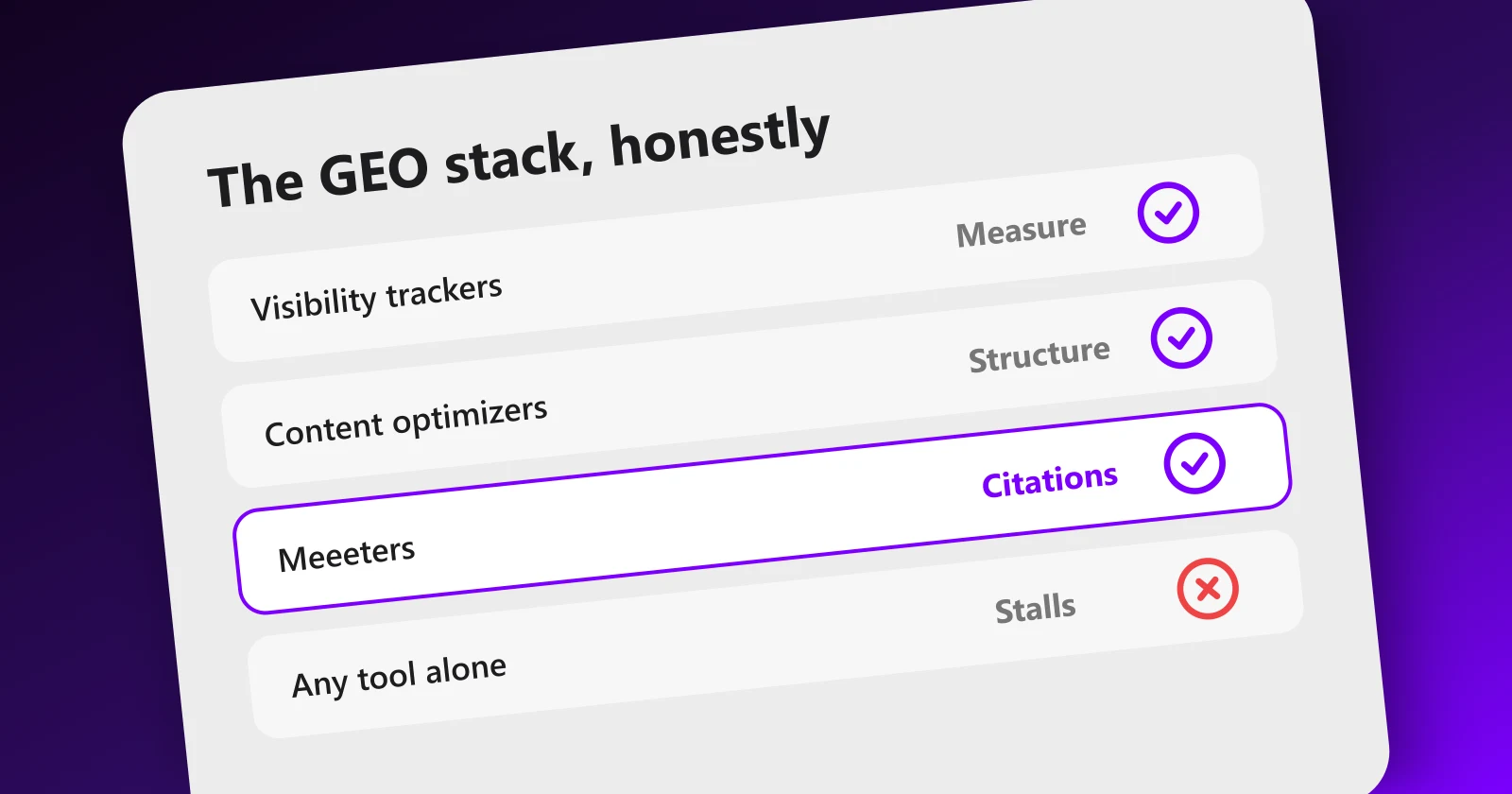
The one-sentence buying guide before the detail: categories 1 and 2 tell you the score, category 3 makes you quotable, category 4 makes you citable. Only 3 and 4 change the outcome.
The comparison table
| Tool / category | What it does | What it does NOT do | Best for |
|---|---|---|---|
| Profound (visibility tracker) | Enterprise-grade AI visibility tracking: brand mentions, citations and sentiment across major assistants, competitor share of voice, agent traffic analytics. Pricing on request. | Does not create content, earn links or change your visibility. Overkill below enterprise budgets. | Enterprise brands with an existing GEO program to report on |
| Peec AI (visibility tracker) | Prompt-based mention and citation tracking across assistants with competitor benchmarks and source breakdowns, from ~€90/mo. | No content or authority features; you act on the data elsewhere. | Marketing teams and agencies needing clean multi-client dashboards |
| Otterly.AI (visibility tracker) | Entry-level AI search monitoring: tracks prompts across ChatGPT, Perplexity and Google AI Overviews, from ~$29/mo. | Smaller prompt volumes and less depth than enterprise tools; measurement only. | Solo founders and small teams wanting a first visibility baseline |
| Semrush AI Toolkit (suite add-on) | AI visibility and sentiment tracking bolted onto the Semrush stack, from ~$99/mo. | Does not go as deep on assistants as dedicated trackers; no citation-earning mechanics. | Teams already on Semrush who want one vendor |
| Ahrefs Brand Radar (suite add-on) | Brand and citation monitoring in AI answers on top of Ahrefs' index and backlink data, bundled with Ahrefs subscriptions. | Measurement on top of a classic suite; the link building remains your job. | SEOs already living in Ahrefs |
| Content optimization tools (category) | Structure pages for quotability: answer-first sections, FAQ blocks, schema coverage, entity consistency checks. | Cannot compensate for a domain nobody links to or mentions; quotable but unknown is still invisible. | Sites with authority whose pages are poorly structured |
| Meeeters (authority layer) | Audit-driven GEO/SEO analysis, AI article drafts built from your real site structure, and a backlink module that finds you dofollow backlinks in your niche from scanned, eligible members (no reciprocal links, no PBNs). | Not a prompt-by-prompt tracking dashboard; pairs naturally with a tracker once citations exist. | Sites that measure fine but never get cited: founders and small teams who need the inputs, not another scoreboard |
Category 1: AI visibility trackers, useful once there is something to track
The direct answer: trackers are the category most people mean by "GEO tools", they are genuinely useful, and they are the last thing you should buy.
What they do well is turn an invisible channel into numbers. You define the prompts that matter ("best CRM for freelancers", "is X better than Y"), the tool runs them against the assistants daily or weekly, and you get mention rates, citation sources, sentiment and competitor share of voice. When a competitor is cited and you are not, the source breakdown shows you exactly which pages the assistant leaned on, which is legitimately valuable competitive intelligence.
The tools worth knowing:
- Profound is the enterprise reference: deep assistant coverage, sentiment, agent analytics, and pricing on request that filters out anyone without an enterprise budget.
- Peec AI has become a favorite of agencies and mid-market teams, from ~€90/mo, with clean competitor benchmarking.
- Otterly.AI is the accessible entry point, from ~$29/mo, and a reasonable first purchase if you just want a baseline.
- Semrush AI Toolkit and Ahrefs Brand Radar are the suite vendors' answers, covered in the next section.
What none of them do: change the answer. A tracker will tell you with beautiful precision that ChatGPT recommends your competitor every single day. It will not write the page, fix your schema, or earn the links that flip the citation. We cover the full measurement stack, including the free parts of it, in how to track AI search traffic.
The buying error we see constantly: a small site with near-zero AI visibility paying $200 a month to confirm, weekly, that it has near-zero AI visibility. If your mention rate is a flat zero, you do not need better instrumentation, you need inputs.
Category 2: classic SEO suites adding AI features
The direct answer: if you already pay for Semrush or Ahrefs, their AI features are the cheapest way to start measuring, and the suite's classic data matters more for GEO than the AI badge does.
This is the point most GEO tool roundups get backwards. Assistants that browse (ChatGPT search, Perplexity, Google's AI features) retrieve from search indexes and lean heavily on pages that already rank; Google states plainly that its AI experiences are built on its core search systems, in its own documentation on AI features. So the boring suite features (rank tracking, site audits, backlink analysis) remain the leading indicators of AI visibility. The new AI dashboards are lagging indicators layered on top.
Semrush AI Toolkit (from ~$99/mo) gives brand visibility and sentiment across major assistants inside the ecosystem you already use. Ahrefs Brand Radar does the equivalent with Ahrefs' crawl and mention data, and pairs naturally with the backlink index when you ask why a competitor gets cited.
What the suites do not do: dedicated trackers go deeper on prompt coverage and assistant breadth, and no suite feature produces content or links. The suites also tempt you into treating GEO as a new tab to check rather than a strategy shift; the actual differences in approach are the subject of GEO vs SEO.
Category 3: content optimization for quotability
The direct answer: this category makes your pages liftable by an answer engine, it is mostly work rather than software, and it only pays off on a domain with some authority.
Assistants extract; they do not admire. A page gets quoted when a machine can isolate a clean, self-contained answer: a question-shaped heading, a direct first sentence, a table with real HTML, an FAQ block with schema. Various tools score and assist this (AI-readability checkers, schema generators, entity consistency audits), and some content platforms now include quotability scoring.
Our honest take: the checklist matters more than the tooling. Most of what these products sell is discipline you can apply manually in an afternoon per page, and the full list lives in our GEO audit checklist. This is also the layer where Meeeters' article generation operates: drafts are built answer-first from a real audit of your site's structure, with FAQ and schema baked in, delivered to your CMS for a human to review and publish.
The limit of the category, stated plainly: quotable content on an unknown domain does not get cited. Structure decides whether you can be quoted; authority decides whether you are.
Category 4: the authority layer, the part no tracker sells
The direct answer: backlinks and brand mentions gate AI citations, no tracking tool earns either, and this is the category that actually moves a mention rate off zero.
The mechanism is not mysterious. Answer engines cite a handful of sources per response, chosen from pages that rank and brands the model has repeatedly seen described across trusted sites. Both signals reduce to authority: links pointing at your domain and unlinked brand mentions accumulating across the web. AI visibility is downstream of search authority; the assistants concentrated Google's jury, they did not replace it. The full mechanics, retrieval, ranking and citation, are the subject of the pillar guide on how to rank in AI search, so we will not re-derive them here.
This is where Meeeters sits, and why we put ourselves in the main table rather than in a self-serving sidebar: it is built to supply the two inputs the other three categories assume you already have. Concretely, here is what the platform does that a tracker or an optimizer does not:
- The free analysis crawls your site, maps your structure and silos, detects your schema and JSON-LD, and lists the missing cluster pages and quick wins. No card required.
- Article drafts are generated from that real audit rather than from generic prompts: each one targets a gap in your own structure, written in your site's language.
- Drafts land in your CMS as drafts (native Webflow connector, or a webhook via Make, Zapier or n8n). Nothing auto-publishes; you review, you publish.
- Links come from an AI-powered backlink module that finds you dofollow backlinks in your niche, from network members that are scanned and eligible. No reciprocal links, no PBNs. Casino, adult and directory sites are banned from the pool.
- Acquisition is predictable: matches come from scanned, eligible members, matched by language and audience so the links come from sites whose readers can become your visitors. You do not pay cash per link, and it is free to start.
- One dashboard holds both inputs plus the scoreboard: content, backlinks, and Google Search Console tracking for clicks, impressions and almost-page-1 queries.
What Meeeters does not do, for symmetry: it is not a prompt-by-prompt tracking dashboard. Once your authority work produces citations, a tracker from category 1 or 2 is the right way to watch them compound. The free SEO analysis is the entry point: run it, and the gaps it finds tell you which of the four categories deserves your first budget.
Which setup for which situation
Solo founder, new or small site. Buy nothing yet. Run the free checks (robots.txt open to AI crawlers, schema present, assistants asked your money questions by hand), fix structure, then put your first real budget into content and links, because a zero mention rate needs inputs, not instrumentation. Otterly.AI at ~$29/mo is a sane first tracker once citations start appearing. Where that budget goes, and why measurement comes after content, is the whole argument of GEO versus SEO.
In-house SEO at a mid-size company. Start with the AI features of the suite you already pay for; that covers reporting for a quarter or two. Spend the incremental budget on the authority layer and on restructuring your top 20 pages for quotability. Graduate to Peec AI or similar when leadership wants competitor share-of-voice reporting the suite cannot provide.
Agency. You need a dedicated tracker early, because clients buy dashboards and multi-client reporting is exactly what Peec AI and Profound are built for. But the retention driver is moving the numbers, which means packaging content and link building alongside the reporting, not instead of it.
What none of these tools do
Three quiet truths that vendors will not put on their pricing pages.
No tool sees the whole picture. Assistants personalize, A/B test and update constantly; every tracker samples. Treat mention rates as directional trends, not census data.
No tool earns a citation by itself. Trackers measure, optimizers format, and both depend on an authority signal that only accumulates from real links and mentions over months.
No tool replaces judgment. The prompt list you track, the pages you restructure, the sites you accept links from: these decisions decide your GEO outcome more than any vendor choice.
The takeaway
The best GEO tool depends entirely on which of the four jobs you have not done yet. Fix retrievability and structure first (free), produce answer-first content on a tight cluster (work), build the authority that gates citations (the layer where Meeeters lives), and only then pay to track the citations you have started earning. Most "best GEO tools" lists sell you the scoreboard first. Buy the team first; if you want to see what the audit finds on your own site, the free SEO analysis is the two-minute version.
Frequently asked questions
Quick answers to the questions people ask most about this topic.
There is no single best GEO tool because the category covers four different jobs. Profound, Peec AI and Otterly.AI lead dedicated AI visibility tracking, Semrush and Ahrefs bolt AI mention data onto classic SEO suites, and authority platforms like Meeeters do the part trackers cannot: earning the backlinks and mentions that make assistants cite you.
No. Trackers are measurement tools: they tell you how often ChatGPT, Perplexity or Google AI Overviews mention your brand and who gets cited instead. Improving those numbers requires content and authority work the tracker does not perform. Buying a tracker before you have citations to track is paying to watch a zero.
Entry-level AI visibility tracking starts around $29 per month with tools like Otterly.AI, mid-market tools commonly run $89 to $500 per month, and enterprise platforms like Profound price on request. The bigger budget line is usually the work the tools point at: content production and link building.
Yes, especially early. You can check AI crawler access in your robots.txt, ask assistants your money questions by hand, add schema and FAQ blocks, and monitor assistant referrals in your analytics for free. Tools become worth paying for once you have real citations to measure and competitors to benchmark against.
For most teams already paying for a suite, yes at the start. Semrush's AI Toolkit and Ahrefs Brand Radar cover the measurement basics on top of the ranking data that still drives most AI citations. Dedicated trackers add depth (more prompts, more assistants, sentiment), and none of the above builds the authority that earns citations in the first place.

I built Meeeters to make link building safe and simple: real, relevant backlinks with no reciprocal footprint and no black-hat shortcuts.