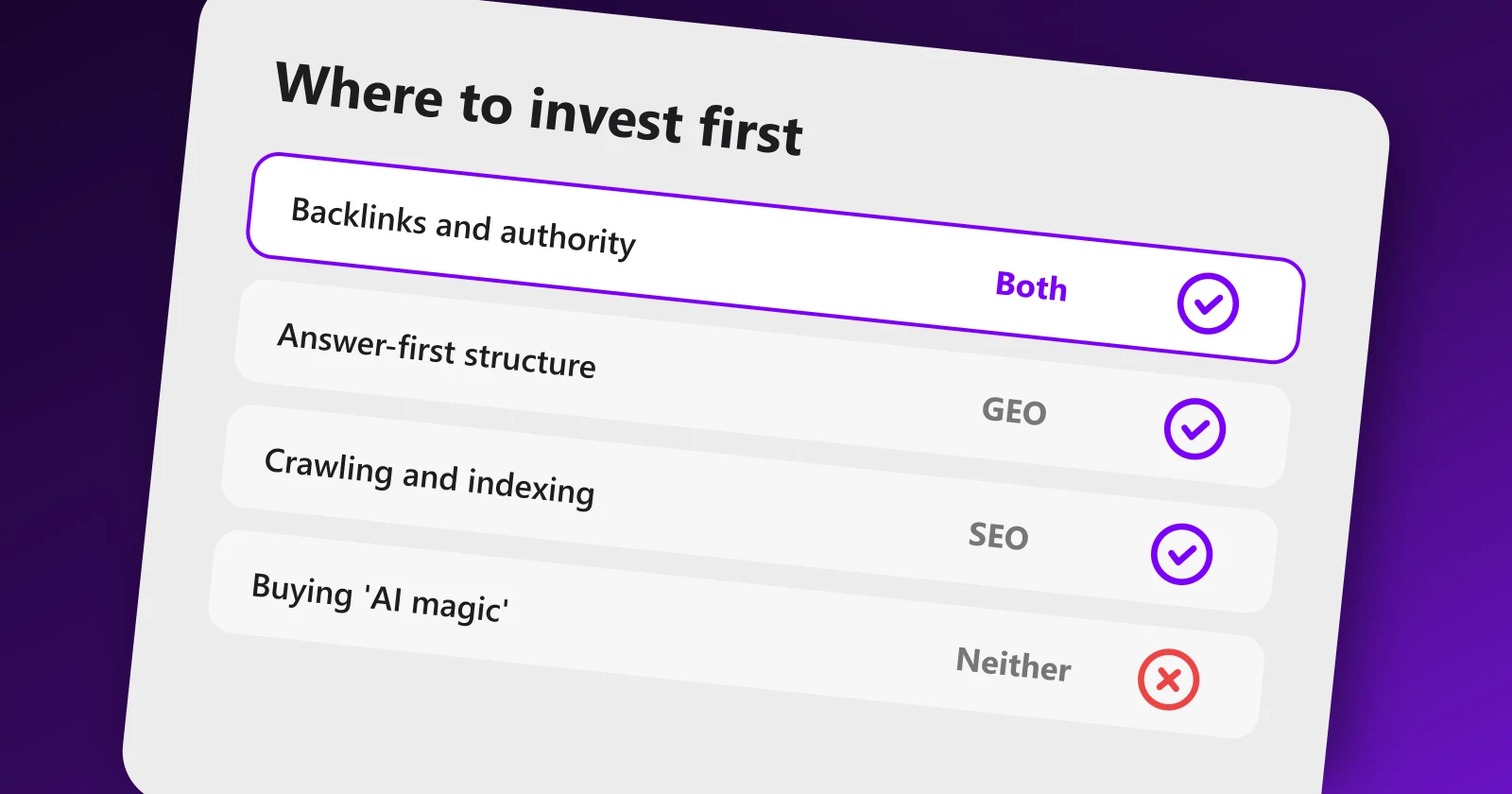
GEO vs SEO: What Actually Changes, and Where to Invest First

You run a site, you have a fixed budget, and every newsletter is telling you that SEO is dead and GEO is the new game. Before you move money, you deserve a straight answer to three questions: what transfers from the SEO you already do, what is genuinely new work, and what is noise. This is that comparison, written for a buying decision rather than a debate.
The short answer
GEO is a layer on top of SEO, not a replacement. Generative engines (ChatGPT search, Perplexity, Google AI Overviews and AI Mode) answer questions by retrieving pages from search indexes and synthesizing from the top results. That single architectural fact settles most of the argument: whoever ranks controls who gets cited, so the discipline that controls rankings still controls the input to AI answers. If the term itself is new to you, start with the plain definition of generative engine optimization and come back; this article assumes you know what GEO is and want to know what it costs you in attention and money.
The honest budget split for most sites is heavily weighted toward the shared fundamentals, with a thin, cheap GEO layer on top. Here is the breakdown that justifies it.
What transfers 1:1 from SEO
These are the investments you have already made (or should have) that earn AI citations with zero modification. If a vendor tells you any of these need an "AI version," hold your wallet.
Domain authority and backlinks. Generative engines carry reputational risk with every citation, so they lean on sources the web already vouches for, and that vouching is still expressed through links and mentions on trusted sites. In practice the bar is higher than in classic SEO: an answer cites two to five sources where a results page listed ten, so the authority threshold for citation sits above the threshold for traffic. Every backlink you earn is simultaneously an SEO asset and a GEO asset. This is the clearest case in the whole comparison of one dollar doing two jobs.
Crawling, indexing and site health. ChatGPT's browsing reads from Bing's index, AI Overviews and AI Mode read from Google's, Perplexity crawls with PerplexityBot. A page that is slow, blocked, noindexed or unrenderable is invisible to all of them for the same reason it is invisible to search. Your existing technical SEO checklist is the GEO technical checklist; Google says as much in its guidance for AI features in Search, which points AI-visibility questions back to standard search essentials.
Content quality and topical depth. Engines synthesize from the most useful source they retrieve. Original information, first-hand experience, complete coverage of one topic in an interlinked cluster: the exact qualities that survive core updates are the qualities that win citation slots. Thin content does not become citable by reformatting it.
Rankings themselves. This is the one people resist, so it deserves its own line: your position in classic search results remains the leading indicator of your AI visibility, because retrieval reads the top of those results. If you rank top three for a query, you are in the candidate pool for the AI answer to that query. If you rank on page two, you are not, and no GEO tactic changes that.
What is genuinely new work
Now the real GEO layer: the tasks that classic SEO did not require and that measurably affect whether you get cited once you are in the pool. There are four, and none of them is expensive.
Answer-first passage writing. Search ranks pages; generative engines lift passages. The new editorial discipline is making every important section self-contained and extractable: the H2 asks the question, the first paragraph answers it completely with the evidence inside (numbers, dates, named sources), and the rest of the section develops. Most sites write the opposite way, warming up for three paragraphs before the point. Retrofitting your top 10 to 20 pages this way is days of editing, not a rebuild, and it is the highest-leverage new task on this list. We see it across Meeeters audits: the difference between a cited page and an ignored one on the same query is usually one liftable paragraph.
llms.txt and machine readability. A small, growing convention: a plain-text file listing your canonical pages with one-line descriptions so agents can ingest your site correctly, alongside a clean RSS feed and lean templates where content dominates the HTML. It is a cheap courtesy signal, not a ranking factor, and it only matters once you have authority worth ingesting. An afternoon of work, once.
Entity consistency. Models learn what your brand is from repetition across the web. New task: write one canonical one-line description of your company, then enforce it verbatim across your site, directories, social profiles and guest content, backed by Organization schema. Inconsistent entities get hedged answers or lose the mention entirely. This was good practice before; GEO makes it mandatory. Reclaiming unlinked brand mentions does double duty here: it strengthens the entity and earns the link.
Citation tracking. Rankings no longer measure everything. You now also want to know: which assistants cite you, on which prompts, against which competitors, and how much referral traffic arrives from assistant domains. That is a genuinely new measurement layer with its own tooling, and a small monthly line item.
What is hype to ignore
The gap between those four tasks and what the GEO industry sells is where budgets go to die.
"AI keyword research" as a separate discipline. The prompts people type into ChatGPT map onto the same intents as search queries, and the engines retrieve against the same indexes. Your existing keyword and intent research covers it.
Proprietary AI visibility scores. A single opaque number scoring your "GEO readiness" measures nothing an engine uses. Pay for observable data (citations, referrals, rankings), not for scores.
Guaranteed citations or AI answer placement. There is no submission pipeline into ChatGPT, Perplexity or AI Overviews, and no paid placement inside organic AI answers. Anyone guaranteeing citations is guaranteeing weather.
Rebuilding your site "for AI." Special bot-facing versions of pages, mass "AI-optimized" content generation, JSON mirrors of your whole site: unnecessary, and mass unreviewed content is the profile core updates punish. The engines read the same web everyone else does.
The investment table
| Investment area | Already covered by SEO? | New work for GEO? |
|---|---|---|
| Backlinks and brand mentions | Yes, transfers 1:1 | No new work, higher stakes |
| Technical health (crawl, index, speed) | Yes, transfers 1:1 | None |
| Topical clusters and content depth | Yes, transfers 1:1 | None |
| Structured data (schema) | Mostly | Minor additions (FAQ, Organization) |
| Passage-level answer-first writing | Partially (snippets rewarded it) | Yes: retrofit key pages |
| llms.txt, RSS, lean templates | No | Yes: one afternoon |
| Entity consistency audit | Rarely done | Yes: define and enforce one-liner |
| Rank tracking | Yes | No |
| Citation and AI referral tracking | No | Yes: new tool, small budget |
| "AI keyword research" | Covered by existing research | Skip |
| Proprietary GEO scores | n/a | Skip |
| Guaranteed citation services | n/a | Skip, does not exist honestly |
Read the middle column top to bottom and the conclusion writes itself: the majority of what GEO requires, you either already have or already know how to buy. For most small and mid-sized sites the new layer lands in the hundreds per month, not thousands, precisely because the expensive parts are shared with SEO.
Three site profiles, three budget splits
Abstract percentages help less than recognizing your own situation, so here are the three profiles we meet most often in Meeeters audits, and how the split changes for each.
The new or low-authority site. Under a couple of dozen referring domains, few or no top-ten rankings, content still thin. The split here is close to 95/5. Nearly everything goes into the foundation: building out one tight topic cluster, earning the first real backlinks, fixing indexing. The 5 percent is habits, not spend: write every new page answer-first from day one (it costs nothing extra), set the canonical brand one-liner now, and add llms.txt when you set up the site. Buying citation tracking at this stage measures silence. New sites have a specific sequencing playbook of their own, covered in GEO for new websites.
The mid-authority site. Real rankings on long-tail queries, some top-ten positions on commercial terms, steady organic traffic, but rarely position one to three. This is the 80/20 profile the rest of this article assumes. Authority is still the growth constraint, so links and content depth keep the majority, but you now rank well enough that retrieval occasionally reads you, which means the GEO layer starts paying: retrofit the ten pages closest to the top three, clean up the entity, start tracking citations monthly to catch the first wins.
The established site. Strong domain, many top-three rankings, a brand that already gets searched by name. Here the split can move toward 60/40 for a few quarters, because the expensive foundation is built and the citation upside is immediate: every ranking you already own is a candidate answer you are not yet being quoted in. Systematic passage retrofits across the whole money-page inventory, quarterly entity audits, and competitive citation tracking (who gets cited on your queries when you do not) become the highest-return work available.
If you cannot honestly place yourself in one of the three, that diagnosis itself is the first purchase to make, and it is the one part of this you can get for free.
What to measure while you spend
A budget decision needs a feedback loop, and GEO vs SEO conveniently share one. Track four numbers monthly, in this order of reliability:
- Rankings on target queries. Still the leading indicator, because retrieval reads the top of the results. If rankings rise, citations follow with a lag.
- AI referral sessions. Visits from assistant domains in your analytics. Small absolute numbers today for most sites, but the trend line tells you whether the layer is working, and these visitors tend to arrive unusually well pre-sold, having already read a synthesized comparison.
- Citation share on your money prompts. Ask the major assistants your ten most valuable questions monthly (or automate it with a tracking tool) and record who gets cited. When a competitor is cited and you are not, read the cited page; the gap is usually authority, structure, or both, and now you know which line of the budget to feed.
- Branded search volume. The slowest and most honest signal: being recommended in answers people do not click still plants the brand, and it surfaces later as branded queries.
Notice that two of the four are metrics you already track for SEO. The feedback loop, like the work itself, is mostly shared.
The verdict: where to put the next dollar
Here is the decision rule we give every site owner who asks.
If your fundamentals are weak, spend on SEO first. Weak means: little authority, few referring domains, patchy indexing, content that does not rank top ten for anything commercially meaningful. In that state, GEO tactics are decoration on a page nobody retrieves. Backlinks gate citations; a domain the engines do not trust does not get quoted no matter how beautifully its paragraphs answer questions. Put the budget into authority and content until you rank, and run the GEO audit checklist to know exactly which fundamentals are failing. Brand-new sites have their own sequencing problem, which is why the playbook differs for them.
If you already rank, add the GEO layer now. For a site with real authority, the layer is absurdly cheap relative to what it unlocks: days of passage editing, an afternoon of machine-readability work, an entity cleanup, one tracking tool. You have already paid the expensive part; the layer converts existing rankings into citations, and early citations compound, because cited sources earn mentions that feed the next round of training data and retrieval.
Either way, refuse the framing that it is a choice. The channels share one foundation. AI visibility is downstream of search authority, and authority is built from backlinks and brand mentions. The deeper mechanics of how the answer engines rank and select sources live in the pillar guide on how to rank in AI search.
How Meeeters makes one budget do both jobs
The entire argument of this article is that GEO and SEO share about 80 percent of their inputs, so the rational purchase is one that buys the shared inputs once. That overlap is exactly what Meeeters was built around: instead of selling an SEO deliverable and a GEO deliverable as separate line items, it packages the work from the "transfers 1:1" column of the table above in one dashboard.
- The free analysis crawls your site, maps your structure and silos, detects your schema and JSON-LD, and lists the missing cluster pages and quick wins, which is the diagnosis all three site profiles above need before splitting a budget. No card required.
- Articles are generated from that real audit rather than from generic prompts: every draft targets a gap in your own structure, in your site's language, feeding the topical depth that both channels reward.
- Each draft arrives in your CMS as a draft (native Webflow connector, or a webhook via Make, Zapier or n8n). You review, you publish; nothing auto-publishes.
- Backlinks come from an AI-powered SEO tool that finds you dofollow backlinks in your niche, from network members that are scanned and eligible: dofollow links from real, vetted sites, with casinos, adult and directory sites banned from the pool. No reciprocal links, no PBNs. This is the input the table marks "transfers 1:1, higher stakes."
- It replaces cold outreach: matches come from scanned, eligible members, matched by language and audience worldwide so authority arrives from sites whose readers can become your visitors.
- The Google Search Console integration tracks the shared feedback loop from the same dashboard: clicks, impressions, and the almost-page-1 queries that sit closest to the citation pool.
Whichever of the three profiles you recognized yourself in, the free SEO analysis shows where your own foundation stands before you move a single dollar.
The takeaway
GEO vs SEO is the wrong fight. SEO decides whether the engines can find and trust you; GEO decides whether they can lift and quote you. One is the foundation, the other is a thin, cheap layer on top, and the layer without the foundation earns nothing. Spend on authority and rankings until you are retrievable, then spend a little more to become quotable, and ignore every product whose pitch requires SEO to be dead.
Frequently asked questions
Quick answers to the questions people ask most about this topic.
GEO targets citations inside AI-generated answers while SEO targets rankings in a results list, but the inputs overlap heavily. Authority, indexability and content quality drive both. The genuinely new GEO work is a thin layer: answer-first passage structure, entity consistency, machine-readability files like llms.txt, and tracking citations instead of only rankings.
If you already rank well, yes, add the GEO layer: it is cheap relative to what you have already built and it converts existing rankings into AI citations. If you do not rank yet, GEO tactics alone will not get you cited, because generative engines pull their sources from search results you are not in.
No. Generative engines retrieve their source material from search indexes (Google's, Bing's, Perplexity's own crawl), so the systems that decide rankings still decide who is in the citation pool. As long as AI answers are grounded in retrieved web pages, SEO remains the foundation GEO stands on.
For most sites, think of it as roughly 80/20. The majority goes to the shared fundamentals (authority, content, technical health) that both channels need, and a small slice covers the GEO-specific layer: restructuring key pages for extraction, entity cleanup, llms.txt, and a citation tracking tool. Sites with weak authority should push the split even further toward SEO.
Backlinks and brand mentions (they gate whether engines trust you enough to cite you), indexable fast pages (retrieval reads the same index), topical clusters (engines prefer sources that own a topic), and structured data. Every dollar spent there moves rankings and citations at the same time.

I built Meeeters to make link building safe and simple: real, relevant backlinks with no reciprocal footprint and no black-hat shortcuts.