Why ChatGPT Doesn't Know Your Brand (5 Causes and How to Fix Each One)

You ask ChatGPT "what is [your brand]?" and it either apologizes, describes a different company with a similar name, or confidently invents a product you never built. Meanwhile it recommends your competitor by name, with a flattering summary. Few things in modern marketing sting quite like it, and few generate as much bad advice.
The good news: this symptom has a short list of causes, five in practice, and each one has a test you can run today and a fix with a known cost. Most brands we audit have two or three of the five at once, which is why single-tactic advice ("just add llms.txt!") disappoints. Run the diagnostic below first, then fix in order of impact.
First, the two-minute mental model
ChatGPT can know about you through two channels. Training memory: what the model absorbed from the public web during training, which is where "knowing your brand" without browsing lives. Live retrieval: what ChatGPT search fetches in real time from a Bing-backed index when the question calls for it. The full supply chain is mapped in where AI assistants get their information, and the retrieval mechanics belong to the pillar on ranking in AI search, so we will not re-derive them here. What matters for diagnosis: the two channels fail for different reasons, and the fastest way to tell them apart is to test with and without browsing.
The diagnostic protocol: ask the model, systematically
Before touching anything, spend thirty minutes gathering evidence. The protocol:
- Write 5 phrasings. Two brand queries ("what is [brand]?", "is [brand] legit?") and three money queries (the questions a buyer in your category asks, like "best [category] for [audience]").
- Ask each one twice: once in a ChatGPT conversation with search/browsing active, once with the model explicitly told not to browse (or in a mode where it answers from memory). Use a clean session each time so earlier answers don't contaminate later ones.
- Log four things per answer: Were you named? Was the description accurate, vague or invented? Who was named instead? Which sources were cited, if any?
- Read the pattern:
- Blank or hallucinated on brand queries without browsing, but accurate with browsing: your site is retrievable but your training-memory footprint is thin. Causes 1 and 3 below.
- Wrong or blank even with browsing: retrieval can't reach or can't find you. Causes 2 and 4.
- Accurate on brand queries but absent from money queries: the model knows you exist but never shortlists you. Causes 4 and 5.
Repeat the protocol monthly; it doubles as your progress tracker, and it slots into the broader GEO audit checklist as the first step.
Cause 1: Not enough consistent mentions for the model to have learned you
The most common cause, and the least glamorous. Training memory is built from the public web, and your own website is one document in billions. If the wider web rarely describes your brand, or describes it in five conflicting ways, the model has nothing stable to learn. You are not in its world model, so it apologizes or improvises.
The test. Search your brand name in a regular search engine. Count the independent pages on the first two pages of results that describe what you do: directories, press, reviews, comparisons, forum threads. Fewer than a handful, or descriptions that contradict each other, and you have found your problem. The no-browsing brand query from the protocol confirms it.
The fix. Manufacture consistent coverage, legitimately:
- Write one canonical boilerplate. A single sentence saying what you are, for whom, in plain words. Then repeat it verbatim: site footer, about page, LinkedIn, Crunchbase, every directory, every guest post bio, every podcast blurb. Consistency is the mechanism; models learn entities from repetition.
- Do the directory circuit. The credible general and vertical directories for your industry, each with the same name, URL and boilerplate.
- Earn press and PR. Founder interviews, expert quotes, original data journalists can cite. Linked coverage is ideal (it compounds with cause 4), but even unlinked mentions feed entity learning, and they can be converted later, as covered in unlinked brand mentions.
- Be present in communities. Reddit, industry forums, Slack and Discord groups, under transparent affiliation. These corpora are heavily represented in training data and in AI citations for opinion queries.
Expect this fix to pay out on model-release timescales, not next week. That is an argument for starting now, not for skipping it.
Cause 2: Your robots.txt (or firewall) blocks the AI crawlers
Self-inflicted and instant to verify. In 2023, blocking every AI user agent was a popular default, often shipped inside a CMS plugin or a CDN toggle. Those blanket rules are still in place on a remarkable number of sites, quietly excluding them from channels that now send customers.
The test. Open yourdomain.com/robots.txt and look for GPTBot, OAI-SearchBot, ChatGPT-User, PerplexityBot or a suspicious wildcard disallow. OpenAI documents its three crawlers and their exact user agent strings on its bots page; each does a different job, and the differences (training versus live search versus on-demand fetches) are unpacked in ChatGPT search optimization. Then test past robots.txt: paste a key URL into ChatGPT with browsing and ask it to summarize the page. An access error means something upstream (Cloudflare bot rules, a WAF, an overzealous security plugin) is blocking at the edge regardless of what robots.txt says.
The fix. Allow, at minimum, the search and fetch agents (OAI-SearchBot, ChatGPT-User); decide on GPTBot deliberately based on your training-data stance. Whitelist those user agents in your CDN's bot management. Re-run the paste-a-URL test to confirm. Total cost: an hour, mostly spent finding who has access to the CDN settings.
Cause 3: Weak or missing entity signals
Sometimes the web mentions you plenty, but the machines can't stitch the mentions into one entity. A generic brand name, inconsistent naming across profiles (Acme vs Acme HQ vs Acme App), no structured data declaring who you are: each adds ambiguity, and ambiguous entities get hedged answers or get confused with a similarly named company.
The test. Three checks. Search your brand name plus your category: does anything about the results suggest the engines conflate you with someone else? Run your homepage through a schema validator: is there an Organization block at all? And compare the name, description and logo across your site, LinkedIn, and top three profiles: identical, or five variations?
The fix. Make the entity machine-readable and boring:
- Add
Organizationschema to your homepage: legal name, alternate names, logo, description (the canonical boilerplate from cause 1), and crucially sameAs links to every official profile: LinkedIn, X, GitHub, Crunchbase, YouTube. The sameAs array explicitly welds your scattered profiles into one entity. Implementation details live in schema markup for AI search. - Normalize your naming everywhere. Pick one rendering of the brand name and enforce it.
- If your name is hopelessly generic, qualify it consistently ("Meeeters, the AI-powered SEO tool") so co-occurrence does the disambiguation.
Cause 4: No authority, so you never make the retrieval shortlist
The quiet gate. When ChatGPT searches, it reads a handful of top results and synthesizes from them. If your pages sit in position 15 on the underlying queries, you are not in the room where the answer is written. And what keeps pages out of the top handful is rarely content quality alone: it is domain authority, which is still built on backlinks.
The test. Check where you actually rank (on Bing especially, since ChatGPT search leans on Bing's index) for the money queries from your protocol. Then compare your linking domains against the brands ChatGPT names instead of you; any backlink tool will show the gap in one chart. If they have ten times your referring domains, you have found the gate.
The fix. Close the authority gap, safely. Relevant dofollow links from real sites in adjacent niches, earned steadily; no bought packages, no reciprocal schemes that leave footprints. This is the part of AI visibility that most GEO advice skips because it is slow and unglamorous, and it is exactly where Meeeters sits: a link network that finds you dofollow backlinks in your niche, from members that are scanned and eligible, so authority grows from real editorial links. No reciprocal links, no PBNs. We see it across audits weekly: brands with flawless schema and lovely content, invisible in AI answers because retrieval never shortlists a domain the web doesn't vouch for. AI visibility is downstream of search authority; there is no markup workaround for that.
Cause 5: Your category has an entrenched default answer
Sometimes everything above is in order and ChatGPT still answers every category query with the same two incumbents. Models are consensus machines: when thousands of "best X" listicles crown the same names, that consensus is baked into memory, and head-on queries return it reflexively.
The test. Ask the model your broadest category query five times across sessions. If the same one or two brands appear every time with high confidence, you are fighting a default, not a signal gap.
The fix. Flank, don't charge. Target the long-tail comparison and use-case queries where no consensus exists yet: "[incumbent] alternative for [audience]", "best [category] for [niche]", "[incumbent] vs [you]". Publish honest comparison pages against the incumbents (they are your best-converting pages anyway), build the review-site and community presence that answer engines cite for exactly these queries, and let the specific wins accumulate into general presence. Defaults erode from the edges; the mention footprint you build on long-tail queries is the training data that eventually revises the headline answer.
Symptom to cause to fix, on one table
| Symptom | Likely cause | Fix |
|---|---|---|
| Blank or "I'm not familiar" on brand queries without browsing | 1: thin training-memory footprint | PR, directories, communities, one boilerplate repeated everywhere |
| Hallucinated details about your company | 1 + 3: sparse and inconsistent signals | Consistent mentions plus Organization schema with sameAs |
| Wrong even with browsing, or can't read your URL | 2: blocked crawlers or edge firewall | Allow OAI-SearchBot and ChatGPT-User; whitelist in CDN |
| Confused with a similarly named company | 3: weak entity signals | Schema, naming discipline, consistent qualifier |
| Knows you, never recommends you for money queries | 4: authority below the retrieval bar | Backlink gap analysis, then steady relevant link building |
| Same two incumbents in every category answer | 5: entrenched default | Long-tail comparisons, reviews, community presence first |
How the causes compound, and the order to fix them
The five causes are listed separately for diagnosis, but in the wild they stack. A young brand typically has thin mentions (1) and a backlink gap (4) at the same time, and often inherited a blanket crawler block (2) from a security plugin it forgot about. Fixing one while ignoring the others produces the frustrating "we did everything and nothing changed" outcome: perfect schema on a domain with no authority, or hard-won press mentions describing a site the crawlers cannot read.
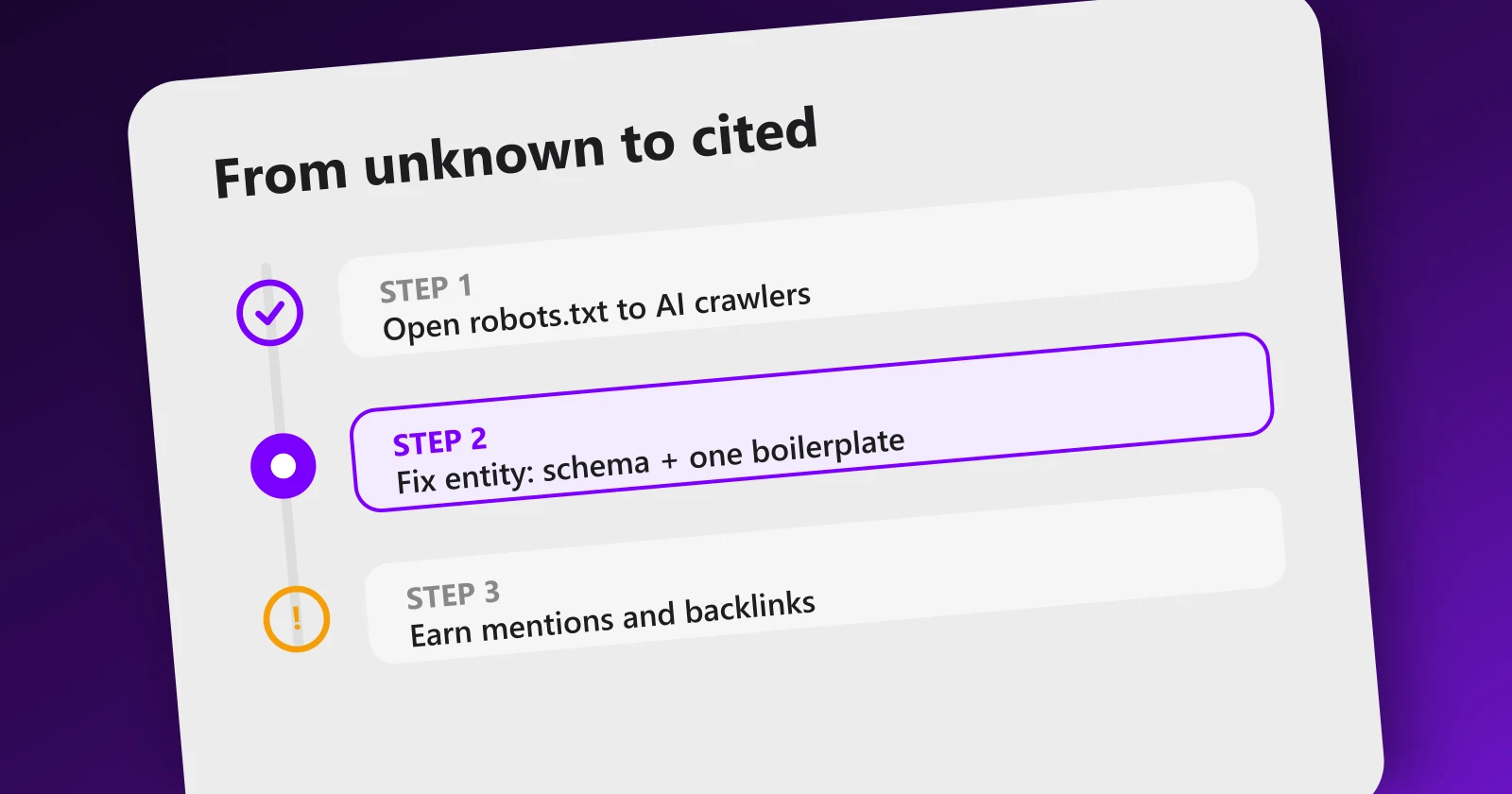
So sequence by cost and latency. Week one: cause 2, because it is an hour of work and everything else is wasted while access is broken. Month one: cause 3, because schema and naming discipline are one-time fixes that make every future mention count double. This quarter and ongoing: causes 1 and 4 together, because mentions and links are the same motion viewed from two angles (coverage that describes you and coverage that vouches for you), and they are the slow variables that gate everything. In parallel: cause 5's long-tail flanking, since those comparison pages start earning retrieval citations long before training memory catches up.
The with-and-without-browsing split from the protocol also tells you where to expect results first: retrieval-side fixes (2, 4, and structure) can show up in searched answers within weeks, while memory-side fixes (1, 3, 5) pay out on model-release timescales. Both clocks reward starting early; neither rewards waiting.
Fixing three of the five causes from one place
The diagnostic is free and the crawler fix is an hour of settings. Causes 3, 4 and 5 are the production-heavy ones: structured data, steady links, long-tail pages. That is the work Meeeters compresses:
- The free SEO analysis crawls your site, detects your schema and JSON-LD, and maps your structure, which covers the cause 3 test and surfaces the long-tail pages your cluster is missing for cause 5. No card required.
- The article generator works from that audit rather than generic prompts: each draft targets a gap in your own structure, written in your site's language, delivered as a draft into your CMS for you to review and publish.
- For cause 4, Meeeters finds you dofollow backlinks in your niche, from network members that are scanned and eligible, matched by language and audience so the referring readers can actually become your visitors. Casinos, adult and directory sites are banned from the pool. No reciprocal links, no PBNs.
- The dashboard plugs into Google Search Console, so the monthly diagnostic protocol gets its numbers (clicks, impressions, and the queries sitting just short of page 1) without a separate tool.
The free SEO analysis is the natural first step: it tells you which of these fixes your site actually needs.
The takeaway
"ChatGPT doesn't know my brand" is a symptom with five well-behaved causes: thin mentions, blocked crawlers, fuzzy entity signals, missing authority, or an entrenched incumbent. Thirty minutes of systematic asking (five phrasings, with and without browsing) tells you which ones you have. Fix access this week, entity signals this month, mentions and authority this quarter, and flank the incumbents while it compounds. If you want the full worksheet version of this process, take the GEO audit checklist, and the free analysis above will show you the authority side of the gap in minutes.
Frequently asked questions
Quick answers to the questions people ask most about this topic.
Usually because the public web doesn't describe your company enough, or consistently enough, for the model to have learned it as an entity. Fewer mentions, inconsistent descriptions, blocked crawlers and low authority all compound into the same symptom: a blank or hallucinated answer.
Open yourdomain.com/robots.txt and look for rules against GPTBot, OAI-SearchBot or ChatGPT-User, then check your CDN or firewall isn't blocking those user agents at the edge. Also paste your URL into ChatGPT with browsing and ask it to summarize the page: an access error is a definitive answer.
Live search results can change within weeks once your pages are indexed and retrievable. Training memory only updates when a new model ships, so mention-building work typically pays out in the next model generation, often several months later. Fix retrieval first for speed, build mentions for permanence.
Telling it in a conversation only affects that conversation (or your personal memory settings), not what the model knows for other users. The only durable inputs are public: consistent coverage across the web, retrievable pages, and structured entity signals on your site.
Indirectly but usefully. Organization schema with sameAs links gives crawlers an unambiguous statement of who you are and which profiles belong to you, which strengthens entity recognition across search engines and the AI systems built on them. It's a supporting signal, not a substitute for mentions and authority.

I built Meeeters to make link building safe and simple: real, relevant backlinks with no reciprocal footprint and no black-hat shortcuts.