ChatGPT Search Optimization: The Two Paths Into ChatGPT's Answers

Ask ChatGPT to recommend a tool in your category. If a competitor comes back and you do not, your first question should not be "how do I do ChatGPT SEO", it should be "which door did they come through?" Because ChatGPT has two doors, they lead to different rooms, and almost everything written about optimizing for ChatGPT fails by treating them as one.
The first door is the model's training memory: what ChatGPT knows about your brand with no internet access at all. The second is live search: what ChatGPT search retrieves, reads and cites in real time. The work that opens door one barely touches door two, and vice versa. This article is the playbook for both. The general mechanics of retrieval-augmented answers live in how to rank in AI search; here we stay strictly on ChatGPT.
Door one: training memory, the slow path
When ChatGPT answers without browsing, it answers from parameters: a compressed impression of the public web as it stood at training time. Your brand exists in that impression only if it was described, repeatedly and consistently, across pages the training corpus included. This has three practical consequences.
It is mention-driven, not site-driven. Your own website is one document among billions. What builds a stable entity in the model's memory is the surrounding coverage: directories, press, reviews, comparison posts, forum threads, podcast show notes, all describing you roughly the same way. A brand with one great website and no footprint is, to the offline model, a rumor.
Consistency beats volume. Models form entities from repetition. If your homepage calls you "a link building platform", your LinkedIn says "SEO growth agency" and a directory lists you as "marketing software", the model averages the noise and hedges, which in practice means it names a clearer competitor. Write one canonical boilerplate sentence for your brand and repeat it verbatim everywhere you control, for a year. This is the cheapest GEO work that exists.
It is slow, with hard update boundaries. Training memory refreshes when OpenAI trains and ships a new model, on a cadence you do not control. Coverage you earn today pays out in some future model version. This is precisely why the compounding argument matters: the mention footprint you build this quarter is baked into every model trained after it. If ChatGPT currently draws a blank on your brand, the diagnostic protocol in why ChatGPT doesn't know your brand will tell you exactly which layer is failing before you spend a euro fixing the wrong one.
The work for door one, then, is classic brand-building with an entity discipline: digital PR, credible directories, review platforms, community presence and a boilerplate you never vary. Backlinks power this path too, not only as authority signals but because linked coverage on real sites is exactly the material training corpora keep.
A concrete illustration of the mechanism. Ask ChatGPT, without search, to describe a category leader in your space and it will produce a tidy, accurate paragraph: founded when, does what, known for which features. That paragraph was not written from the leader's homepage; it is the average of hundreds of third-party descriptions that all agreed with each other. Now ask about a brand with three inconsistent directory listings and no press, and you get hedging or invention. The gap between those two answers is not intelligence, it is corpus density, and corpus density is buildable.
Door two: live search, the fast path through Bing
When ChatGPT searches the web (which it now does by default for anything current, commercial or factual), it stops being a memory and becomes a retrieval pipeline: query goes out, an index responds, the model reads the top results and writes a cited answer.
Here is the strategic fact most teams miss: that index is built on Bing. OpenAI's partnership with Microsoft means ChatGPT search retrieves from Bing's search infrastructure, supplemented by OpenAI's own crawler, OAI-SearchBot. The full supply chain of who feeds which assistant is mapped in where AI assistants get their information, but the ChatGPT-specific conclusion is blunt: a page that is invisible on Bing is invisible to ChatGPT search.
Which makes Bing SEO, the channel everyone ignored for fifteen years, suddenly consequential. The checklist:
- Verify your site in Bing Webmaster Tools. It is free, takes minutes (you can import your Google Search Console verification), and it is the only way to see how Bing actually treats you.
- Audit your Bing indexation. Check the index coverage reports and spot-check your money pages with site: queries on Bing. Sites optimized exclusively against Google routinely have Bing gaps: pages Bing never discovered, or crawl errors nobody watched.
- Adopt IndexNow. Bing supports this open protocol for instant URL submission: instead of waiting for a recrawl, you ping the endpoint when a page is published or updated. Most major CMS platforms and SEO plugins support it natively. For freshness-sensitive queries, this closes the gap between publishing and being retrievable.
- Rank on Bing for your money queries. Bing's ranking systems reward the same fundamentals as Google (authority, relevance, structure) with a somewhat stronger taste for exact-match relevance and established domains. If you rank top five on Google, check where you sit on Bing; the delta is your ChatGPT search gap.
Then structure the pages themselves for extraction: answer in the first paragraph, one sub-question per H2, real tables, FAQ schema. ChatGPT cites a handful of sources per answer, and it lifts from pages where the answer is liftable.
What ChatGPT search actually cites
Spend an evening running your category's queries through ChatGPT search and a clear taxonomy of winners emerges. It is worth internalizing, because it tells you what to publish next:
Pages that resolve one intent completely. ChatGPT search synthesizes from few sources, so it prefers a single page that covers the whole question over three partial ones. The definitive, dated guide beats the swarm of related posts every time.
Comparison and alternatives pages. For commercial queries ("X vs Y", "best X", "X alternatives"), honest comparison content is cited constantly, including vendor-published comparisons when they are genuinely informative and include competitors by name. These are also your highest-intent landing pages, so the incentive is aligned.
Pages with concrete, attributable facts. Prices in numbers, steps in lists, limits and specs stated plainly. The model builds answers from claims, and it cites the page a claim came from. A page with nothing quotable cannot be a source, however good it looks to a human.
Current pages. For anything time-sensitive, visible dates and recent updates matter. Stale pages get displaced by fresher ones even from weaker domains, which makes a quarterly refresh cadence on money pages one of the highest-ROI habits in this channel.
Review platforms and communities. For trust queries ("is X legit", "X reviews"), ChatGPT search cites G2, Trustpilot, Reddit and their equivalents more than it cites brands. You do not control those pages, but you influence them: a steady, authentic review pipeline is ChatGPT SEO even though nobody calls it that.
Know your OpenAI crawlers, because they are different decisions
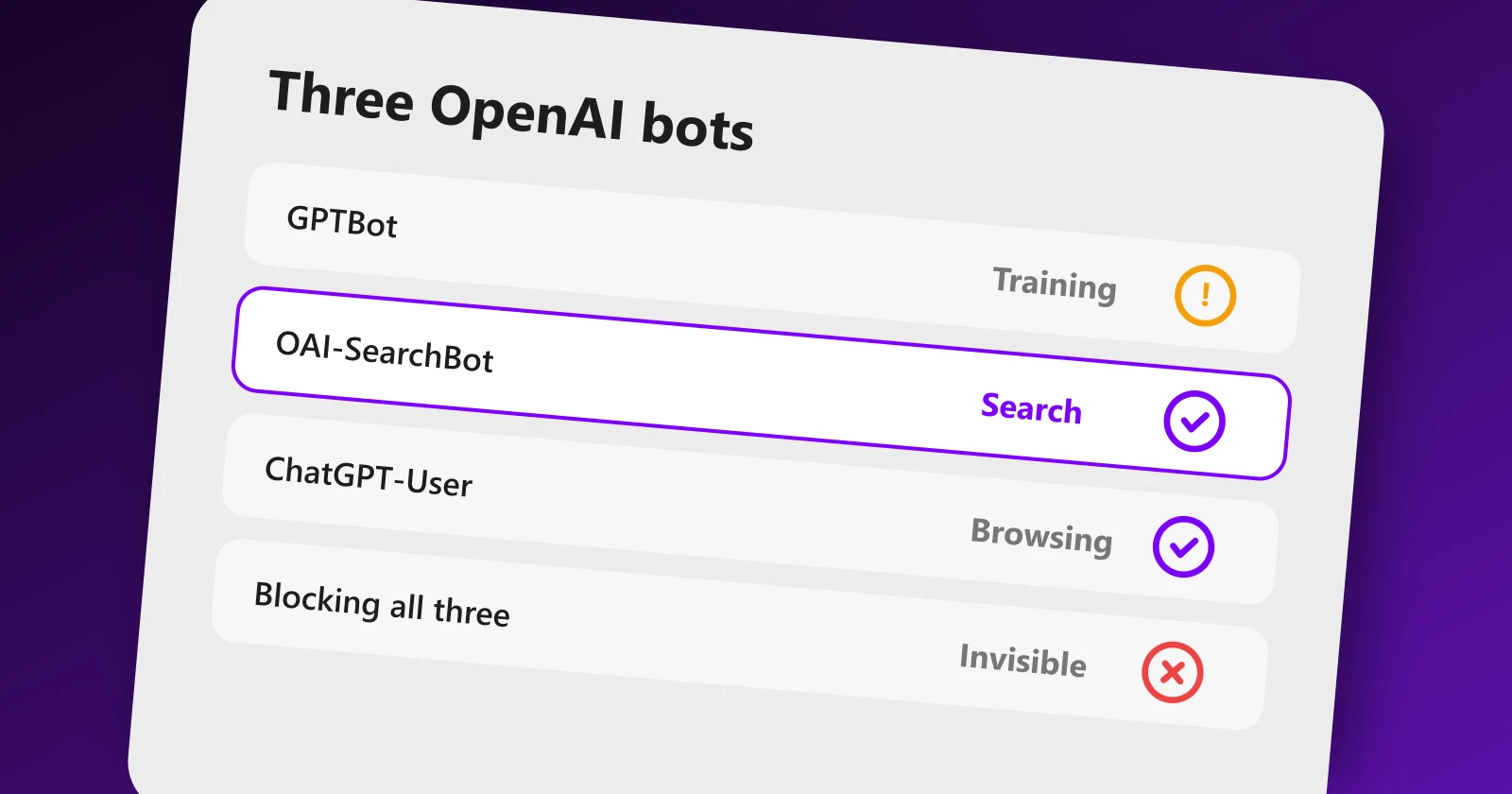
OpenAI operates three distinct user agents, documented on the OpenAI bots page, and conflating them is the most common self-inflicted wound in ChatGPT visibility. Plenty of sites blocked everything OpenAI-related in 2023 to opt out of training, and in doing so silently removed themselves from ChatGPT search citations, a channel that did not exist yet when they made the call.
| Crawler | What it does | What blocking it does |
|---|---|---|
| GPTBot | Collects public web content for training future OpenAI models | Keeps your content out of upcoming training runs: no training-memory presence from your own site, but no effect on live search |
| OAI-SearchBot | Crawls and indexes the web for ChatGPT search | Removes you from live, cited, traffic-sending ChatGPT search answers |
| ChatGPT-User | Fetches a specific page in real time when a user's conversation needs it (browsing, link reading, some agent actions) | Breaks on-demand fetches: users who ask ChatGPT about your page get an error instead of your content |
The rational default for most businesses: allow all three. If your policy is to refuse training use, block GPTBot alone and keep OAI-SearchBot and ChatGPT-User open; that opts you out of training while preserving search citations and user-initiated fetches. Whatever you decide, check what your robots.txt says today, because there is a good chance the decision was made in a different era by a blanket rule. And as with every crawler, confirm your CDN or bot protection is not blocking at the edge what your robots.txt allows.
Measurement: the channel tags itself
ChatGPT does something unusually convenient: when a user clicks a cited link, the URL arrives with utm_source=chatgpt.com appended. Your analytics already segments it; you just have to look.
Build the loop in an hour:
- Create a channel segment or exploration filtered on utm_source=chatgpt.com and watch sessions, landing pages and conversions monthly.
- Note which pages earn the citations. They tell you what ChatGPT considers your citable surface, and they are the template for what to publish next.
- Pair the passive data with active testing: ask ChatGPT your 10 to 20 money queries on a weekly cadence, once with search enabled and once without, and log who gets named. The with-and-without split tells you which door each result came through: no-search answers reveal training memory, searched answers reveal your Bing-backed retrievability.
The broader measurement stack, including how the other assistants tag or hide their referrals, is covered in how to track AI search traffic.
One interpretation note: expect ChatGPT referral sessions to convert differently from organic search. A user arriving from a cited link has already read a synthesized answer that named you; the click is closer to a referral from a trusted colleague than to a cold SERP visit. In the segments we watch, these sessions are lower volume but noticeably deeper in the funnel, which is worth remembering before anyone dismisses the channel for its session count.
The order of operations
If you are starting from zero, sequence the work like this:
- Week 1: unblock and verify. Fix robots.txt for OAI-SearchBot (and decide on GPTBot deliberately), verify Bing Webmaster Tools, turn on IndexNow, build the chatgpt.com analytics segment.
- Month 1: the citable surface. Take your five most valuable queries and make the page answering each one answer-first, dated, factual and structured. Confirm each is indexed on Bing.
- Quarter 1: the entity. Write the canonical boilerplate, push it across every profile and directory, and start the PR and community work that generates consistent third-party descriptions.
- Ongoing: authority. Retrieval shortlists are ranked lists, and rank is still gated by backlinks and domain strength. This is where the two doors converge, and where we see it plainest across Meeeters audits: the brands ChatGPT names are the brands whose authority already earned them rankings and coverage. AI visibility is downstream of search authority, and building the links and the mention footprint together, which is what Meeeters does from one dashboard, moves both doors at once.
What not to bother with
Skip the folklore. There is no meta tag that makes ChatGPT prefer you, no "AI keywords" density trick, and no benefit in publishing a hundred thin pages aimed at conversational phrasings: retrieval rewards the one page that fully resolves the intent, not the swarm. Be equally skeptical of tools promising guaranteed ChatGPT placement; nobody sells slots in either the training corpus or Bing's index. The unglamorous inputs (crawler access, Bing indexation, answer-first structure, consistent entity, real authority) are the entire lever set.
Working both doors at once with Meeeters
The two doors need different work, but their inputs overlap: pages that resolve one intent completely, and a domain with enough authority to rank them, on Bing included. Meeeters covers those shared inputs so the sequencing above does not require three separate tools:
- The free SEO analysis crawls your site, maps its structure, detects your schema and JSON-LD, and lists the missing pages and quick wins: the month 1 citable-surface work, scoped in minutes.
- The article generator drafts against those exact gaps, in your site's language, and delivers drafts into your CMS through a native Webflow connector or a webhook via Make, Zapier or n8n. Nothing auto-publishes, so every page ChatGPT might cite passed a human first.
- Door two runs on rankings, and rankings run on links: Meeeters finds you dofollow backlinks from scanned members in your niche, from vetted real sites, with casinos, adult and directory sites banned from the pool.
- Matching by language and audience means those links come from sites whose readers overlap with yours, which is also the kind of third-party coverage that feeds door one's training memory.
- Google Search Console integration sits in the same view: clicks, impressions, and almost-page-1 queries, ready to read next to your utm_source=chatgpt.com segment.
The free SEO analysis takes a few minutes and no card, and it scopes the week 1 and month 1 work before you spend anything.
The takeaway
ChatGPT is two systems wearing one interface. The offline model recommends brands it absorbed from consistent web coverage, which you influence slowly through mentions and entity discipline. ChatGPT search recommends pages it retrieves through a Bing-backed index, which you influence quickly through crawler access, Bing SEO and extractable structure. Optimize both doors, measure through the self-tagging referrals, and put real authority under it all. Start with the robots.txt check: it takes two minutes, and it is astonishing how many brands are still locked out of the room they are trying to get named in.
Frequently asked questions
Quick answers to the questions people ask most about this topic.
Make sure OAI-SearchBot is allowed in your robots.txt, get your site fully indexed on Bing (ChatGPT search leans on Bing's index), and rank for your money queries there. Then structure pages answer-first so the model can lift and cite your content.
GPTBot collects data for training OpenAI's models; blocking it keeps your content out of future training runs. OAI-SearchBot indexes the web for ChatGPT search; blocking it removes you from live, cited answers. You can allow one and block the other.
Yes. ChatGPT search retrieves web results through an index built on Bing's data, so a page invisible on Bing is invisible to ChatGPT search. Verify your site in Bing Webmaster Tools, fix indexation gaps and consider IndexNow for instant discovery.
ChatGPT appends utm_source=chatgpt.com to links it cites, so sessions arrive pre-tagged in your analytics. Segment by that parameter, watch which landing pages receive it, and compare it month over month like any other channel.
Usually one of two gaps: the model's training memory contains stronger, more consistent coverage of the competitor, or the competitor ranks on Bing for the queries ChatGPT search runs. Diagnosing which gap you have determines the fix, from PR and mentions to Bing indexation.

I built Meeeters to make link building safe and simple: real, relevant backlinks with no reciprocal footprint and no black-hat shortcuts.