Where AI Assistants Get Their Information (and How to Be In It)

When ChatGPT tells a user which CRM to pick, or Perplexity explains how to fix a deliverability problem, that answer came from somewhere specific. Not from a mysterious AI brain: from identifiable indexes, crawlers, licensing deals and communities that you can list, and in most cases, show up in. This article maps the actual source ecosystem of the major AI assistants, because you cannot optimize your presence in a supply chain you have not seen.
The two pipelines: training data and live retrieval
Every mainstream assistant draws on two distinct pipelines, and they reward different things.
Training data is what the model absorbed before it shipped: books, code, licensed corpora, and enormous web crawls (the public Common Crawl dataset and each lab's proprietary crawls among them). Two properties matter for you. First, it is frozen: every model has a knowledge cutoff, typically months to more than a year before you are talking to it, so nothing you published recently exists there. Second, it is weighted by repetition: brands and facts described consistently across many pages get encoded strongly; a brand mentioned rarely, or described differently everywhere, barely registers. This is the pipeline behind unprompted brand recommendations, and it is why a young or thinly-mentioned company simply does not exist to the base model, a problem with its own diagnosis in why ChatGPT doesn't know your brand.
Live retrieval is what happens at question time: the assistant runs a search behind the scenes, reads the top results, and writes an answer grounded in them, usually with citations. This pipeline is fresh (your page published yesterday can be cited today) and brutally narrow (only the top handful of retrieved results get read). The mechanics of that retrieval-and-synthesis loop are the subject of the pillar guide on how to rank in AI search, so one sentence suffices here: assistants answer from what their search layer hands them, which makes the question "where does the assistant get information" really the question "whose index does it search."
So let's answer that, engine by engine.
ChatGPT: Bing's index plus OpenAI's own crawlers
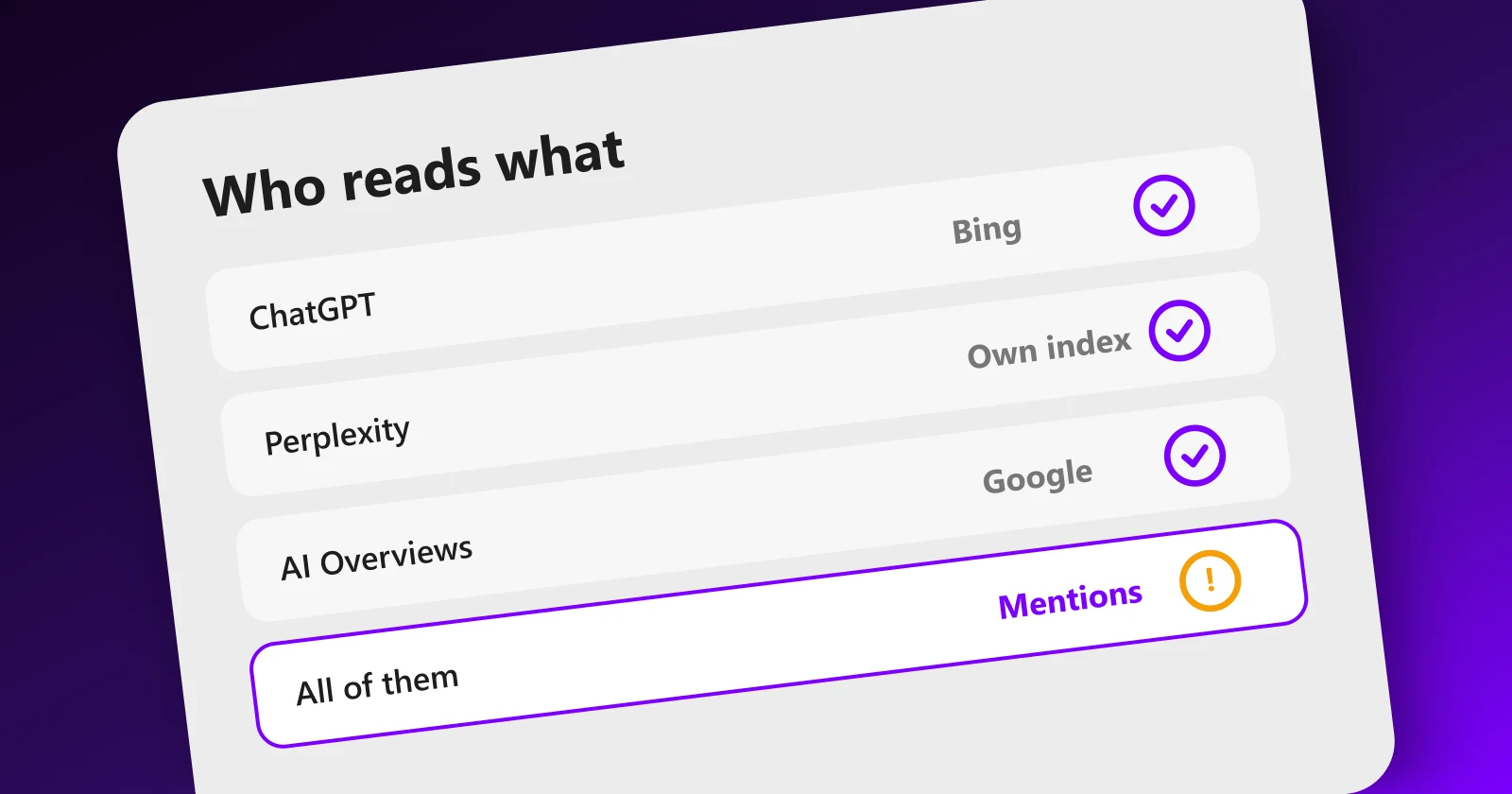
For current information, ChatGPT uses its search feature, launched by OpenAI in October 2024. OpenAI has been reasonably transparent about the plumbing: search is powered by third-party search providers, with Bing the primary one, combined with content fetched by OpenAI's own crawlers and information from its publisher partners.
The practical consequences:
- Bing indexing is a hard prerequisite. If your site is absent or weak in Bing's index, you are largely absent from ChatGPT's retrieval pool. Verify your site in Bing Webmaster Tools and treat Bing rankings as a real metric again.
- OpenAI's crawlers need access. OpenAI publishes distinct user agents, including GPTBot (crawling for training) and OAI-SearchBot (fetching for search results). Blocking OAI-SearchBot in robots.txt removes you from ChatGPT search citations; blocking GPTBot keeps you out of future training data. Those are separate decisions, and many sites block both without meaning to.
- Answer-shaped pages win the citation. Once retrieved, the model lifts the passage that most directly answers the prompt. The tactical playbook for this engine specifically is covered in ChatGPT search optimization.
Perplexity: its own crawler, citations by design
Perplexity is the purest answer engine of the group: every response is built from retrieved sources and cited inline. It operates its own crawler, PerplexityBot, and maintains its own index, supplemented by partner sources and, for some query types, specialized data providers.
What that means for a site owner: allow PerplexityBot in robots.txt, then earn your way into the retrieval pool the usual way, by being one of the most useful and authoritative pages for the query. Perplexity's habit of citing several sources per answer makes it, in our experience, the easiest engine to get a first AI citation from, which also makes it a good early scoreboard for your GEO work. The engine-specific tactics live in our Perplexity SEO guide.
Google AI Overviews and AI Mode: Google's index, Google's ranking
Google's AI answers are the least mysterious of the set, because Google has said plainly how they work: AI Overviews and AI Mode are grounded in Google's index and use its core ranking systems to select the supporting pages they cite. Google's own documentation on AI features in Search tells site owners there is no special markup or AI-specific requirement: standard SEO is the input.
One mechanic deserves a mention because it changes tactics slightly: for complex questions, Google's AI features issue multiple related subqueries behind the scenes and assemble the answer from pages ranking across all of them. A page that owns one specific subquestion can get cited in an AI answer for a broader prompt it could never rank for directly. That rewards deep, well-structured topic clusters over single mega-pages. Platform-specific playbooks live in Google AI Overviews optimization.
The map, in one table
| Assistant | Index / crawler it reads | What to optimize |
|---|---|---|
| ChatGPT (with search) | Bing's index, plus OpenAI's OAI-SearchBot and publisher partners | Bing indexing and rankings, allow OAI-SearchBot, answer-first passages |
| Perplexity | Own index via PerplexityBot, plus partner sources | Allow PerplexityBot, rank for the underlying queries, quotable structure |
| Google AI Overviews / AI Mode | Google's index, core ranking systems | Classic Google SEO, topic clusters covering subqueries, extractable answers |
| Microsoft Copilot | Bing's index | Bing indexing and rankings, same assets as ChatGPT |
| Base models (no browsing) | Training data: web crawls, books, licensed corpora | Consistent brand mentions across many authoritative pages, over time |
Notice what the right-hand column keeps saying: indexes, rankings, structure, mentions. There is no fifth secret input.
The licensing layer: deals that shape answers
On top of crawling, the labs buy access, and those deals visibly tilt what assistants say.
Reddit and Google. In early 2024, Reddit signed a content licensing arrangement with Google, reported at around 60 million dollars per year, giving Google structured access to Reddit's content for training and products. Reddit threads were already ranking prominently in Google results; the deal cemented Reddit as core supply for Google's AI features.
OpenAI's publisher deals. OpenAI has signed licensing agreements with a long list of publishers, including Axel Springer, the Associated Press, the Financial Times, News Corp, Le Monde and Condé Nast. Partner content gets surfaced and attributed in ChatGPT's answers, particularly for news queries.
You cannot buy a seat at that table, but you can draft behind it: the licensed sources are known, and presence inside them (coverage in licensed publications, genuine participation where your customers ask questions on Reddit) flows into the pipelines with the deal's weight behind it. Which brings us to the pattern behind the whole ecosystem.
Why Wikipedia, Reddit and YouTube get cited constantly
Anyone who uses these assistants notices the same three names recurring in citations. It is not favoritism; it is triple exposure.
They dominate both pipelines. Wikipedia is among the most heavily weighted sources in most training corpora, and it ranks on page one for a large share of informational queries, so it wins in training and in retrieval simultaneously. Reddit ranks remarkably well for experience-flavored queries ("best X for Y", "is Z worth it") and is licensed into training. YouTube is the default supply for how-to and demonstration intent, and for Google's products it is first-party inventory.
They are structured for extraction. An encyclopedia entry, an upvoted thread with a top answer, a video with chapters and a transcript: each is a container where the answer to one question is easy to locate and lift. That is precisely the property that gets any source cited.
They carry consensus and experience signals. Models are tuned to prefer grounded, verifiable claims (Wikipedia's citations) and first-hand experience (Reddit's entire format). Your site competes with that preference, and the way to compete is to exhibit the same properties: evidence in the passage, experience in the voice.
What this means for a normal business site
You are not Wikipedia and you do not have a licensing deal. Here is the realistic playbook, in priority order.
1. Be excellent in the indexes that feed retrieval. Your own indexed, ranking pages remain your single largest surface in every assistant. That means classic SEO health (crawlable, fast, indexed in Google and Bing) plus pages structured so each important question gets a direct, self-contained answer. Do not block the AI crawlers you want citations from; check robots.txt today, it takes five minutes.
2. Be present in high-authority third-party sources. Assistants trust sources the web vouches for, so mentions of your brand in publications, industry sites and comparison pages the engines already cite are retrieval assets, not vanity. Every unlinked mention is half-finished work: claiming unlinked brand mentions converts the citation-side asset into the authority-side one too. This is the compounding loop in plain sight: AI visibility is downstream of search authority, and authority is built from backlinks and mentions, which is why Meeeters treats links and content as one system in one dashboard rather than two separate projects.
3. Participate honestly in the communities the engines read. If Reddit threads answer your category's buying questions, be usefully present in them as a real participant, not a spammer. Same for the niche forums and Q&A sites that rank in your vertical. You are placing your brand in the exact supply chain the assistants consume.
4. Feed the training pipeline patiently. Consistent brand descriptions across many pages, over months, is how you come to exist in the next model's weights. Slow, unglamorous, compounding.
We see the gap constantly in Meeeters audits: businesses with genuinely good products that are absent from every one of these surfaces, wondering why assistants recommend their competitors. The diagnosis is rarely mysterious once you look at the supply chain. If you want that look at your own site, a free SEO analysis shows where you stand in the indexes that matter in a few minutes.
How to verify which engines are actually reading you
Everything above is the map; your server logs are the territory. Three checks, none requiring a specialist:
Read your robots.txt with the crawler list in hand. The user agents that matter for citations are OAI-SearchBot (ChatGPT search), PerplexityBot (Perplexity), Googlebot (which also feeds AI Overviews and AI Mode) and Bingbot (which feeds ChatGPT and Copilot via Bing's index). Separately, GPTBot and Google-Extended control training-data collection, not search citations. A surprising number of sites installed a blanket AI block in 2023 and unknowingly removed themselves from every retrieval pipeline; unblocking the search-facing bots while keeping your training-data policy is a two-line change.
Grep your access logs for the same user agents. Seeing PerplexityBot and OAI-SearchBot fetch your pages confirms you are in their pipelines; their total absence over weeks, on a site that allows them, usually points to an authority problem rather than a technical one. The engines fetch what their retrieval layer considers worth fetching.
Watch the referral and prompt evidence. Assistant referral traffic shows up in analytics under domains like chatgpt.com and perplexity.ai, and it is the ground truth that citations are converting into visits. Pair it with a monthly manual habit: ask each assistant the five questions your customers actually ask, and record which sources get cited. Tracking this properly over time is its own discipline, and the tooling for it is covered in the pillar and the tools guide.
Fifteen minutes of verification beats any amount of theorizing about pipelines, and it turns the rest of this article from background reading into a checklist you have already started.
Entering the supply chain with Meeeters
Everything in this map reduces to two assets you control: pages that rank in the indexes assistants read, and a brand the authoritative web vouches for. Meeeters was built to grow both at once.
- The audit crawls your site, maps its silos, and finds the cluster pages you are missing for the queries you want assistants to retrieve you on.
- The article generator turns those gaps into drafts written in your site's language, delivered into your CMS for review; nothing goes live without you.
- The link network earns the third-party vouching engines look for: dofollow links from real, vetted sites, matched by language and audience so the linking site's readers can actually become your visitors. Casinos, adult and directory sites are banned from the pool.
- The network replaces cold outreach: Meeeters finds you dofollow backlinks in your niche, from members that are scanned and eligible. No reciprocal links, no PBNs.
Before optimizing any single pipeline, run the free SEO analysis to see which ones are missing you today.
The takeaway
AI assistants are not oracles; they are pipes connected to inspectable sources. Training data rewards being described consistently across the authoritative web. Retrieval rewards ranking in Bing (ChatGPT, Copilot), Google (AI Overviews, AI Mode) and Perplexity's own crawl. Licensing deals tilt the mix toward Reddit and major publishers, and Wikipedia, Reddit and YouTube recur because they saturate every pipeline at once. Your move is unchanged by any of the branding: be indexed, be ranked, be quotable, and be mentioned by the sites and communities the engines already trust.
Frequently asked questions
Quick answers to the questions people ask most about this topic.
From two places. Its base knowledge comes from training data: books, licensed content and web crawls with a fixed cutoff date. For current questions, ChatGPT search retrieves live results, powered primarily by Bing's index together with OpenAI's own crawlers, then writes an answer citing those pages. If your site is not indexed and ranking for a query, ChatGPT has almost no way to cite it.
Yes. Perplexity operates its own crawler, PerplexityBot, and builds its own index, supplemented by partner sources. It cites sources on every answer by design. Allowing PerplexityBot in your robots.txt and ranking for the underlying queries are the two levers that matter for being cited there.
Google AI Overviews and AI Mode are grounded in Google's own index and, per Google, use its core ranking systems to select supporting pages. In practice, pages that rank well for the query and related subqueries are the citation pool. Standard SEO plus extractable answer-first passages is the optimization path.
Three reinforcing reasons: both are heavily represented in training data, both rank strongly in the search indexes assistants retrieve from, and both carry the kind of content models trust for grounding (encyclopedic consensus on Wikipedia, first-hand experience on Reddit). Licensing deals, like Reddit's arrangement with Google, deepen the effect.
Be present in the pipelines they read. Get your pages indexed and ranking in Google and Bing for the queries you care about, allow AI crawlers in robots.txt, structure pages so a direct answer is easy to lift, and earn mentions on high-authority sites and communities the engines already cite. Authority is the gate: assistants cite sources the web already vouches for.

I built Meeeters to make link building safe and simple: real, relevant backlinks with no reciprocal footprint and no black-hat shortcuts.