Perplexity SEO: How to Get Cited by the Answer Engine That Footnotes Everything

Perplexity is the easiest AI answer engine to reason about, because it shows its work. Every sentence in a Perplexity answer carries a numbered footnote, every footnote points at a real page, and one of those pages could be yours. There is no mystery box: either you are in the citations or you are not, and you can check in ten seconds.
That transparency makes Perplexity the best training ground for GEO. The levers are concrete, the feedback loop is same-day, and what you learn transfers to every other engine. Here is how Perplexity picks its sources, and the playbook to become one of them.
How Perplexity decides who gets a footnote
Perplexity answers by retrieving first and writing second. When a user asks a question, it pulls candidate pages from its own web index, built by its crawler PerplexityBot, supplemented by search partnerships, then a language model reads those candidates and composes an answer where each claim is attributed to a source. We cover the general retrieval mechanics in how AI search engines rank content, and where AI assistants get their information maps each engine's supply chain, so one paragraph will do here: Perplexity is a search engine with a writer on top, and everything about earning its citations follows from that.
Two properties make Perplexity distinct from ChatGPT or Google's AI features:
It is citation-first by design. Other engines cite sometimes; Perplexity cites always. That means citation slots exist for every query, including yours, and the competition for them is legible: run the query, read who won, study why.
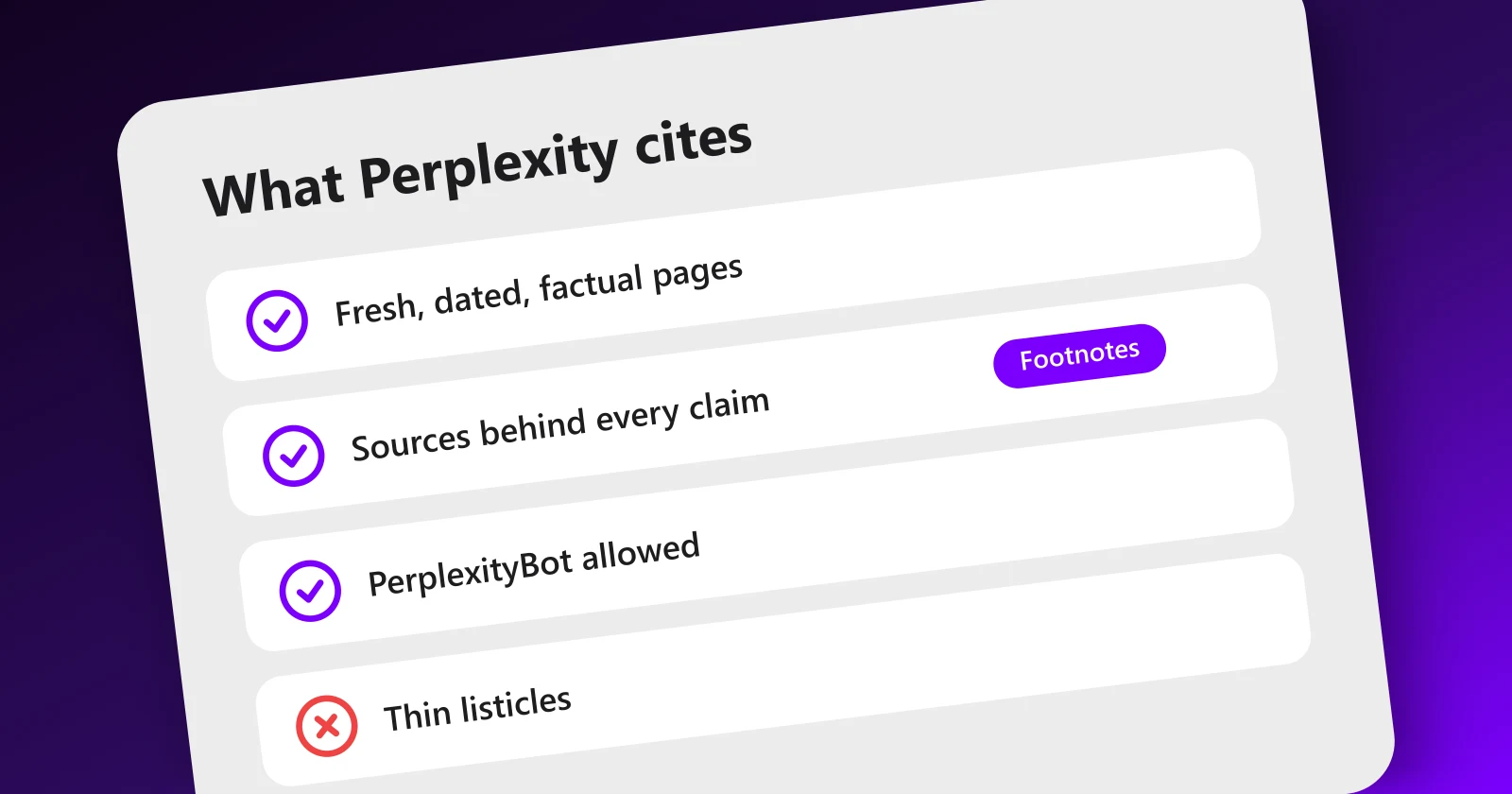
It weighs freshness and factual density heavily. Perplexity's product promise is current, verifiable answers. Pages with a visible date, concrete facts and named sources beat undated essays, and recently updated pages regularly displace older ones in the citations. If your content strategy is evergreen-and-forget, Perplexity will quietly rotate you out.
One more pattern worth naming: for opinion and recommendation queries ("best CRM for freelancers", "is X worth it"), Perplexity leans conspicuously on Reddit threads and review platforms rather than vendor blogs. It wants human experience for subjective questions, and it goes where that experience lives. We will use that below.
Lever 1: Let PerplexityBot in
The zero-cost prerequisite: PerplexityBot must be able to crawl you. Perplexity documents its crawlers publicly in the Perplexity crawler docs, and the distinction matters. PerplexityBot builds the search index, and a separate user agent, Perplexity-User, fetches pages on behalf of a user during an answer. Blocking the first removes you from the candidate pool entirely.
Check your robots.txt right now. Plenty of sites blanket-blocked every AI user agent in 2023 to protest training scrapes and never revisited the decision. Whatever your position on training crawlers, PerplexityBot is a different animal: it is a search indexer whose output is a cited link that sends you referral traffic. Blocking it is closer to blocking Googlebot than to blocking a training scrape.
The explicit allow looks like this:
User-agent: PerplexityBot
Allow: /
While you are in the file, confirm you are not blocking it by accident through a wildcard rule, and confirm your CDN or bot-protection layer (Cloudflare and similar) is not challenging or dropping the crawler at the edge. A robots.txt allow means nothing if the WAF returns a 403. Fetch your key pages with the PerplexityBot user agent string and check the status codes.
Lever 2: Publish dated, factual, source-backed pages
Perplexity's writer needs claims it can attribute. The pages that win citations read like the answer's raw material: specific facts, numbers with context, named sources, and a visible publication or updated date. The pages that lose are the ones AI content farms produce, fluent paragraphs with nothing quotable inside.
Practical translation:
- Date everything, honestly. Show a published date and an updated date in the visible page and in your Article schema. Refresh your most important pages on a real cadence (quarterly is a reasonable default) and change actual substance when you do. Perplexity favors fresh pages, but a fake date on stale content is a trust problem, not a hack.
- Make claims, not gestures. "Onboarding takes about 10 minutes and requires a DNS verification" is citable. "Our streamlined onboarding gets you started fast" is not. Audit your money pages for sentences a third party could quote as fact; if there are none, the page cannot be a source.
- Cite your own sources. Pages that link to primary sources give the engine a verification trail, and they read as journalism rather than marketing. When you state a number, say where it comes from.
- Bring original data when you can. Even a small dataset (your own pricing survey, a benchmark you ran, aggregated anonymized stats from your product) makes you the primary source that everyone else, including Perplexity, has to cite.
Lever 3: Structure for extraction, answer first
Perplexity reads pages the way a hurried researcher does: it wants the answer near the top and the structure to be self-explanatory. The format that wins is the one we use across this blog:
- A title that states the question or the claim, not a teaser.
- The direct answer in the first paragraph, before any wind-up.
- H2 sections that each resolve one sub-question, opening with their own answer.
- Real HTML tables for comparisons, real lists for steps, FAQ blocks with schema for the long tail. The markup side is covered in schema markup for AI search.
None of this is Perplexity-specific, which is the point: answer-first structure is the shared currency of every answer engine, and Perplexity is simply the one that pays out fastest and most visibly.
Two structural details punch above their weight with Perplexity specifically. First, self-contained sections: because the engine attributes individual claims, a paragraph that makes sense out of context is easier to cite than one that leans on the three paragraphs before it. Write each H2 so it could be lifted whole. Second, quotable summary sentences: one line per section that states the finding plainly, numbers included. When you read Perplexity answers in your niche, you can often spot the exact sentence it lifted; write those sentences on purpose.
Beyond page structure, make the whole site cheap to ingest. Keep templates lean so the main content dominates the HTML rather than being buried under navigation and widgets. Maintain a clean RSS feed, because fresh-content discovery is a Perplexity strength you want to feed. An llms.txt file listing your canonical pages with one-line descriptions costs an afternoon and gives agents a map; it is a minor signal, but it stacks. And keep response times fast: crawlers on a budget, and PerplexityBot crawls aggressively, index what they can fetch cheaply.
Lever 4: Be present where Perplexity already looks
For subjective queries, Perplexity cites communities, not vendors. You cannot change that preference, so join it.
Reddit and forums. Find the threads that already rank for your category's recommendation queries ("best X", "X vs Y", "anyone used X?") and become a legitimate participant: answer questions under a transparent affiliation, and earn mentions from users who actually like your product. Astroturfing gets detected by both the community and, increasingly, the engines. Genuine presence does not scale like content, which is exactly why it is defensible.
Review platforms. G2, Capterra, Trustpilot and their vertical equivalents feed both Perplexity's citations and the training data of every model. A steady, authentic review pipeline (ask every happy customer, respond to every negative one) is GEO work even though it predates GEO.
Digital PR. When an industry publication covers your niche, Perplexity cites the publication. Being quoted in that coverage puts your brand inside the pages the engine already trusts, and the mention often becomes a link. Unlinked ones still count for entity recognition, and can be converted later, as we cover in unlinked brand mentions.
Query type by query type: what Perplexity cites and what you should do
| Query type | What Perplexity tends to cite | Your move |
|---|---|---|
| Factual ("what is X", "how does X work") | Documentation, encyclopedic pages, definitive guides with dates | Own the definitive, dated, source-backed guide in your cluster |
| Recommendation ("best X for Y") | Reddit threads, review platforms, comparison articles | Earn community mentions and reviews; publish an honest comparison including competitors |
| News and trends ("what changed in X") | Recent articles from indexed publishers, official announcements | Publish fast, dated analysis when your industry moves; keep an RSS feed |
| How-to ("how to do X") | Step-by-step guides with numbered lists, tool documentation | Answer-first tutorial with real steps, screenshots and a dated update log |
| Local and pricing ("X pricing", "X near me") | Official pricing pages, aggregator sites | Keep a public, crawlable pricing page with concrete numbers |
| Brand ("is X legit", "X reviews") | Review platforms, Reddit, your own site | Maintain review presence; publish a factual about page with Organization schema |
The pattern across every row: Perplexity assembles answers from whoever is the most concrete, current and verifiable source for that slice of the query space. Pick the rows that decide your revenue and staff them deliberately.
The publisher program, and what it signals
Perplexity runs a revenue-sharing publisher program, launched after a bruising 2024 dispute over its crawling and summarization practices, with early partners including major news organizations. Unless you are a media company, you will not join it, but it tells you two useful things about the platform's direction. First, Perplexity is structurally committed to citations: its answer to the plagiarism criticism was to pay sources, not to hide them. Second, partnered publishers get preferential surfaces, which means the citation competition in news-adjacent queries will tilt toward professional media over time. For commercial and technical queries (the ones that matter for most businesses reading this) the field remains open, and the levers above are the whole game.
Monitor it like a channel, weekly
Perplexity visibility is measurable in an afternoon and trackable in ten minutes a week:
- Write down your money queries, 10 to 20 of them: the questions a ready-to-buy user in your category actually asks.
- Ask Perplexity each one, weekly, and log which domains appear in the citations. A spreadsheet is enough to start; dedicated tooling exists when you outgrow it, covered in how to track AI search traffic.
- Watch referrals from perplexity.ai in your analytics. Citation clicks arrive with a clean referrer, so the channel is unusually easy to attribute.
- When a competitor is cited and you are not, open the cited page and diff it against yours: fresher date, more concrete facts, better structure, or a stronger domain. Usually it is two of the four.
That fourth step is the growth loop. Perplexity gives you a public, per-query scoreboard of exactly what it wants, so every lost citation is a diagnosis for free.
Two measurement caveats worth knowing. Perplexity answers are not perfectly stable: the same query can cite slightly different sources across sessions as the index refreshes, so judge trends over weeks, not single asks. And referral volume from Perplexity is typically modest relative to its influence, because many users read the answer without clicking the footnotes. Treat the citation itself as the asset (it is your brand named at the moment of decision) and the click as a bonus.
The gate under all of it: authority, and how Meeeters opens it
Everything above determines whether Perplexity quotes you once it has found you. Whether it finds you is decided earlier, at retrieval, and retrieval favors domains with demonstrated authority: real backlinks, topical depth, an established entity. We see this pattern across Meeeters audits constantly: two pages with near-identical structure and freshness, and the one on the stronger domain takes the citation. Meeeters exists to build that missing half alongside the content:
- The free SEO analysis crawls your site, maps your structure, checks your schema and JSON-LD, and lists the pages your cluster is missing: for Perplexity, those are the dated, factual guides it currently has nothing of yours to footnote for.
- Backlinks come from a non-reciprocal network: dofollow links from vetted sites in your niche, with no reciprocal footprint. Casinos, adult and directory sites are banned from the pool.
- The network finds you dofollow backlinks from members that are scanned and eligible, which makes link growth predictable instead of dependent on cold outreach.
- Matching runs on language and audience worldwide, so the domains vouching for you have readers who can actually become your visitors.
- The article generator drafts the missing pages from that audit, in your site's language, delivered as drafts into your CMS. You review and publish, which keeps the honest dates and factual updates Perplexity rewards under your control.
- The same dashboard tracks the results through Google Search Console: clicks, impressions, and the queries sitting just short of page 1.
Run the free SEO analysis first (no card required), then compare its gap list against the citation scoreboard you built above: the overlap is your publishing queue.
The takeaway
Perplexity is the answer engine that tells you exactly how to win it: every answer is a public list of who got cited and why. Open the gate for PerplexityBot, publish dated and factual pages that open with the answer, show up in the communities it quotes for opinion queries, and check your money queries every week. Then make sure the domain under those pages carries real authority, because the footnote goes to the source the engine already trusts. If ChatGPT is your other target, the playbook shifts in interesting ways: see ChatGPT search optimization for that engine's version of this article.
Frequently asked questions
Quick answers to the questions people ask most about this topic.
Perplexity retrieves candidate pages from its own index (built by PerplexityBot) and partner search data, then its models synthesize an answer and attach citations to the pages that best support each claim. Fresh, factual, clearly structured pages from authoritative domains win those citation slots most often.
Yes, if you want Perplexity visibility. PerplexityBot builds the index Perplexity retrieves from, so blocking it removes you from the candidate pool. It is a separate decision from blocking AI training crawlers: PerplexityBot is a search indexer, and citations send referral traffic.
For opinion and recommendation queries, Perplexity prefers sources with visible human experience, and Reddit threads plus review platforms are the densest supply. If your category is decided by 'best X' queries, being genuinely present and mentioned in those communities matters as much as your own blog.
Ask Perplexity your 10 to 20 money queries directly and note which domains appear in the citations, then repeat weekly. Also watch your analytics for referral traffic from perplexity.ai, which arrives when users click the footnotes.
Yes. Perplexity retrieves before it writes, and retrieval favors pages that already demonstrate authority: backlinks, topical depth and clean structure. The same signals that rank you in Google put you in Perplexity's candidate pool.

I built Meeeters to make link building safe and simple: real, relevant backlinks with no reciprocal footprint and no black-hat shortcuts.