Schema Markup for AI Search: The Types That Actually Matter

There are two popular positions on schema markup and AI search, and both are wrong. The first says schema is the secret handshake that gets you into ChatGPT answers: add JSON-LD, get cited. The second says LLMs only read text, so schema is dead weight. The truth sits one layer down in the stack, and once you see where structured data actually enters the pipeline, it becomes obvious which types are worth your time and which are cargo cult.
How schema actually reaches AI answers
The honest mechanism first, because it dictates everything else. Large language models consume rendered text. When ChatGPT reads your page, it is not parsing your JSON-LD as a semantic database; the markup rides along as noise, if it is fetched at all. So the naive version ("schema talks to the AI") is false.
But AI answers are not produced by a model reading the raw web. Nearly every assistant that answers with sources runs a retrieval step: a search system picks a handful of candidate pages, and the model synthesizes from those. That retrieval layer is where structured data has been consumed for over a decade. Google states that AI Overviews are built on its core ranking systems, and those systems parse structured data to understand entities, validate facts and populate the Knowledge Graph. Bing, which supplies ChatGPT's live search results, has consumed schema.org markup since its inception as well.
So the causal chain is: schema feeds search engines and knowledge graphs, search engines and knowledge graphs feed retrieval, retrieval decides what the model sees. You are not marking up your site for the LLM. You are marking it up for the machine layer that decides whether the LLM ever sees you. The pillar on how to rank in AI search covers the full retrieval picture; here we stay on the structured data layer.
One more honest caveat: schema is a clarifier, not a creator. It disambiguates and validates what your content and authority already claim. Markup on a page with no rankings changes nothing, because the retrieval layer never selects the page. We see this pattern across Meeeters audits constantly: sites with immaculate JSON-LD and no backlinks, invisible in AI answers, because AI visibility is downstream of search authority and schema cannot substitute for it.
The five types that earn their keep
Schema.org defines close to 800 types. For AI visibility, five do almost all the work:
| Schema type | What it does for AI visibility | Priority |
|---|---|---|
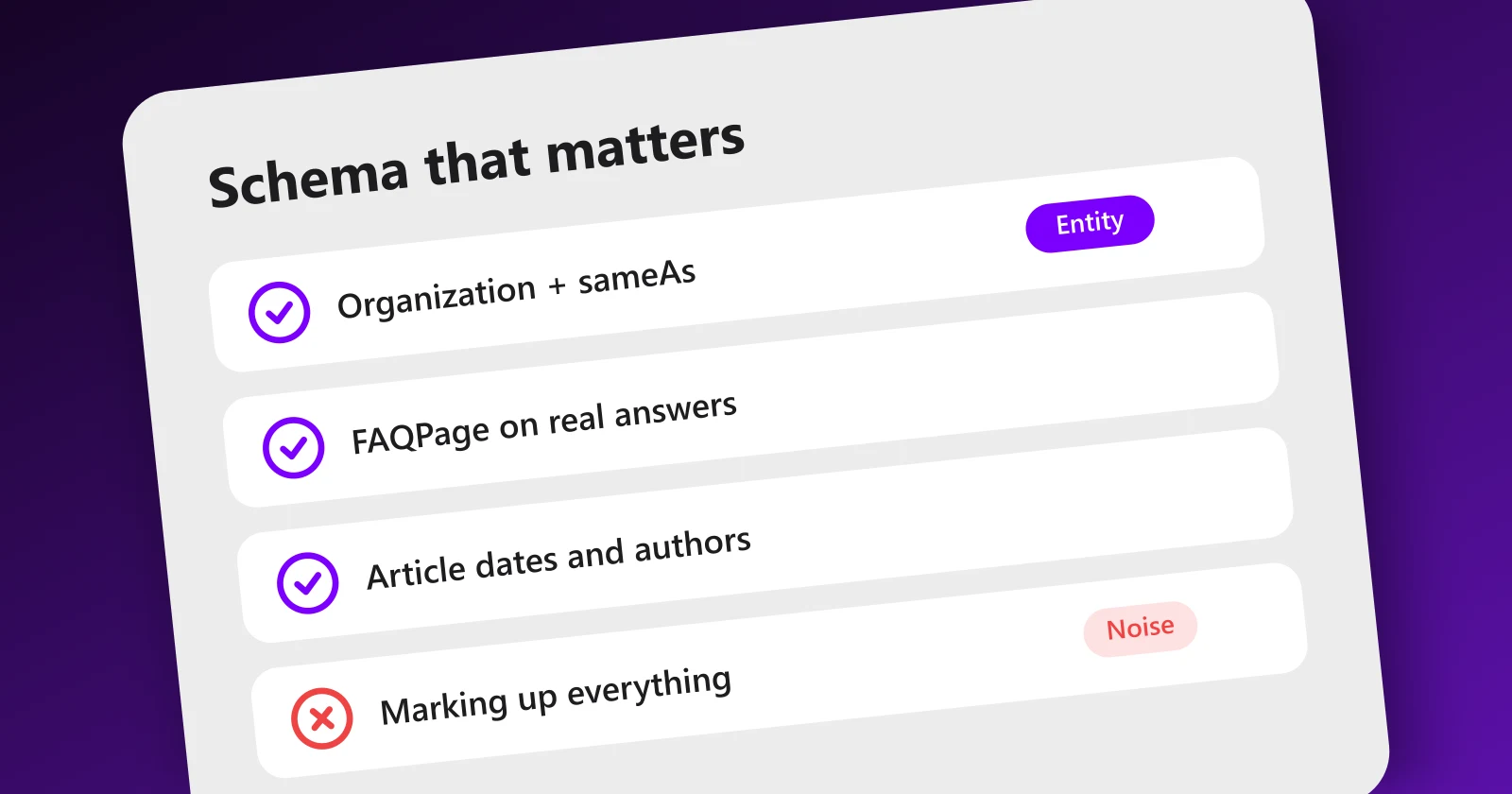
| Organization (+ sameAs) | Disambiguates your brand entity: connects your name, domain, logo and profiles into one identity that knowledge graphs can resolve | Critical, sitewide |
| Article / BlogPosting | Declares authorship, publish and modified dates: freshness and accountability signals retrieval systems use | High, every post |
| FAQPage | Hands engines pre-chunked, self-contained Q&A pairs, the exact shape AI answers are assembled from | High, where genuine FAQs exist |
| Product + Offer | Provides verifiable price, availability and review facts for commercial queries | High for ecommerce, ignore otherwise |
| HowTo | Structures step-by-step tasks so systems can extract ordered instructions | Medium, genuine tutorials only |
Everything below walks through why each one matters and how to not mess it up.
Organization + sameAs: the entity foundation
Start here, because entity confusion is the silent killer of AI visibility. When systems cannot resolve whether "Meeeters" is a SaaS, a typo, or three unrelated things, they hedge, and hedging systems cite someone clearer. This is a large part of why ChatGPT may not know your brand even when your product is good.
Organization markup with a complete sameAs array is how you stitch your identity together: it tells every consuming system that your domain, your LinkedIn, your GitHub, your Crunchbase and your X profile are the same entity. Here is a compact, complete example:
{
  "@context": "https://schema.org",
  "@type": "Organization",
  "name": "Meeeters",
  "url": "https://meeeters.com",
  "logo": "https://meeeters.com/logo.png",
  "description": "Link building platform combining a non-reciprocal link network with an AI article generator driven by a real site audit.",
  "sameAs": [
    "https://www.linkedin.com/company/meeeters",
    "https://x.com/meeeters",
    "https://www.crunchbase.com/organization/meeeters"
  ]
}
Three rules make this work. Put it on every page (it is your identity, not a page property), typically via your site template. Keep the description identical to the one-line brand description you use everywhere else: repetition is how entities consolidate. And only list sameAs URLs that are genuinely yours and alive; a dead profile link is a contradiction, and contradictions are what this markup exists to eliminate.
Article and BlogPosting: authorship and freshness
Every substantial post should carry Article or BlogPosting markup declaring headline, author (as a Person with their own URL where possible), publisher (your Organization), datePublished and dateModified.
Why this matters for AI answers specifically: retrieval systems weight freshness on time-sensitive queries, and dates in structured data are the least ambiguous freshness declaration you can make. Authorship feeds the expertise side of E-E-A-T: a consistent author entity, linked across articles and to an author page, is machine-verifiable in a way that a byline string is not. None of this makes a weak article strong, but on the margin, when a retrieval system picks between two similar candidates, the one with unambiguous provenance is the safer citation, and answer engines are reputationally conservative.
Keep dateModified honest. Bumping the date without changing the content is one of those tricks that worked on nobody for years and now actively reads as a spam signal.
FAQPage: pre-chunked answers engines can lift
Here is the type most directly shaped like an AI answer. A marked-up FAQ is a set of self-contained question and answer pairs: no pronouns pointing elsewhere, no context needed, each answer complete in two to four sentences. That is precisely the passage format retrieval systems chunk content into and the format assistants quote.
The history needs stating honestly: in 2023 Google restricted FAQ rich results (the expandable dropdowns in classic search) to well-known health and government sites, so most sites lost the visual treatment. Many teams concluded FAQ schema was dead. Wrong conclusion. The rich result died; the parsing did not. Google's documentation for FAQPage structured data still describes the markup, and the underlying value for AI search was never the dropdown: it was handing the machine layer clean Q&A chunks.
Two constraints. The questions and answers in your markup must appear verbatim on the visible page (hidden markup-only FAQs violate Google's guidelines and the trust principle below). And the FAQs must be real: questions your audience asks, answered specifically. Five sharp pairs beat twenty keyword-stuffed ones.
Product and Offer: facts for commercial queries
If you sell anything, Product with nested Offer markup is non-negotiable, because commercial AI queries ("best X under $50", "is Y worth it") are assembled from concrete facts: price, currency, availability, ratings. Structured data is the cleanest source of those facts, and shopping-oriented AI experiences increasingly draw on merchant feeds and product markup rather than prose.
Declare name, description, offers (with price, priceCurrency, availability), and aggregateRating if you genuinely have reviews. The trust rule bites hardest here: a JSON-LD price that disagrees with the on-page price is the fastest way to teach systems your markup lies. Automate the sync or do not mark it up.
For SaaS, mark up your pricing page plans as offers. It is uncommon, easy and one of the few structured signals in a category where most competitors ship none.
HowTo: step extraction for tutorial content
HowTo markup declares an ordered list of steps with names and text. Like FAQ, its visual rich result was deprecated by Google in 2023, and like FAQ, the structural value survives: step-by-step queries are a massive share of assistant usage, and content whose steps are explicitly structured is easier to extract faithfully than steps buried in paragraphs.
Use it only on genuine procedural content (setup guides, tutorials, recipes-for-doing-X). Marking up a listicle as HowTo because a tool suggested it is exactly the noise problem covered below.
The mistakes that undo everything
Markup contradicting the visible page. The cardinal sin. Different price, different author, a rating that appears nowhere on the page, an FAQ present only in JSON-LD. Structured data works because it is trusted; every contradiction spends that trust, and Google issues manual actions for structured data that misrepresents page content. The rule is one sentence: markup declares what the page already shows, never what you wish it showed.
Marking up everything. Schema plugins love to emit WebPage, BreadcrumbList, SiteNavigationElement, ReadAction and a dozen other types on every URL. Harmless individually, but collectively they bury the entities that matter in boilerplate. Curate: five accurate types beat twenty-five automatic ones.
Set-and-forget. Schema drifts. Authors leave, prices change, profiles die, and eighteen months later your markup is a museum of stale claims. Validation belongs in your regular GEO audit, not in a one-time setup task.
Expecting schema to carry a weak site. Worth repeating because the disappointment is so common: structured data refines how systems read pages they already retrieve. If your pages never enter the candidate pool, the bottleneck is authority and rankings, and the fix lives in links and content, not in JSON-LD. Backlinks and brand mentions gate who gets cited; schema just makes sure that when you are cited, you are cited correctly. Meeeters pairs both sides in one dashboard for exactly this reason: the audit tells you what to publish and mark up, the network earns the authority that makes it retrievable.
Implementation and validation, quickly
Use JSON-LD in a <script type="application/ld+json"> block, which Google explicitly recommends over microdata, per the structured data introduction. Generate it from your CMS templates so it stays in sync with content automatically: hand-written markup is where contradictions breed.
Validate every template with Google's Rich Results Test and the schema.org validator, then confirm in Search Console's enhancements reports that markup is detected without errors sitewide. Full type definitions live at schema.org. Fifteen minutes per template, once, plus a quarterly re-check.
Order of operations for a typical site: Organization sitewide first, Article on the blog second, FAQPage on the pages that genuinely answer questions third, Product if you sell, HowTo where deserved. That sequence front-loads the entity work, which is the part with compounding returns. It also pairs naturally with the lighter-weight signals like llms.txt: schema is the layer with confirmed consumers, llms.txt is the speculative one, and they cost about the same afternoon.
A priority plan by site type
The generic advice above compresses into different to-do lists depending on what you run:
| Site type | Ship first | Ship second | Skip |
|---|---|---|---|
| SaaS | Organization + sameAs sitewide | FAQPage on pricing and feature pages, Article on the blog | HowTo outside genuine docs |
| Ecommerce | Product + Offer on every product page | Organization, then FAQPage on buying guides | Marking up thin category pages |
| Content site / blog | Article with real author entities | Organization, FAQPage on question posts | Product, HowTo on listicles |
| Local business | Organization (or LocalBusiness) with consistent NAP | FAQPage on service pages | Almost everything else |
Two patterns cut across all four rows. First, the entity layer always comes before the content layer: a perfectly marked-up article from an ambiguous publisher inherits the ambiguity. Second, every row has a "skip" column because restraint is part of the craft. The sites that get schema right ship fewer types with total accuracy, and the ones that get it wrong ship everything a plugin offers and let half of it drift out of sync. If you are inheriting a site with years of accumulated markup, an hour spent deleting inaccurate or redundant types is usually worth more than an hour spent adding new ones.
Keeping markup and retrievability in sync with Meeeters
Schema work has two failure modes described above: markup that drifts out of sync with the page, and markup on pages nothing retrieves. Meeeters was built to watch both sides from the same screen.
- The free SEO analysis detects the schema and JSON-LD you already ship while mapping your structure and silos, so markup gaps appear next to content gaps instead of in separate tools. No card required.
- Article drafts target the missing cluster pages that audit finds, written in your site's language and delivered as drafts into your CMS for you to review and publish.
- The retrievability side runs on a niche link network: dofollow links from real, vetted sites, matched by language and audience, with casinos, adult and directory sites banned from the pool.
- Google Search Console integration surfaces the almost-page-1 queries, which are exactly the pages where accurate markup pays off soonest.
Before touching a template, run the free SEO analysis: it shows which pages need markup and which need authority first.
The takeaway
Schema markup will not whisper your brand into ChatGPT's ear. It does something quieter and more durable: it makes your entity unambiguous and your facts verifiable to the retrieval systems that decide which pages AI answers are built from, including the Google stack under AI Overviews. Ship the five types that matter, keep every declared fact identical to the visible page, validate quarterly, and put the saved time into the authority that gets you retrieved at all.
Frequently asked questions
Quick answers to the questions people ask most about this topic.
Indirectly but meaningfully. LLMs read text, not JSON-LD, but the retrieval systems that choose which pages to feed them (Google's ranking systems under AI Overviews, knowledge graphs, search indexes) do consume structured data. Schema helps those systems understand and trust your entity, which improves your odds of being in the candidate pool.
Organization with a complete sameAs array is the foundation, because it disambiguates your brand entity. Then Article or BlogPosting for authorship and freshness, FAQPage for liftable Q&A pairs, and Product with Offer if you sell something. HowTo is worth adding on genuine step-by-step content.
Yes. Google restricted the visual rich result in 2023 to a small set of sites, but the markup itself is still parsed. A marked-up FAQ hands retrieval systems clean, self-contained question and answer pairs, which is exactly the format AI answers are assembled from.
Markup that contradicts the visible page: a different price, a different author, dates that do not match. Structured data is a trust signal, and a mismatch teaches systems to discount everything else you declare. The second biggest is marking up everything, which buries your important entities in noise.
JSON-LD. Google recommends it, it keeps structured data separate from your HTML templates, it is easier to generate programmatically and easier to audit. There is no AI-specific reason to prefer microdata.

I built Meeeters to make link building safe and simple: real, relevant backlinks with no reciprocal footprint and no black-hat shortcuts.