How to Show Up in Google AI Overviews

Google AI Overviews changed the geometry of the search results page. The answer now sits above position one, it cites two to five sources, and everyone else absorbs the click loss. If you sell anything that people research on Google, being one of those citations is the difference between owning the query and renting scraps of it.
The good news is that AI Overviews are the most transparent of all AI search surfaces, because Google has said on the record how they work. The less good news is that most of what gets published about "AI Overview hacks" ignores what Google actually said. This article is the platform-specific playbook: what triggers an Overview, how sources get picked, which levers genuinely move citations, and how to measure any of it with the imperfect data available.
If you want the general theory of how AI search retrieval works across all engines, that lives in our pillar on how to rank in AI search. This page stays on one question: how to show up in Google AI Overviews specifically.
What AI Overviews are and when they trigger
An AI Overview is a generated summary that appears at the top of a normal Google results page for queries where Google's systems decide a synthesized answer helps more than a list of links. It is built by a Gemini model grounded in Search results, it cites sources as links inside and beside the answer, and it appears inside classic Search, not in a separate product. That last point matters for strategy: your audience did not go anywhere. They typed the same query into the same box, and the page changed shape around them.
Overviews do not trigger on every query, and the pattern is consistent enough to plan around. They appear overwhelmingly on informational and question-shaped queries: definitions, how-to tasks, "why does X happen", comparisons in research mode, and long conversational queries. They appear rarely on navigational queries (someone typing a brand name wants the site, not a summary) and inconsistently on transactional queries, where Google still prefers shopping units and product results. Google has also stated it applies higher quality bars on sensitive topics, so many health and finance queries either show no Overview or show a more conservative one.
The practical consequence: your informational content is the exposed surface. Product and category pages are largely out of the blast radius today, while blog posts, guides, and documentation are exactly what Overviews summarize and cite. That is where the optimization effort goes.
Google's official position: no separate system, no opt-in
Here is the sentence that should anchor every AI Overview strategy: Google says AI Overviews use its core ranking systems to identify supporting pages. There is no separate AI index, no submission process, no special file that gets you included, and no markup that guarantees a citation. Google documents this in its AI features guidance, which is refreshingly short precisely because the advice reduces to: do the things that make pages rank in Search.
Two implications follow, and they cut in opposite directions.
First, you cannot shortcut it. Any vendor promising direct placement in AI Overviews is selling something that does not exist. The candidate pool for citations is drawn from pages that Google's ranking systems already surface for the query and its related interpretations. If your page cannot rank anywhere meaningful for the topic, no amount of formatting will make an Overview quote it. Rankings remain the entry ticket, which is why AI visibility stays downstream of the classic authority work: content that earns backlinks, a coherent site structure, and a trusted brand.
Second, everything you already invested in SEO transfers. Sites did not start from zero when Overviews launched in 2024. The sites getting cited today are largely the sites that were ranking yesterday, adjusted by one new factor: extractability, which we cover below.
Do you need to rank top 3? What the citation studies actually show
The entry ticket is ranking, but the seat assignment is more interesting. Multiple independent studies from SEO tool vendors (Ahrefs, Semrush, and others have each published analyses since launch) converge on the same nuance: pages cited in AI Overviews usually rank in the top organic results for the query or a close variant, but far from always in the top 3, and sometimes not on page one for the exact head term at all.
The mechanism explains the data. The model composing the Overview is answering several sub-questions at once, and it pulls the passage that best answers each one. Your page ranking 8th for the head term can still hold the single clearest explanation of one sub-question, and that passage gets cited while positions 1 and 2 do not. Deeper pages, the specific guide rather than the broad hub, get pulled for the same reason: specificity wins at the passage level.
So the realistic framing is: ranking in the top 10 or so for the query, or for the sub-question your passage answers, puts you in the pool. Passage quality decides whether you get picked from the pool. That two-stage model drives the entire playbook below.
The playbook: six levers that move AI Overview citations
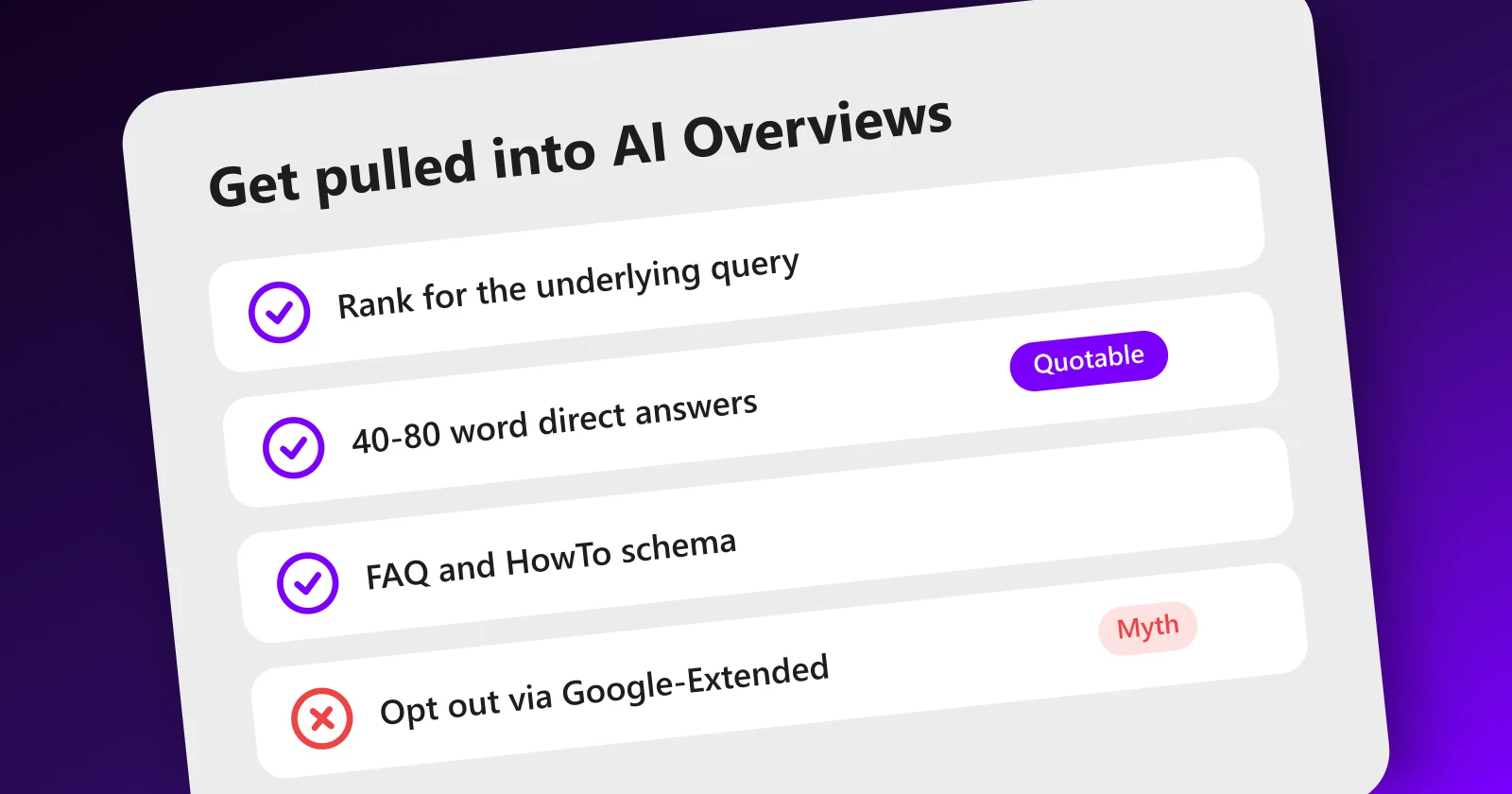
1. Win the underlying query first
Everything starts here, and we see this across Meeeters audits constantly: sites asking why they are absent from AI Overviews when they rank 40th for the query. The Overview cannot cite what Search does not surface. Pick the queries that matter commercially, check where you actually rank, and close that gap with the classic inputs: a genuinely better page and enough authority to support it. For competitive queries that usually means links, which is the slow variable most content teams skip. Content earns relevance, links earn authority, and citation slots go to pages holding both.
2. Write answer-first passages sized for extraction
The model lifts passages, so give it passages built to be lifted. Under every question-shaped heading, open with a direct answer of roughly 40 to 80 words: long enough to be complete and safe to quote out of context, short enough to fit the summary format. State the answer plainly in the first sentence, add the necessary qualification in the second and third, then develop nuance in the paragraphs after. If your best answer currently sits in paragraph four after three paragraphs of preamble, you have written a page one intent too literary for extraction.
3. Put the questions in your H2s
Match your headings to the sub-questions the query implies, phrased close to how people ask them. "How long does it take" as a heading with the direct answer immediately below is a clean retrieval unit: the heading tells the system what the passage answers, the passage delivers it. This also disciplines your content structure into one sub-intent per section, which is the same property that makes pages quotable across every AI surface, not just Google's.
4. Add FAQ and HowTo schema where it is legitimate
Structured data does not put you in an Overview, but it removes ambiguity about what your content is. FAQ markup labels question-answer pairs explicitly, HowTo-style structure makes step sequences machine-legible, and Article markup with real dates supports freshness signals. Google documents the requirements in its FAQ structured data guidance. Use it where the content genuinely is a FAQ, skip it where it is not, and go deeper on the full markup strategy in our guide to schema markup for AI search.
5. Keep the content demonstrably fresh
Overviews favor current information, particularly on topics where the answer changes. A page that says "as of 2023" is telling the system its passage might be stale. Maintain real update cycles on your money pages: refresh the facts, update the dateModified honestly (never fake it, date manipulation without content change is a known spam pattern), and prune claims that have expired. Freshness will not rescue a weak page, but staleness disqualifies a strong one.
6. Make your entity unambiguous
When the Overview mentions a brand, tool, or company, the system needs certainty about what that entity is. Consistent naming everywhere, an Organization schema block with sameAs links to your real profiles, and one canonical description repeated across your site and directories all reduce the hedging that keeps ambiguous brands out of generated answers. This work compounds beyond Google: the same entity clarity feeds every assistant, which is why brand mentions, including unlinked brand mentions, have become a citation input in their own right.
Trigger types: likelihood and what wins
| Query type | AI Overview likelihood | What wins the citation |
|---|---|---|
| Definitions ("what is X") | High | A crisp 40 to 80 word definition high on a page that owns the term |
| How-to and task queries | High | Numbered steps under clear headings, HowTo-style structure, current screenshots or specifics |
| Question queries ("why", "can", "does") | High | Question-matched H2 with an immediate direct answer, FAQ schema |
| Comparisons in research mode | Medium | An honest comparison table plus a verdict paragraph the model can compress |
| Health, finance, legal (YMYL) | Medium, more conservative | Strong E-E-A-T signals, credentials, citations to primary sources |
| Local queries | Low to medium | Business profile data more than page content |
| Transactional ("buy X", "X pricing") | Low | Product data and shopping surfaces, largely outside Overview scope today |
| Navigational (brand names) | Very low | Nothing to win, the user wants the site itself |
Plan effort top-down: definition, how-to, and question queries are where citations are actually available.
How to monitor AI Overview visibility
The honest answer first: Google gives you no dedicated report. Search Console bundles AI Overview impressions and clicks into the regular Performance data, with an impression counted when your link appears in an Overview and position reported in a way that folds the Overview into the standard ranking view. You cannot filter Overview traffic out.
What works instead is pattern reading, and one pattern is the reliable tell: position stable, CTR down. When a query keeps its average position but click-through drops sharply over a few weeks, an AI Overview almost certainly appeared above you and is absorbing clicks. Segment your key queries, watch for that signature, then check the live SERP manually (or with a rank tracker that captures Overview presence) to see whether you are cited inside the Overview or displaced below it. Cited-and-stable is a defensible position; displaced-and-dropping means the extraction work above is overdue. We keep the full measurement setup, including assistant referral tracking and log analysis, in our guide to tracking AI search traffic.
What not to do
Do not block Google-Extended thinking it removes you from AI Overviews. This is the most common technical misunderstanding we encounter. Google-Extended is a robots.txt control that governs whether your content is used to train Gemini models. AI Overviews are a Search feature fed by normal Googlebot crawling, and Google's crawler documentation is explicit about the separation. Blocking Google-Extended costs you nothing in Overviews and gains you nothing in them either. The only real opt-out from Overviews is opting out of Google Search indexing, which is commercial self-harm.
Do not chase the Overview with markup tricks. No schema type places you in an Overview. Structured data describes reality; it does not override ranking.
Do not spin up dozens of thin question pages. One page per micro-question fragments your authority. A section with a strong passage on a page that owns the topic beats a thin standalone page on the fragment, and consolidating intent per page is also how you avoid your own pages competing against each other.
Do not optimize for Overviews in isolation. The same query typed into Google's conversational tab behaves differently: AI Mode fans a question out into multiple background searches and rewards topic-cluster coverage even more heavily. The extraction work you do here transfers there, so build once for both surfaces.
Shortening the path to the entry ticket
The six levers reduce to two jobs: rank for the underlying query, then be the most extractable passage once you do. Meeeters is built to run both jobs from one place, which matters here because Overviews only cite what already ranks:
- The free SEO analysis crawls your site, maps your structure, detects your existing schema and JSON-LD, and flags the quick wins, so lever 4 starts from facts about your markup instead of guesses.
- It also finds the pages your topic cluster is missing, which are precisely the informational queries where Overview citations are actually available.
- The article generator turns each of those gaps into a draft written in your site's language, delivered into your CMS through a native Webflow connector or a webhook via Make, Zapier or n8n. You review, you publish; nothing goes live on its own.
- Authority, the entry ticket itself, grows through a network of sites in your niche: you give one verified link and receive a dofollow link from a different vetted site, with no reciprocal footprint for Google to discount.
- The same dashboard pulls in Google Search Console data (clicks, impressions, and the queries sitting just short of page 1), which is exactly where you will spot the position-stable, CTR-down signature this article told you to watch for.
A free SEO analysis shows where you stand on the entry ticket today, no card required.
The takeaway
Google told everyone the strategy and most of the industry refused to believe it was that unglamorous: AI Overviews cite pages that Google's core ranking systems already surface. Win the underlying query, then make each page extractable with answer-first passages under question-shaped headings, honest schema, real freshness, and a clear entity. Watch position-stable-CTR-down patterns because that is the only measurement signal Google left you. And skip the folklore: Google-Extended is a training control, not an Overview lever. If you want to know where you stand today, the free analysis above shows whether your pages can rank for the queries you need, which is, per Google itself, the whole entry ticket.
Frequently asked questions
Quick answers to the questions people ask most about this topic.
Rank well for the underlying query first, because AI Overviews cite pages surfaced by Google's core ranking systems. Then make each page extractable: a direct 40 to 80 word answer under every question-shaped H2, FAQ schema, current dates, and one clear intent per page.
No. Cited pages usually rank somewhere in the top organic results for the query or a closely related one, but multiple industry studies have found citations pulled from well beyond position 3, including deep pages that never appear on page one for the head term. Passage-level relevance decides which ranking page gets quoted.
No. Google-Extended controls whether your content trains Gemini models, not whether it appears in AI Overviews. AI Overviews are a Search feature governed by normal Googlebot indexing, so the only way to fully opt out is to deindex from Search, which nobody should do.
You cannot directly, because Google Search Console bundles AI Overview impressions and clicks into regular organic data. The workable proxy is pattern analysis: queries where your position is stable but CTR drops sharply usually gained an AI Overview, and manual SERP checks confirm whether you are cited in it.
Mostly informational and question-shaped queries: definitions, how-to tasks, comparisons, and health or finance style research questions. Navigational and high-intent transactional queries trigger them far less, because a generated summary adds little when the user wants a specific site or product page.

I built Meeeters to make link building safe and simple: real, relevant backlinks with no reciprocal footprint and no black-hat shortcuts.