Google AI Mode SEO: How to Get Cited in Conversational Search

For twenty five years, Google search meant one thing: type a query, get a list of links. AI Mode is Google's own break with that contract. It is a dedicated conversational tab inside Search, rolled out broadly through 2025, where the response to a question is a full AI-written answer with citations, and where the interface invites you to keep asking follow-ups instead of clicking away. Google has described AI Mode as its most powerful AI search experience, and its documentation for site owners is collected in the AI features guidance.
For anyone doing SEO, AI Mode raises a sharper question than AI Overviews ever did. An Overview is a summary bolted on top of a results page you can still see. AI Mode replaces the results page entirely: if the answer does not cite you, there is no position 4 to fall back to. This article covers how AI Mode actually retrieves content, why its fan-out mechanic quietly rewrites content strategy in favor of topic clusters, how it differs from AI Overviews, and what you can and cannot measure.
One boundary up front: the general mechanics of how AI engines retrieve and ground answers are covered in our pillar on how to rank in AI search, and the discipline-level overview lives in what is generative engine optimization. This page owns one intent: optimizing for Google AI Mode specifically.
What AI Mode is, in practical terms
AI Mode is a tab in Google Search (alongside Images, News, and the rest) where the entire response is generated. Ask a question and you get several paragraphs of synthesized answer, citations linking to source pages, and suggested follow-up questions. Ask a follow-up and the session continues with context carried over, closer to a ChatGPT conversation than a search session. It launched as a Labs experiment in early 2025, went broadly available in the US that year, and has been expanding across markets since.
Three properties define it for SEO purposes.
It is still built on the index. AI Mode does not have a private web. It retrieves from the same Google index, using Google's search systems to find candidate content, then a Gemini model composes the answer from what was retrieved. Google's guidance to site owners is the same unglamorous line it gives for AI Overviews: there is no special markup or opt-in, and the foundation is content that ranks. Indexability, crawlability, and authority all carry over intact.
Citations are the only visibility. There is no list below the answer. A handful of sources get linked; everyone else who ranks for the underlying queries gets nothing. This is the concentration effect of AI search taken to its endpoint, and it makes the authority gap between cited and uncited sites more binary than classic SEO ever was.
Sessions are conversational. Follow-up questions keep users inside the interface, and each follow-up is a new retrieval round. A single session might touch eight or ten distinct questions across one topic. Whoever covers that topic most completely keeps getting retrieved as the session deepens, which previews the strategic conclusion of this whole article: coverage wins sessions, not just queries.
Query fan-out: the mechanic that changes your content strategy
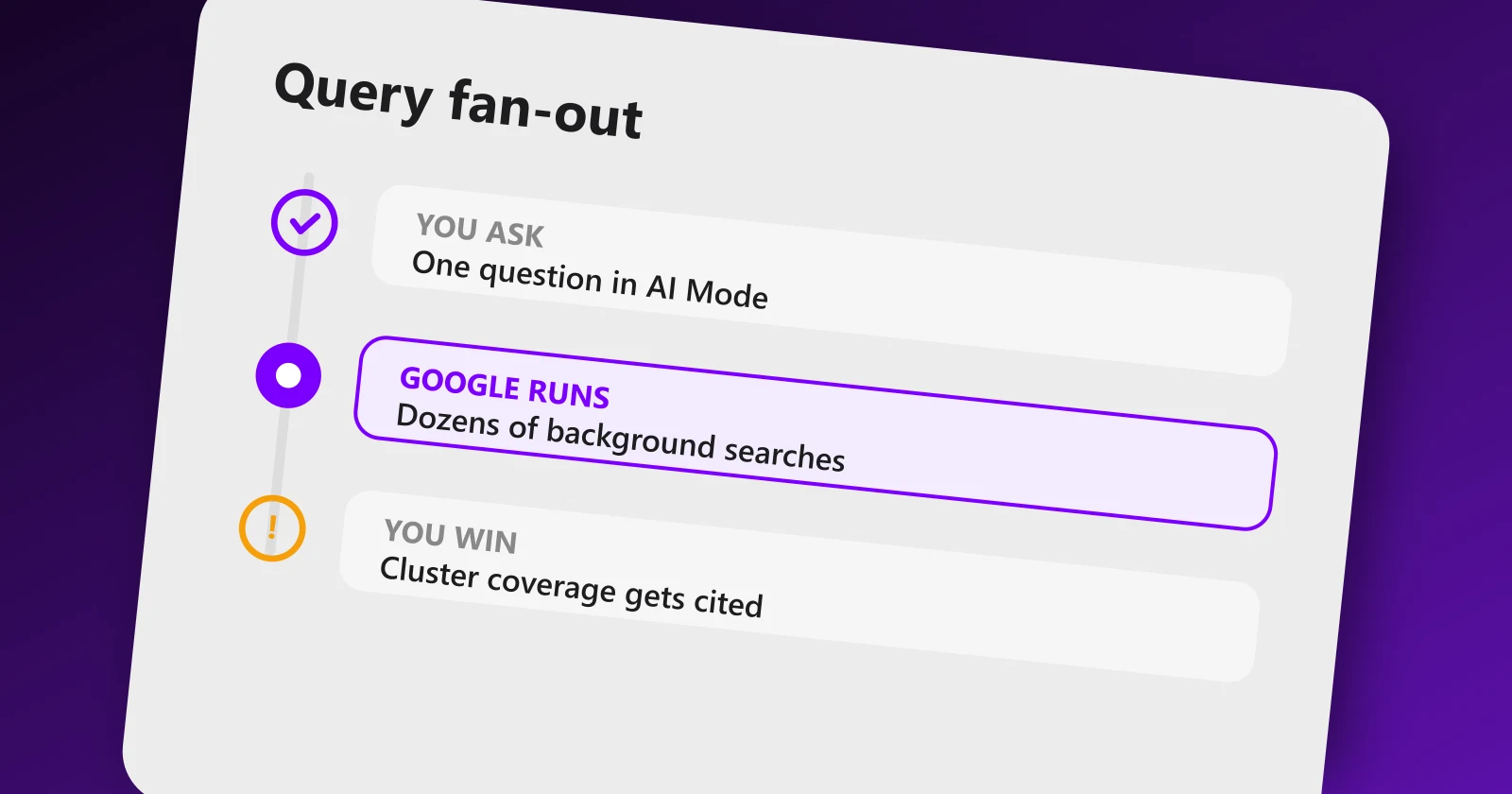
Fan-out is the single most important thing to understand about AI Mode, and Google has been unusually open about it. When you ask AI Mode a question, it does not run one search. It decomposes your question into multiple related queries (sub-topics, interpretations, adjacent angles), issues them as background searches in parallel, and synthesizes the final answer from everything those searches return.
Ask "is it worth switching my small business to solar," and behind the answer AI Mode might have searched something like: solar installation costs for small commercial buildings, payback period for business solar, available tax incentives, maintenance requirements, and how output varies by region. You typed one query. The system ran half a dozen. Every one of those hidden queries is a retrieval event your content can win or lose.
The strategic consequences are worth stating precisely, because this is where AI Mode SEO genuinely differs from everything before it.
Long-tail coverage becomes an entry mechanism, not a bonus. In classic SEO, ranking for an obscure long-tail query earned you that query's small traffic. Under fan-out, ranking for that same long-tail query can get you cited in the answer to a big head-term question, because the head term fanned out into your long-tail territory. Your article on the payback period of commercial solar gets pulled into answers about "should I switch to solar" that you never targeted and could never have ranked for directly. The long tail is now a side door into head-term answers.
Topic clusters beat single pages, structurally. A cluster (one pillar plus satellites that each resolve one sub-question, interlinked) maps almost one-to-one onto how fan-out decomposes questions. Each background query finds the satellite built for it. A single monster page competes in every fan-out query with the same URL and dilutes its passage relevance in each; a cluster fields a specialist for each. We see this across Meeeters audits: the sites appearing repeatedly in AI answers are rarely the ones with the best single page, they are the ones with no gaps in the cluster.
Gaps are invisible losses. When your cluster is missing the "costs" satellite, you do not see a lost ranking anywhere. You just silently fail to be retrieved for the cost-shaped background query, and a competitor takes that slice of the answer. Auditing coverage against the questions a topic implies matters more than auditing positions.
AI Mode vs AI Overviews: same index, different game
Both surfaces are Google, both are grounded in Search, and Google itself notes that AI Mode extends the approach behind AI Overviews. But they reward different optimization emphases, and treating them as one thing leads to misallocated effort. The full playbook for the Overview side is in our guide to Google AI Overviews optimization; here is the comparison that matters.
| Dimension | AI Overviews | AI Mode |
|---|---|---|
| Surface | Summary box on the classic results page, organic links still below | Dedicated conversational tab, generated answer replaces the results list |
| When it appears | Automatically on queries where Google decides it helps, mostly informational | When the user chooses the tab or is routed into it, any question welcome |
| Retrieval | Grounded in results for the query and close variants | Query fan-out: multiple decomposed background searches per question |
| Session shape | One-shot, user scrolls on or clicks | Multi-turn, follow-up questions with carried context |
| Citation style | A few links woven into and beside a short summary | Fuller answers citing sources across multiple sub-topics |
| What wins | The best extractable passage on a ranking page | Cluster coverage across fan-out queries plus quotable passages |
| Optimization emphasis | Passage extraction on pages that already rank | Topic completeness, one intent per page, entity clarity across the cluster |
The overlap is real: an answer-first passage under a question-shaped H2 serves both. The divergence is scope. Overviews reward the best page; AI Mode rewards the best-covered topic.
The AI Mode playbook
Build the cluster before polishing the hero page
Inventory the questions your topic implies, not just the keywords with volume. Take your head query, list every sub-question a smart buyer would ask on the way to a decision (costs, comparisons, timelines, risks, alternatives, how-tos), and check which ones you have a page for. Those missing pages are fan-out queries you currently forfeit. Zero-volume questions are explicitly worth building under this model: fan-out retrieves for relevance to the background query, and a question with no measurable search volume can still be a background query AI Mode issues thousands of times inside bigger sessions.
Own exactly one intent per page
Fan-out retrieval is precise: each background query wants the page that answers it, not the page that mentions it among six other things. Give each satellite one intent, answer it completely, and link sideways to siblings for everything adjacent. This also protects you from self-cannibalization, where two overlapping pages split relevance for the same background query and neither gets retrieved. If two of your pages could plausibly answer the same fan-out query, merge them or sharpen the split.
Write passages that survive being quoted alone
The composing model lifts passages out of context. A passage that begins "as mentioned above, this approach also works here" is dead on arrival; a passage that restates its subject and delivers a complete claim in 40 to 80 words is liftable. Open every section with the direct answer, keep one idea per paragraph, use real HTML tables for comparisons, and phrase headings as the questions they answer. Structured data reinforces this legibility, and the specifics are in our guide to schema markup for AI search.
Keep authority growing, because fan-out does not suspend ranking
Every background search is still a search, ranked by systems that weigh authority. A complete cluster on a domain with no authority loses each fan-out query to thinner content on stronger domains. This is the part of GEO that never becomes a formatting exercise: AI visibility stays downstream of search authority, backlinks and brand mentions gate who gets retrieved, and the cluster only converts into citations once the domain can rank it. Building both tracks at once, the pages and the backlinks that let them rank, is exactly the pairing Meeeters runs from one dashboard, and it matters double here because fan-out multiplies the number of ranking contests your domain enters per question.
Start clusters early if your site is new
Fan-out is unusually kind to newer sites in one respect: a background query is often specific enough that big generalist domains have no dedicated page for it, and a focused new site with the exact answer can be the best candidate. The window is at the specific end of the long tail, which is where new sites should start anyway; the full sequencing is in our guide to GEO for new websites.
Measuring AI Mode: the honest state of the data
There is no dedicated AI Mode report. Google confirmed that impressions and clicks from AI Mode are included in Search Console's regular Performance data, blended into the organic totals with no filter to separate them. A click from an AI Mode citation and a click from a classic blue link are indistinguishable in your reports. Anyone selling you a precise "AI Mode traffic" number is estimating, at best.
What you can actually do: test your money questions in AI Mode by hand on a recurring schedule and record who gets cited (a spreadsheet and a monthly hour is a legitimate methodology at this stage); watch for organic clicks holding steady while classic position tracking suggests they should not, which hints at citation traffic; and monitor query diversity, because a cluster getting picked up by fan-out often starts appearing in Search Console for oddly specific long-tail queries you never targeted. Full measurement setups, including assistant referrals and log-file signals, are covered in how to track AI search traffic.
Accept the imprecision rather than paying to obscure it. The leading indicators (rankings on the underlying queries, cluster coverage, citation checks by hand) are all measurable today and all upstream of whatever reporting Google eventually ships.
Filling the fan-out gaps without hiring a content team
Fan-out turns AI Mode into a coverage contest: every missing satellite is a background query you forfeit, and every satellite only counts if the domain can rank it. Meeeters attacks both sides of that equation:
- The free SEO analysis crawls your site and maps your structure and silos, so the cluster inventory this playbook asks for is generated instead of hand-built. It lists the pages your cluster is missing along with the quick wins.
- The article generator works from that audit: each draft targets one specific gap in your structure (one intent per page, by construction), written in your site's language, delivered as a draft into your CMS through the native Webflow connector or a webhook via Make, Zapier or n8n.
- Nothing auto-publishes. You review every satellite before it goes live, which keeps quality control in your hands on a surface where sloppy pages simply never get retrieved.
- Authority grows in parallel through niche links: give one verified link, receive a dofollow link back from a different vetted site, matched by language and audience, with no reciprocal footprint. That is what lets each satellite win its background query.
- Google Search Console integration in the same view surfaces clicks, impressions and almost-page-1 queries, which is exactly where the oddly specific long-tail pickups from fan-out first appear.
Start with the free SEO analysis: it maps the missing satellites and the link gap in one pass, with no card required.
The takeaway
AI Mode did not invent new ranking signals, it changed the shape of the contest. One question now becomes many background searches, so the winners are sites that cover a topic completely enough to be retrieved across the fan-out, with each page owning one intent and every passage quotable on its own. Rankings remain the entry condition, authority remains the gate, and none of it is measurable with precision yet, so build for the mechanics rather than the dashboard. Map your cluster's gaps, fill them, and keep the authority compounding: those two habits decide who gets cited as fan-out spreads to every market Google serves.
Frequently asked questions
Quick answers to the questions people ask most about this topic.
AI Mode is a conversational tab inside Google Search that answers questions with a full AI-generated response and citations instead of a list of links, and it supports follow-up questions in the same session. Under the hood it still retrieves from Google's index, so ranking-eligible content remains the raw material.
Fan-out is AI Mode's retrieval technique: it decomposes one user question into multiple related background searches, runs them in parallel, and synthesizes the answer from all the results. Your pages can be cited for questions you never targeted, as long as they rank for one of the hidden background queries.
AI Overviews summarize one query on the classic results page, so a single strong page can win. AI Mode fans a question out into many background searches and sustains multi-turn sessions, so breadth matters more: topic clusters that cover the long tail get retrieved across many fan-out queries, not just the head term.
Not separately. Google folds AI Mode impressions and clicks into the regular organic data in Search Console, with no dedicated filter or report. You can only read indirect signals: query patterns, CTR shifts, and manually testing whether AI Mode cites you for your money questions.
Yes, it is the entry condition. AI Mode retrieves candidate passages from Google's index using search systems, so content that cannot rank for any relevant query is invisible to the fan-out. Authority and indexability carry over; what changes is that passage clarity and topic coverage decide who gets quoted.

I built Meeeters to make link building safe and simple: real, relevant backlinks with no reciprocal footprint and no black-hat shortcuts.