SEO Report Example: What a Useful Audit Actually Looks Like

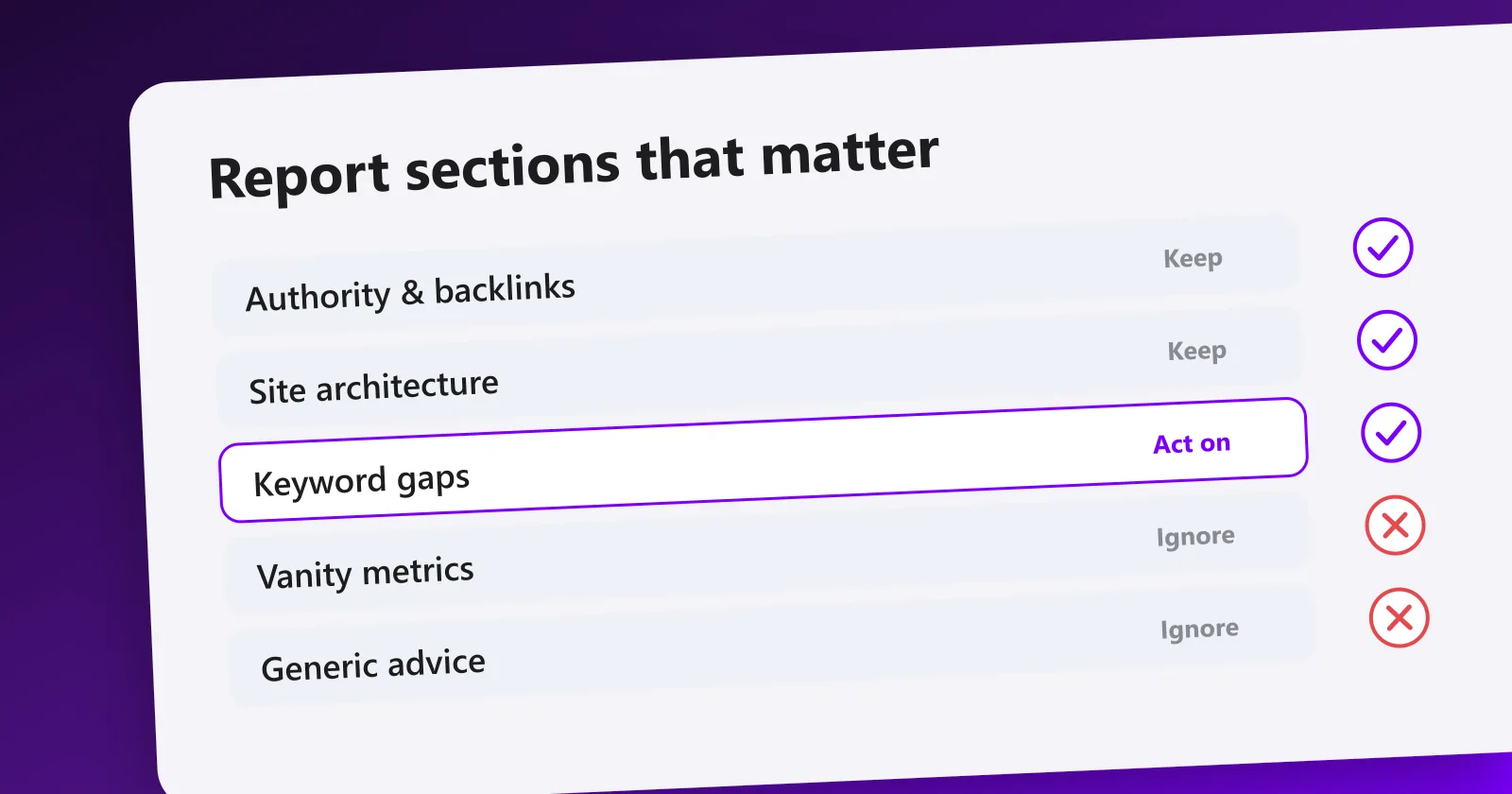
Search "SEO report" and you get template galleries: color-coded PDFs, gauge charts, a "health score" out of 100. Most of it is decoration. A report earns its keep only if it changes what you do on Monday. Here is a real report, section by section, with a note on what to act on and what to skip.
Section 1: Authority (where you actually stand)
The first page should tell you your real position, not a vanity score. Three numbers matter:
- Domain Rating (DR): your site's backlink strength on a 0 to 100 scale. It sets your realistic competitive ceiling. A DR 12 site does not outrank DR 60 sites on a head term, and knowing that redirects your effort to winnable queries.
- Referring domains: how many distinct sites link to you. More predictive than raw backlink count, because ten links from one domain count far less than ten links from ten domains.
- Traffic estimate: organic visitors per month, from live data. Your baseline to measure against.
Skip the "SEO score out of 100". It aggregates unrelated signals into one number that moves for reasons you cannot act on.
Section 2: Architecture (the map with the gaps)
This is the most useful and most often missing section: a visual tree of your site, its silos, and the pages that should exist but do not. Google rewards topical depth, a cluster of related pages around a pillar reads as expertise, and a report that only lists your existing pages misses the point. You want the gaps: the subtopics your structure implies but has not covered yet. Each gap is a page to create, tagged by search intent so you write the right kind of page.
Section 3: Keyword and content gaps
The queries your competitors rank for and you do not. Done well, this section does not dump 5,000 keywords, it filters to the ones you can realistically win (low difficulty, real volume, clear intent) and maps each to a page. A list of 5,000 keywords is a database; a list of 30 keywords mapped to 30 pages is a plan.
Section 4: Quick wins (start here)
The single most actionable page in any report. Quick wins are pages already ranking in positions 3 to 12: high impressions, weak click-through, one small push from page one. Pulled from your own Search Console, ranked by impact, these are where effort converts fastest. If your report has this section and you do nothing else, you still win. Meeeters surfaces these as "Almost page 1" straight from your Search Console data.
The section that decides everything: what happens next
Here is the honest test of an SEO report. A report that ends in a PDF ends in a to-do list you will not finish. The value is not the diagnosis, plenty of tools diagnose, it is the follow-through. A report is only as good as the action it triggers.
That is the whole design of the Meeeters report. Every gap it finds becomes a page in your queue. Every page gets a draft written for you. The SEO automation calendar schedules them to your CMS as drafts you review, and the link building network earns the authority those new pages need. The report is not the deliverable; the published, ranking pages are.
See it on your own site
The fastest way to understand a report is to read yours. The free SEO analysis runs the full report at signup, on live data, in about two minutes, and refreshes it monthly. For the deeper technical layer (indexation, rendering, structured data), see the SEO audit services breakdown.
Frequently asked questions
Quick answers to the questions people ask most about this topic.
Four things that lead to action: your real authority (domain rating, referring domains, backlink profile), your site architecture with its structural gaps, keyword and content gaps against competitors, and a prioritized list of quick wins. If a section does not change what you do next, it is filler.
A page already ranking in positions 3 to 12 with high impressions and weak click-through. It is close to page one, so a small improvement produces the fastest ranking gain. Good reports rank these by impact using your own Search Console data, not generic estimates.
Short enough to act on. A 60-page PDF is a sales artifact, not a work plan. The signal-to-noise pages are the prioritized action list and the architecture map. If those two are clear, the rest is optional context.
Yes. The Meeeters free SEO analysis runs a full report at signup, no credit card, and refreshes it monthly. It uses the same live SERP and backlink data that paid audits rely on.

I built Meeeters to make link building safe and simple: real, relevant backlinks with no reciprocal footprint and no black-hat shortcuts.