How to Check Competitors' Backlinks (and Steal What Works)

Your competitors have already done your link prospecting for you. Every site that links to them is, by definition, a site that links to businesses like yours. That is the whole premise, and it is why competitor backlink analysis turns link building from guesswork into a checklist: see what got them ranked, keep what is replicable, skip what is junk.
I build Meeeters around making link acquisition efficient, and I will be honest about the part most guides skip: most of what you find in a competitor's profile is not replicable, and pretending otherwise is why people burn a weekend on this and come away with nothing. A realistic analysis ends with 20 to 30 percent of their profile as your actual target list. That list is worth having. The other 70 percent is noise, paid placements you should not copy, and links that exist for reasons you cannot reproduce.
This guide covers the full workflow: choosing the right competitors, pulling the right metric, filtering aggressively, running the gap analysis that tells you what a keyword actually costs, replicating by source type, and turning the whole thing into a monthly loop.
Step 1: pick the right competitors
Not your business rivals. Your SERP rivals.
The distinction matters more than anything else in this workflow, because getting it wrong poisons every step downstream. The company you lose deals to might not rank for anything. The niche blog that owns page one for your money keyword might not be a business at all. For link analysis, only the second one matters.
The selection method, concretely:
- List your 5 to 10 money keywords, the ones with commercial intent that you actually want to rank for.
- Search each one, in an incognito window, and note the domains that hold positions 1 to 5.
- Count the frequency. A domain that appears across four of your keyword searches is a core competitor. A domain that appears once is a coincidence.
- Take the 3 to 5 domains that recur.
Two refinements that most people miss:
Analyze at page level, not just domain level. A domain-level view of a big publisher tells you nothing useful: their homepage has 50,000 referring domains because they are a big publisher, not because of the article outranking you. What you want is the referring domains pointing at the specific URL that beats you. That number is usually shockingly small, often 10 to 40, and it is the number that actually defines your target.
Pick one aspirational and one adjacent. Your list should include one site slightly above your weight class (to see where the ceiling is) and one roughly at your level that is beating you anyway (to see what is achievable this quarter). A list of five giants tells you only that giants have lots of links.
Why Meeeters dodges the competitor backlink tool
Classic link building lives inside competitor backlink checkers: scrape who links to the sites above you, filter hard, outreach for weeks. That is reverse-engineering someone else's profile.
Meeeters skips that loop. It finds you verified dofollow backlinks from network members that are scanned and eligible, in your niche. No reciprocal links, no PBNs. You do not need to recreate a rival's link graph to grow. The matching is the prospecting. See how Meeeters works.
The free comparison below is optional. Use it after you pick the right SERP rivals, when you want a fast side-by-side on referring domains (the number that matters), not a vanity backlink count. Then keep reading for the filter and gap workflow, or skip the spreadsheet and start with Meeeters.
It also lives on its own page as a standalone competitor backlink checker if you just want to run the comparison without the workflow.
Read the gap, not the absolute number. Referring domains decide rankings far more than raw backlinks. A site with two million backlinks and forty referring domains is a forty-link profile. Full breakdown in referring domains vs backlinks.
Step 2: pull their referring domains
Run each domain, and each specific competing URL, through a backlink tool when you need a deeper export than the free comparison above. Our comparison of backlink checkers covers which ones do what, at which price.
The metric that matters is referring domains, not backlinks. One site linking to you 500 times counts roughly once in Google's eyes; a profile showing "12,000 backlinks" from 40 referring domains is a profile with 40 links. This distinction is the single most common way people misread a competitor's strength, and it is worth understanding properly: our explainer on referring domains vs backlinks covers why the gap between the two numbers is itself a signal.
Sort by the tool's authority metric, but read it with suspicion. Authority scores are modelled, not measured, and they are gameable, which is why a site can show a strong rating with no traffic at all. Our piece on fake domain rating explains the tells. The practical rule: never accept an authority score without checking estimated organic traffic next to it. Authority without traffic is the classic manufactured-metric signature.
What you get on free tiers is a sample, typically the first 100 links or so. That sounds limiting and mostly is not, because you are looking for patterns, not completeness. If 30 of the first 100 links are guest posts, you have learned that this competitor's strategy is guest posting, and no amount of additional data changes that conclusion.
For your own side of the comparison, use Google Search Console. It is free, and more importantly it shows the links Google actually sees, which no third-party crawler can promise.
Step 3: filter for links worth having
Discard first. This is where the honest math lives: you are hunting editorial links, and most of what you pulled is not one.
| Discard | Why |
|---|---|
| Directories, profile pages, forum signatures | Anyone can get these, so they carry almost nothing. If it took no editorial decision, it earns no editorial credit. |
| Sites with no organic traffic | The fake-authority tell. A site nobody visits passes nothing worth having. |
| Obvious paid placements | Replicating these means buying links. Meeeters does not use paid placements. |
| Casino, CBD, and adjacent junk | The stuff that builds toxic profiles. Inheriting a competitor's liabilities is not a strategy. |
| Irrelevant niches | A link means little without topical proximity. A fintech blog linking to your gardening store helps nobody. |
| Syndicated copies of one article | Fifty sites republishing one press release is one link, not fifty. |
What remains is your prospect list: real sites, in your topic, already proven willing to link out to someone like you.
Run the numbers on what you kept. If you pulled 400 referring domains and kept 90, that is normal and healthy. If you kept 300, you filtered too gently. If you kept 12, either your competitor's profile is genuinely thin (useful information, they may be ranking on content rather than links) or you filtered too hard.
Step 4: run the gap analysis
This is the step that pays for the whole exercise.
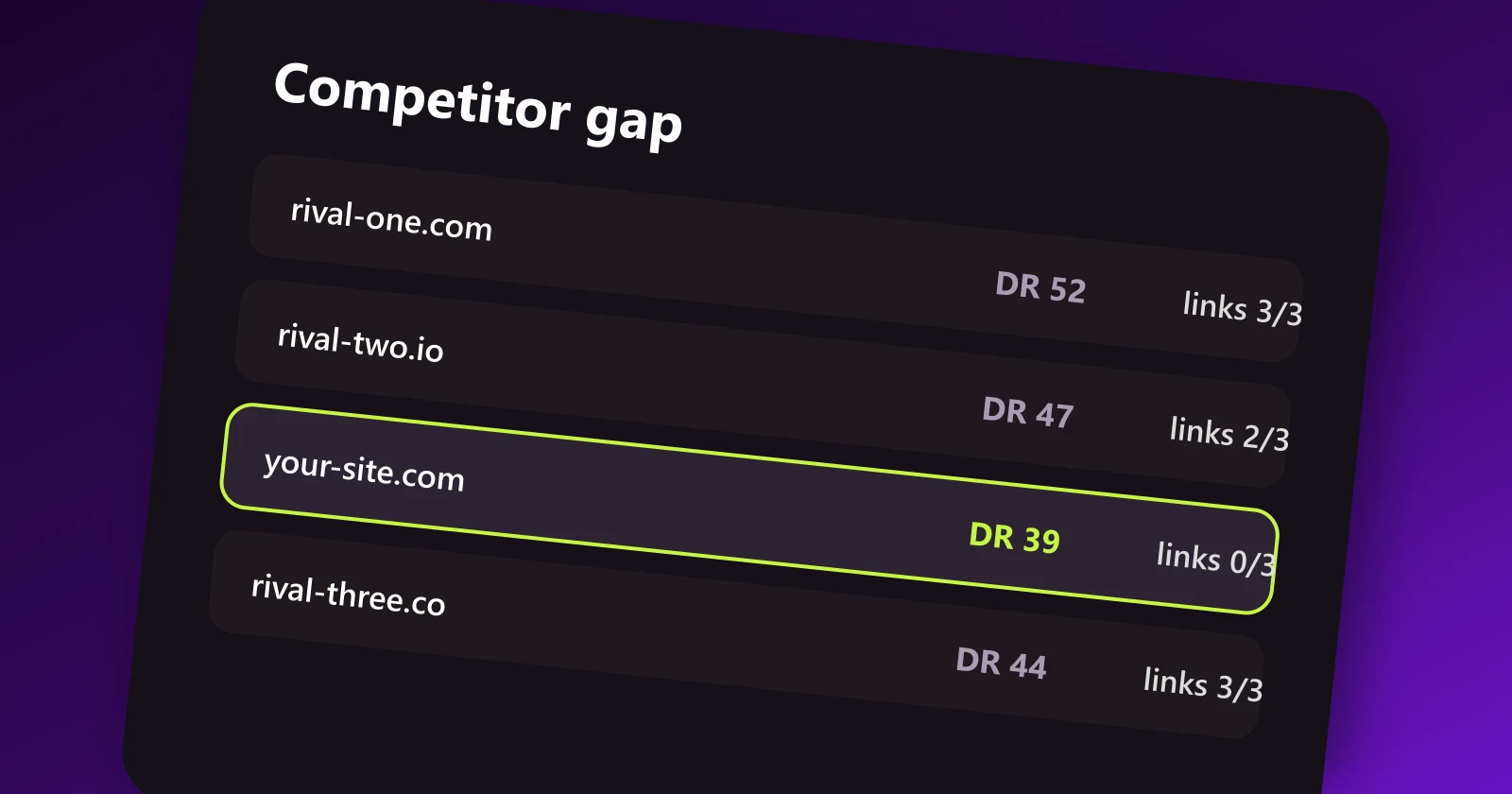
Most tools have a "link intersect" or "backlink gap" view: sites that link to two or more of your competitors but not to you. Turn it on, put your domain in the "does not link to" slot, and put your 3 to 5 competitors in the others.
The output is the highest-probability target list that exists for your niche. The logic is simple and strong: a site that linked to three of your rivals has a demonstrated, repeated habit of writing about your exact topic and linking out while doing it. They are not a cold prospect. They are a site that has said yes three times to businesses like yours and simply has not been asked by you.
Sort that list by how many competitors each site links to. Three-competitor overlaps go to the top of your outreach queue, always.
The same analysis answers the budget question. If the pages outranking you have 25 to 40 referring domains and your competing page has 6, you now know the size of the hole, and you can stop guessing at how many links a keyword costs. Our guide to how many backlinks to rank walks through how to read that gap without over-reading it, because link count is a necessary condition, not a sufficient one. If your content does not match the intent, 40 links will not save it.
Step 5: replicate by source type
Each link type has its own playbook. Sorting your prospect list by how the link was earned is what turns a spreadsheet into a plan.
| What you found | How to replicate | Realistic conversion |
|---|---|---|
| Resource or "best tools" page | Pitch your inclusion, easiest ask there is | 10-20% |
| Guest post byline | The site accepts guest content; pitch a better topic | 5-15% |
| Broken or outdated link near their mention | Offer your page as the fix | 5-10% |
| Unlinked mention of the competitor's category | Your own unlinked mentions are the better version of this | 20-40% |
| Podcast or interview | Pitch yourself as a guest | 15-25% |
| Original data cited by others | You need your own data first | Slow, high value |
| Partner or community links | They exchange; join a structured network | Depends on the network |
| Paid placement | Do not | 0%, by choice |
The specific plays behind these rows are covered in resource page link building and broken link building, and the full comparison of methods sits in link building methods compared. Templates for the actual emails are in the outreach templates library.
That partner-and-community row is more common than most people admit. A meaningful share of any competitor's profile is partnerships and exchanges, and it is usually the part that looks mysterious when you audit it: links from relevant sites, in genuine content, with no visible reason. The clean way to replicate it is an AI-powered SEO tool that finds you dofollow backlinks in your niche. At Meeeters your links come from network members that are scanned and eligible, vetted through Google Search Console ownership, network graph analysis, and a compliance score, never a direct swap. Every link is verified for placement and dofollow status. No reciprocal links, no PBNs or spammy sites. That is how Meeeters works, and it is the honest answer to "how did they get that link" for a big slice of any profile.
The links you cannot replicate, and why that is fine
Every competitor profile contains links you will never get, and recognising them early saves weeks:
- Age. A link from a 2015 roundup on a site that stopped publishing in 2019. The door is closed.
- Corporate relationships. Their investor, their parent company, their acquisition announcement.
- Genuine news. They raised a round, got acquired, or had a scandal. You cannot pitch your way into that.
- Personal relationships. The founder's college roommate runs a niche blog. It happens constantly and explains more link profiles than anyone admits.
- Paid, undisclosed. You can spot these, you cannot ethically match them, and you should not want to.
If 40 percent of a competitor's strong links fall into these buckets, that is not a failure of your analysis. It is the analysis working: it tells you their moat is partly non-replicable, and your effort belongs on the 60 percent that is. Chasing the unreachable is how people conclude that link building does not work.
A worked example
Say you sell project management software for architects. Your money keyword is "project management for architects."
- Competitors: you search, and three domains recur across your keyword set: a niche architecture-tech blog, a general PM tool with a strong article, and a small competitor at roughly your size.
- Page-level pull: the general PM tool's domain has 60,000 referring domains, which is useless information. Their ranking article has 31. That is your real target number.
- Filter: across the three, you pull 380 referring domains and keep 84 after discarding directories, dead sites and two obvious paid networks.
- Gap: 11 sites link to two or more of them and none to you. Three link to all three: an architecture newsletter, a design-tools roundup, and an industry association resource page.
- Sort by type: the roundup and the resource page are inclusion pitches, the easiest asks on the list. The newsletter takes guest contributions. That is your first week of outreach, and it is three warm targets instead of a spreadsheet of 380 cold ones.
Five steps, from a wall of noise to three names worth emailing on Monday. That is what the workflow is for.
Common mistakes
- Judging by domain rating alone. Traffic is the sanity check on every authority score. No traffic, no value, whatever the number says.
- Analyzing the homepage instead of the ranking page. The single most common error, and it makes every conclusion wrong by an order of magnitude.
- Treating the count as a target. Forty links to a page whose content does not match search intent will not rank. Links amplify a good page; they do not rescue a bad one.
- Copying the profile instead of the pattern. You do not want their exact 84 links. You want to learn that they win with roundups and guest posts, and then go win with roundups and guest posts.
- Doing it once. A single snapshot tells you where they are. The monthly delta tells you what is working right now, which is far more useful.
Turn it into a monthly loop
Competitor analysis is not a one-off. The first pass is the expensive one, two to three hours. After that, set a monthly 30-minute review:
- New referring domains your rivals gained since last month, the warmest prospects you will ever find, because that site is publishing on your topic this month.
- New gaps opened, and gaps you closed.
- Links you earned that they lack, which is the part worth reporting.
- Links they lost, since backlinks disappear constantly and a dead link on a live page is a replacement opportunity.
Track your own side with a dofollow filter on, since nofollow mentions inflate the numbers without moving rankings much, and measure the program properly with the framework in how to measure link building.
Start with the free version of the loop: run a free SEO analysis to get your domain rating and referring domains, then measure the gap to the sites you want to beat. And while you work through your prospect list, the Meeeters network keeps your profile growing in parallel: it finds you dofollow backlinks in your niche from network members that are scanned and eligible, so the slow half of link building is not the only half you have running.
Frequently asked questions
Quick answers to the questions people ask most about this topic.
Yes, for a first pass. Put your domain next to a few SERP rivals in the free comparison on this page: referring domains, total backlinks and a strength score, side by side, no signup. Full referring-domain exports and link intersect views on Ahrefs or Semrush still need a paid plan. Your own profile is free and more accurate via Google Search Console, since it shows the links Google actually counts.
No. Meeeters finds you verified dofollow backlinks from scanned members in your niche, so you do not reverse-engineer a rival's profile to grow. Use a checker only if you want to size the authority gap after you pick the right SERP rivals. The matching is the prospecting.
Quality over count. Ten links from relevant, trafficked sites that already link to several of your competitors move you more than a hundred scraped directory links. Use the referring-domain count of the pages ranking above you as a ceiling to aim at, not a quota to hit, and expect only 20 to 30 percent of their profile to be replicable at all.
Copying their good links is safe: you are targeting sites already proven to link to your topic, which is just efficient prospecting. The trap is copying blindly. Competitor profiles also contain paid placements, PBNs and spam you do not want to inherit, and a link you cannot explain is a link you should not chase.
Monthly, in about 30 minutes. The first deep analysis takes two to three hours and builds your prospect list. After that you are only looking at the delta: new referring domains your competitors gained since last month, which is a much shorter list and often the most actionable one, because a site that just linked to a rival is warm right now.

I built Meeeters to make link building safe and simple: real, relevant backlinks with no reciprocal footprint and no black-hat shortcuts.
Related searches, answered
What people actually type before landing here, with the short answer and where to read more.
- Find competitor backlinks
- Export their referring domains rather than their raw link count, then keep only the sites that link out editorially.Referring domains vs backlinks ›
- Competitor backlink checker
- Every checker returns roughly the same list. The work is filtering it down to domains you can realistically reach.Run the free checker ›
- Competitor links
- Not every competitor link is worth copying: directories, sitewide footers and paid placements move nothing.Which links actually pass value ›
- Competitor backlink analysis
- Compare link velocity, not totals. A site that added 40 domains this quarter tells you more than one sitting on 4,000.Safe link velocity ›
- How to check competitor backlinks
- Pick three real SERP competitors, pull their domains, remove the ones you already have, and outreach what is left.Outreach templates ›
- Competitor backlink analysis tool
- Free tiers cap the export at a few hundred rows, which is usually enough since only the top domains matter.The tools worth paying for ›
- Are competitor backlinks worth replicating?
- Replicate the pattern, not the list: if half their links come from resource pages, build the asset those pages cite.Resource page link building ›
- Competitor link gap
- The gap that matters is domains linking to two competitors but not to you, since those sites already link in your niche.Assets that earn links ›