How to Measure Link Building: KPIs, ROI and What to Ignore

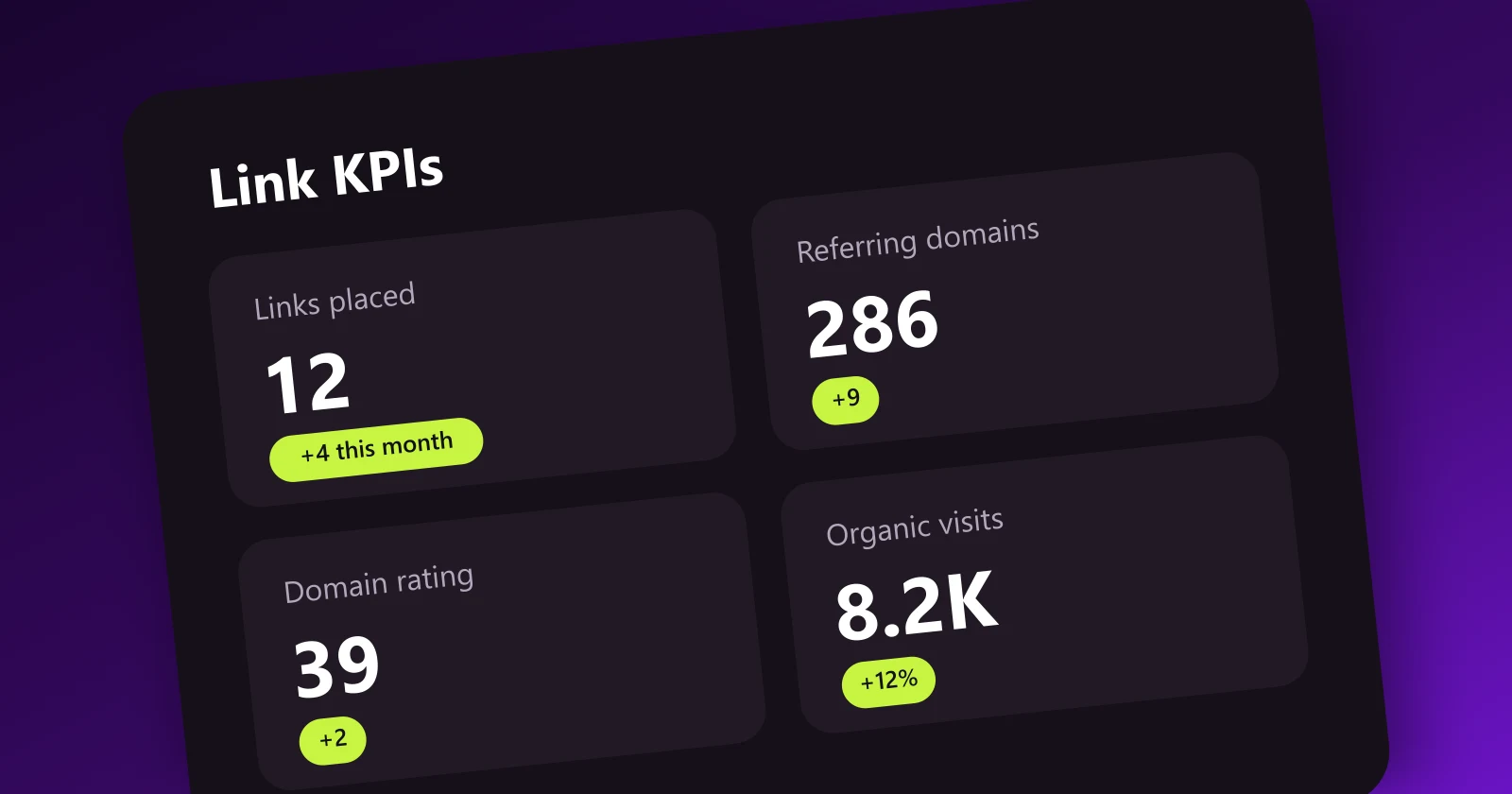
Most link building measurement fails in one of two directions. Either it measures nothing beyond a monthly invoice and a vague feeling that SEO is happening, or it drowns in 40-metric dashboards where the number that matters, revenue from organic search, is buried under backlink counts and authority scores that nobody can act on.
We have built links for our own projects and watched hundreds of sites move through the Meeeters network, and the sites that improve fastest share one habit: they measure a small set of numbers, on the right time horizon, and ignore everything else. This guide is that measurement system. It covers which KPIs matter and when, the real cost per link across methods, why attribution takes months, which metrics are pure vanity, and how to build a monthly dashboard in under an hour with free tools.
The two clocks: leading vs lagging metrics
The single biggest measurement mistake is judging link building on one clock. Link building operates on two.
Leading metrics are things you control and can count this week: emails sent, links placed, referring domains added, cost per link. They tell you whether the machine is running. They do not tell you whether it is working.
Lagging metrics are the outcomes: rankings, organic traffic, conversions from organic. They tell you whether the work mattered. They arrive 1 to 6 months after the work, which means they are useless for steering week to week and essential for judging quarter to quarter.
Both clocks are necessary. Manage activity with leading metrics, judge strategy with lagging ones, and never mix the time horizons. A campaign with great leading numbers and flat lagging numbers after six months has a targeting problem: you are building links, but to the wrong pages or from the wrong sites. A campaign judged on lagging metrics after four weeks has a patience problem, and the usual casualty is a strategy that was about to work.
The KPI stack, from activity to revenue
Here is the full stack we recommend, ordered from most immediate to most meaningful. You do not need all six for a small site, but you should know where each one sits.
1. Links placed
The raw production number: how many links went live this month. Count only links that meet your quality bar, which at minimum means editorially placed, on an indexed page, on a site with real organic traffic. A link that fails those checks is not a KPI, it is noise.
Consistency beats volume here. Five links a month for a year outperforms sixty links in January and silence after, because sustained referring domain growth is itself a healthy pattern, while spikes followed by nothing look unnatural and, more practically, mean your competitors pass you in the quiet months.
2. Referring domain growth
More useful than links placed, because ten links from one domain carry nothing like the weight of ten links from ten domains. Track total referring domains to your site and, separately, referring domains to your money pages. The second number is the one that moves rankings on the pages that pay you.
Watch the trend against your closest competitors, not in isolation. If you add 8 referring domains a month and the competitor above you adds 20, your gap is widening while your dashboard looks green. Understanding what a referring domain actually signals helps keep this metric honest.
3. Authority trend
Domain Rating, Domain Authority, or whichever proxy your tool provides. This belongs in the stack with a firm caveat: it is a trend line, not a target. A DR climbing from 15 to 30 over a year alongside growing traffic is a healthy confirmation signal. Chasing DR as a goal is how people end up buying links from sites with inflated, fake metrics. We will come back to this in the vanity section, because DR abuse deserves its own paragraphs.
4. Target-page rankings
The first true lagging metric, and the sharpest one. When you build links to a specific page for a specific keyword cluster, track those keywords weekly. Position movement on targeted pages is the cleanest available evidence that your links, rather than general site momentum, did the work.
Track a control group too: a few similar pages you did not build links to. If targeted pages climb while control pages sit still, you have real attribution. If everything climbs together, credit the algorithm update or your content, not the campaign.
5. Organic traffic to target pages
Rankings are the mechanism, clicks are the point. Pull organic clicks per target page from Search Console and watch them against the ranking movement. A page that climbs from position 9 to position 4 should show a click multiple, not a rounding error. If rankings improved and traffic did not, the keyword had no real volume, which is a targeting lesson for the next campaign.
6. Conversions from organic
The top of the stack and the bottom of the funnel: signups, leads, or sales from organic sessions on the pages you strengthened. This number is noisy, lagged, and confounded by everything from seasonality to pricing changes. It is also the only number your accountant recognizes. Measure it quarterly rather than monthly, and treat it as the final verdict on strategy rather than a steering wheel.
Cost per link: the honest math
Cost per link is the metric that makes methods comparable, and almost nobody calculates it honestly. The dishonest version counts only cash. The honest version counts cash plus hours at what your time is actually worth.
| Method | Cash cost | Time per link | All-in cost per link |
|---|---|---|---|
| Agency placements | $300 to $600 | Minimal | $300 to $600 |
| Guest posting (DIY) | $0 to $100 | 6 to 12 hours | $300 to $1,200 |
| Cold outreach (Skyscraper, broken links) | ~$50 tools | 5 to 10 hours | $250 to $1,000 |
| Digital PR campaign | $500 to $5,000 | High | $200 to $1,000 per link earned |
| Structured exchange network | Subscription | Minutes per link | $10 to $50 |
A few notes on that table. Agency pricing of $300 to $600 per link is the current market for decent quality, and the full breakdown of what drives it is in our guide to link building costs. Guest posting looks free until you count the hours: pitching, writing 1,500 words, revisions, and follow-up routinely burn a full working day per placed link. Cold outreach economics depend entirely on conversion rate, which for most operators sits at 1 to 3 links per 100 emails.
Exchanges are the outlier, and the reason is structural: there is no cold start. In a structured network like Meeeters, one placed editorial link earns one credit, and one credit converts to one verified backlink from a relevant, traffic-vetted site. The discovery, trust, and verification costs that dominate every other method are handled by the platform, which is why the per-link cost lands at minutes of work instead of hours. The safety of that model comes from niche relevance, real traffic, editorial placement, and healthy ratios, and from the fact that the reciprocal pattern is removed: your return link never comes from the site you linked to.
Whatever mix you run, compute the same number for each method every quarter: total cost including hours, divided by links placed that meet your quality bar. The first honest calculation usually reallocates the budget by itself.
Cost per link is not value per link
One caution before moving on: a $600 link from a genuinely authoritative, relevant site can be worth more than ten $50 links. Cost per link keeps methods comparable, but pair it with your quality bar, otherwise the metric optimizes you toward cheap and useless. The pairing that works: minimum quality threshold first, lowest cost per link among qualifying options second.
Attribution reality: the lag is weeks to months
Here is the uncomfortable truth that makes link building measurement genuinely hard: the gap between cause and effect is 4 to 12 weeks at minimum, often longer.
The chain has real, physical delays in it. Google has to recrawl the linking page, which for a mid-authority blog can take days to weeks. The link then has to be processed into the link graph and authority recalculated. Rankings then shift gradually, often in steps around algorithm refreshes rather than smoothly. Traffic follows rankings, and conversions follow traffic. Stack those delays and a link placed in January is often still delivering its ranking effect in April.
This lag has three practical consequences:
- Never judge a campaign inside 8 weeks. The links have not finished working. Cutting a campaign at week six because rankings are flat is like judging a savings account by its first week of interest.
- Annotate everything. Keep a dated log of every link placed, every content change, and every known algorithm update. When rankings move in March, the log tells you whether to credit January's links or February's content rewrite. Without the log, you are guessing.
- Expect compounding, not steps. Links interact. The tenth referring domain to a page often moves rankings more than the third did, because thresholds matter in competitive SERPs. Flat months followed by a jump is the normal shape, not a sign of failure.
The broader timeline question, how long SEO takes to show results overall, follows the same logic across content and technical work, and we cover it in depth in how long does SEO take. The summary: 3 to 6 months for meaningful movement is normal, and anyone promising week-two results is selling something.
Setting targets: what good looks like
KPIs without targets are just weather reports, so here are honest benchmarks for what healthy numbers look like at different stages. Treat these as starting points to calibrate against your niche, not laws.
For a new site, months 1 to 6. Two to five new referring domains per month is a solid, natural-looking pace. Your leading metrics matter almost exclusively here, because lagging metrics barely exist yet: a site with no history can rank for long-tail terms quickly, but competitive keywords will not move regardless of link velocity. Target cost per link under $100 all-in at this stage, which in practice means exchanges, templates-driven passive links, and cheap sweat rather than agency retainers.
For an established small site, DR 20 to 40 equivalent. Five to fifteen referring domains per month, with at least half pointing at money pages and their supporting content rather than the homepage. This is the stage where target-page ranking movement becomes your primary quarterly judgment: if six months of consistent link building has not moved your tracked keywords, the problem is targeting or content, not volume.
For a competitive site chasing hard keywords. The relevant benchmark stops being your own history and becomes the gap analysis: how many referring domains do the pages ranking above you have, and how fast are they adding more. Count the referring domains of the top three ranking pages for your target keyword, compare to yours, and divide the gap by your realistic monthly link rate. That quotient, in months, is your honest timeline, and it is the single most clarifying calculation in link building. If the answer is 40 months, change keywords, not tactics.
Two universal warning thresholds apply at every stage. If more than roughly a third of your new links share the same exact-match anchor text, diversify immediately, because over-optimized anchors are the most common self-inflicted wound in outreach-driven campaigns. And if your live-link reconciliation shows more than 20% of placements dying within a year, your source quality bar is too low, whatever the metrics said at placement time.
Vanity metrics: what to ignore
Half of good measurement is refusing to measure the wrong things. These are the numbers that look like progress and measure almost nothing.
Raw backlink counts
The classic. "We built 4,000 backlinks this month" is a spam confession, not a KPI. Backlink counts are trivially inflated by sitewide footers, scraped aggregators, and forum profiles, none of which move rankings. One editorial link from a relevant page with traffic outweighs thousands of those. If a report leads with total backlinks instead of referring domains and their quality, question everything else in the report.
DR alone
Domain Rating is a third-party estimate of link profile strength, useful as a rough filter and a trend line. It becomes a vanity metric the moment it becomes a target, for one simple reason: it can be manufactured. Sellers inflate DR with link schemes precisely because buyers filter by it, then sell placements on sites with DR 60 and 200 organic visitors a month. We wrote a full guide on spotting fake Domain Rating because the pattern is that common. The tell is always the same: authority score high, organic traffic missing. Understand what DR actually measures, use it as one input, and never report it as an outcome.
Traffic-free "authority" placements
Related and worth its own line: a link from a site with no organic traffic passes little value regardless of its metrics, because the metrics were the product. Traffic is the one signal that is expensive to fake at scale, which is why it should sit at the center of your quality bar.
Outreach activity theater
Emails sent, open rates, and "opportunities identified" are operational numbers for the person running outreach. They do not belong in a results report. An agency reporting 2,000 emails sent and 4 links placed is reporting a 0.2% conversion rate and hoping you read it as effort.
Building a simple monthly dashboard
You need one spreadsheet, Google Search Console, and one backlink tool. Setup takes under an hour, updates take about thirty minutes a month.
- Create a link log. One row per placed link: date, linking URL, target URL, anchor text, method, cash cost, hours spent, dofollow status, and a live/dead flag. This log is the spine of everything else.
- Add a monthly metrics tab. One row per month with: links placed, referring domains (total and per money page), authority score, and for each target page its main keyword position, organic clicks, and impressions from Search Console.
- Pull Search Console data on the same day each month. Use the Performance report filtered by page for your targets. Same day monthly matters, because GSC data is itself lagged a few days and consistency beats precision.
- Pull referring domains from your backlink tool. Any of the major tools works, and several offer free tiers sufficient for a small site. Log the number, but skim the new referring domains list too: you are looking for both wins you did not know about and junk you did not build.
- Annotate events. A column for anything that could move rankings: content updates, site migrations, known Google updates. Thirty seconds of annotation saves hours of confused attribution later.
- Review on two cadences. Monthly: leading metrics, is the machine running, is cost per link drifting. Quarterly: lagging metrics, are target pages climbing, is organic traffic and conversion trending up, should the method mix change.
That is the entire system. It fits in one spreadsheet and answers the three questions that matter: are we building links, are they good, and are they working.
Verify that links stay live
One measurement habit separates professionals from everyone else: checking that the links you counted still exist. Placed links decay constantly. Sites redesign and drop old posts, editors prune outbound links, pages get consolidated, domains die. Industry studies consistently find a meaningful share of links vanish within a year of placement, and our full breakdown of why backlinks disappear covers each failure mode.
The measurement implication is direct: your real KPI is live links, not placed links. Reconcile the link log quarterly, flag dead placements, and chase the recoverable ones, since a polite note to a site that dropped your link during a redesign recovers it surprisingly often. If you paid for a placement with a duration promise, the reconciliation is how you enforce it.
This is also a place where structure beats willpower. Manual reconciliation is tedious enough that most people quietly stop doing it. In a structured exchange network, placement and dofollow status are verified automatically and a credit only counts when the link is confirmed live, which removes the most commonly skipped step of measurement by making it part of the mechanism.
Pulling it together
Measure on two clocks. Steer monthly with links placed, referring domain growth, and honest cost per link. Judge quarterly with target-page rankings, organic traffic, and conversions. Ignore raw backlink counts, DR as a target, and activity theater. Keep one annotated spreadsheet, reconcile live links quarterly, and give every campaign at least eight weeks before you call it.
If you want a baseline before you start measuring anything, run a free SEO analysis: it maps your current link profile and target pages, and from there you can earn your first verified backlink through the Meeeters network with the measurement already built in.
Frequently asked questions
Quick answers to the questions people ask most about this topic.
Referring domain growth on your target pages, cost per placed link, and target-page ranking movement. Referring domains matter more than raw backlink counts, cost per link keeps you honest across methods, and rankings on the pages you actually built links to are the clearest proof of impact.
Expect 4 to 12 weeks between a link going live and measurable ranking movement, sometimes longer for competitive keywords. Google must crawl the link, recompute authority signals, and re-evaluate rankings. Judging a campaign in month one almost guarantees a wrong conclusion.
Only as a trend line, never as a target. DR is a third-party estimate that can be inflated cheaply, which is exactly why sellers game it. A rising DR alongside growing referring domains and traffic is a healthy signal. DR alone tells you almost nothing about whether links are driving business results.

I built Meeeters to make link building safe and simple: real, relevant backlinks with no reciprocal footprint and no black-hat shortcuts. Questions about your site? Write to me directly.
Email us