What Is a Link Building Service? Definition, Process, and When It Actually Works

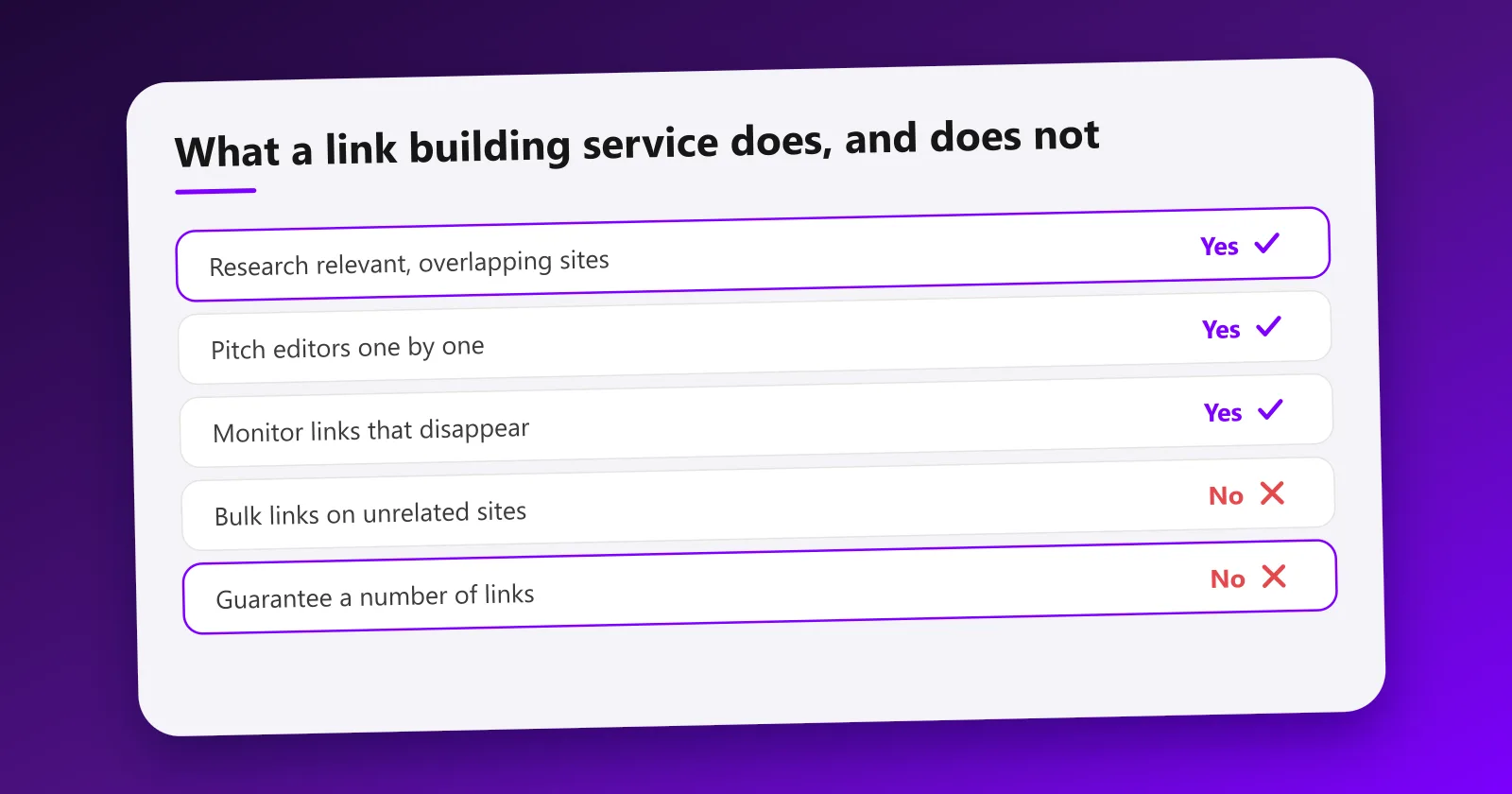
A link building service acquires backlinks to your website from other domains. It researches sites whose audience overlaps yours, pitches them, and coordinates the placement so the link goes live in the right context.
What it is not: buying hyperlinks in bulk, or spraying your URL across thousands of unvetted sites. Those are a different product sold under the same name, and the confusion between the two is what makes this decision hard.
What these services actually do
The problem a link building service solves is logistical and relational. Finding relevant sites, reaching the right person, and getting a placement agreed takes time, outreach skill and a network most in-house teams do not have.
Research. The service audits your existing backlink profile, maps the topics where your content has a legitimate claim, and finds sites with audience overlap. This is targeted discovery, not a list scraped by domain rating. Increasingly this research is wired into tooling rather than done by hand, and a whole category of MCP-native tools for AI agents now exists to connect that kind of workflow to live data sources, which is worth knowing about before paying someone to do the lookups manually.
Outreach. Once candidates are mapped, someone pitches editors or site owners, or finds an opening where a link emerges naturally: a resource list, an expert quote, a co-authored piece. Good services write each pitch. Cheap ones template it, which is why their reply rates collapse.
Placement and tracking. The link goes live with the agreed anchor and rel attributes, then someone checks it is still there months later. Links decay: sites get redesigned, articles get pruned, owners change. A service that delivers and disappears leaves you with a profile that quietly shrinks.
The distinction worth holding: editorial links, earned because the content is genuinely useful, carry more weight than negotiated links. Both are legitimate. Neither is the same as a purchase.
The process, step by step
- Audit and strategy. Your current links, your competitors' sources, your content. This step decides whether the rest is worth doing. A service that skips it is guessing.
- Target list. Sites that serve an audience adjacent to yours. Accounting software points at finance blogs and small business resources, not gardening sites.
- Asset check. Often the honest answer is that you have nothing worth linking to yet. Original research, a real guide, a tool. Outreach without an asset is a hard sell that burns your name.
- Outreach. Personalised, explaining why that site's readers benefit. This is the part that takes the hours.
- Negotiation and placement. Terms get agreed, including whether money is involved, and the link goes live with
rel="sponsored"if it does. - Reporting. Placement confirmed, link monitored, results reported against rankings and referral traffic rather than against link count alone.
If you want the internal version of this before hiring anyone, the link building checklist covers what to do yourself, and how to measure link building covers what to hold a service to.
The mistakes that waste the budget
Anchors and relevance that do not match. A link about dog training from an astronomy blog passes very little. An over-optimised commercial anchor repeated across placements passes a pattern instead.
Ignoring velocity. A long flat line followed by fifty links in one month is not what natural growth looks like. Spread matters more than speed.
Buying links before the content is ready. If the pages receiving the links do not deserve attention, the authority lands somewhere that cannot use it.
Choosing on price alone. Cheap usually means templated outreach, footer placements, or a private network reselling the same slots to everyone. The safe link building guide covers where the actual line sits.
No transparency on paid placements. If a service will not tell you which links were paid for, you are carrying a risk you cannot see.
Treating it as a one-off. Links disappear. Without monitoring, you pay once and lose the result slowly.
The real difference: brokers sell links, good services arrange relevance
This is the part most articles on the subject skip.
A broker offers a number: twenty links from authority sites in your niche, at a price. They then place your URL in twenty pre-negotiated slots on sites they already control or trade with. It is fast, and the linking site's audience has no particular reason to care.
A strategic service asks a different question first: where does your audience already spend time, and which sites would they trust on this subject? Then it approaches those sites with a reason to link rather than a request to be linked.
The difference shows up later. Placements from unvetted networks tend to fade because context and trust are weighted heavily. Placements from genuinely aligned sites compound, because each one reinforces the same topic. This is why a site with a hundred well-chosen links routinely outranks one with five hundred generic ones, and best link building services compares the providers on exactly that axis.
When hiring one makes sense
It makes sense when your content is strong but has no reach, when you are competing against sites with a decade of accumulated links, when you have budget for organic growth but nobody to do outreach, or when technical and on-page work is already done and rankings have stalled anyway.
It makes less sense when the content is not finished, when the budget is small enough that only corner-cutting fits inside it, or when your market is hyper-local or non-English, where the networks are thin and a few direct relationships beat any process.
The clearest warning sign, whatever the price: a guaranteed number of links. Nobody can guarantee that another site will agree to link to you. A service that promises it has already decided not to ask.
If you would rather build the links yourself, Meeeters writes the articles and matches you with sites in your own niche, with every placement verified. Run the free SEO analysis to see where your link profile stands today.
Frequently asked questions
Quick answers to the questions people ask most about this topic.
Yes, though the weight has shifted from quantity to quality. You do not need thousands of links, and chasing them is counterproductive. What still matters is that established, relevant sites vouch for your content, which remains one of the few signals you cannot manufacture on your own page. Links amplify a sound foundation rather than replacing it: with weak content and poor technical health, links change very little.
Link buying means paying for a hyperlink whose only purpose is to influence rankings, with nothing in it for the reader. That is against Google's guidelines. Link building means finding sites where your content genuinely fits, then earning or negotiating a placement. When money changes hands, the link should carry rel="sponsored". A service that hides the payment and the commercial nature of the placement is exposing you, not protecting you.
Longer than most people expect, and the delay has two parts. Google has to crawl the new link, which usually happens within days to weeks, then it has to re-evaluate your site, which takes considerably longer. On competitive terms held by established sites, months is normal. On narrow, low-competition terms, movement can come faster. Any service promising a ranking date is guessing.
A good backlink comes from a site whose topic genuinely overlaps yours, sits inside content a human actually reads, and uses an anchor that describes what the reader will find. A bad one comes from an unrelated site, sits in a footer or a sidebar, uses an exact-match commercial anchor, or belongs to a batch of identical placements sold to many buyers. The second kind wastes money and leaves a pattern.
It can, under specific conditions: links acquired in bursts after long inactivity, links from unrelated sites, repeated exact-match commercial anchors, or paid placements with no disclosure. Those are patterns rather than individual mistakes, which is why they are detectable. A service that spreads placements over time, targets relevant sites, varies anchors and discloses paid links avoids all of them.
Enough that a suspiciously cheap offer tells you something. Real link building is labour: research, outreach, follow-up and relationship work, most of it done by people. When a price is far below what that labour would cost, the difference is made up somewhere, usually with templated outreach or a network of sites reselling the same placements. Ask what the price buys in hours and in named target sites rather than in link count.

I built Meeeters to make link building safe and simple: real, relevant backlinks with no reciprocal footprint and no black-hat shortcuts.