Green Dashboards, Red Graph: Inside a Fully Automated Link Exchange

There is a category of SEO product that produces the happiest customers in the industry: the fully automated kind. Content writes itself, links build themselves, the authority chart climbs, and nobody had to send a single outreach email. The reviews say the same thing in different words: it just works while I sleep.
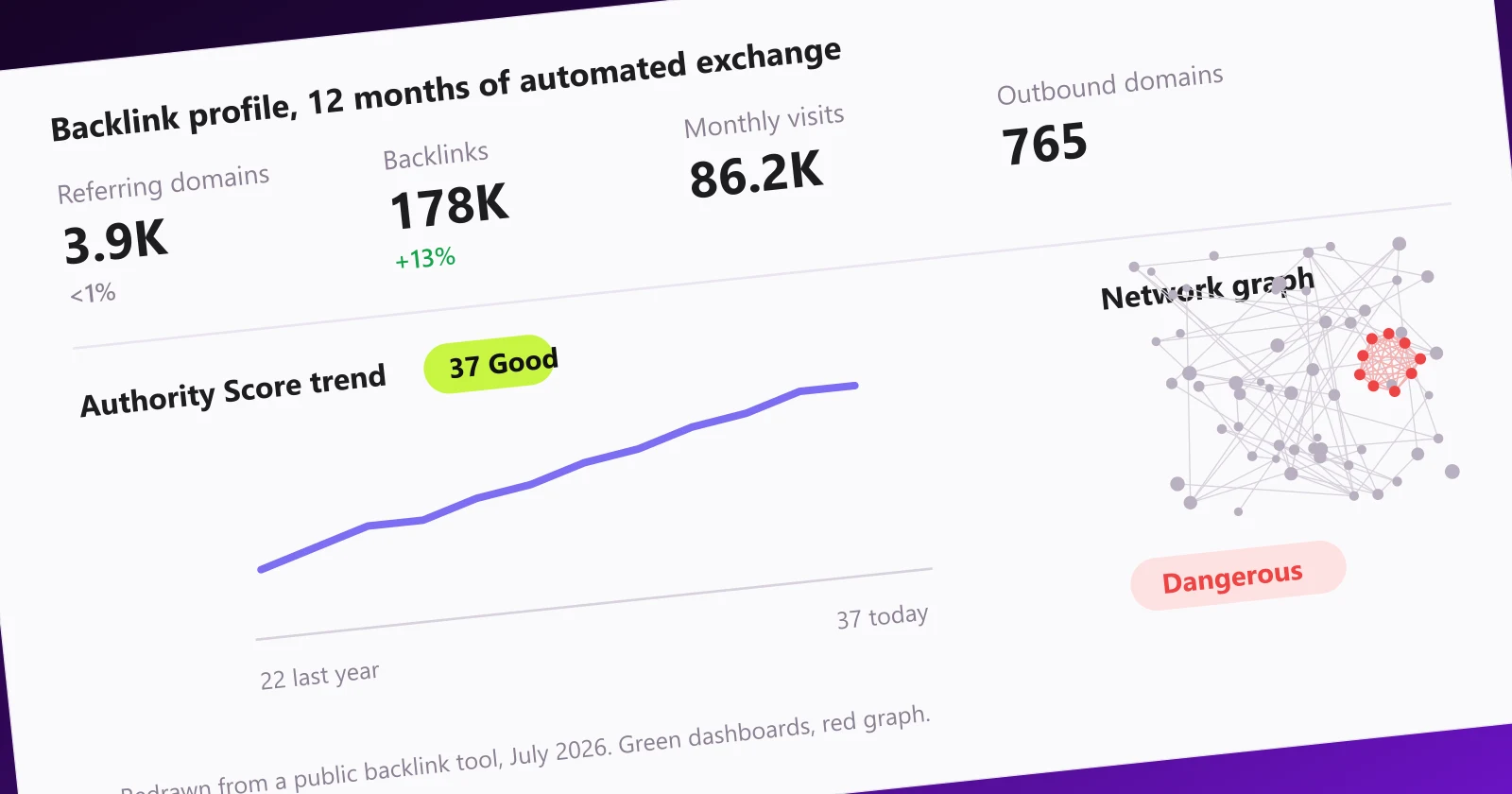
We pulled the backlink profile of one fast-growing platform in this category, an AI content tool with a built-in automatic backlink exchange, into a standard backlink analysis suite. The result is the clearest illustration we have seen of how this model behaves: every headline metric green, and one panel bright red.
The dashboard everyone screenshots
Taken one metric at a time, the profile looks like a success story:
- Authority score 37, up from 22 in twelve months, labeled Good by the tool
- 86.2K monthly visits, with about 41.8K organic
- Backlinks growing 13% month over month
- Customer testimonials reporting DR jumps and doubled traffic
And the customers are not wrong to be happy. This is the part worth being honest about: the satisfaction is real, and it comes from the automation itself. Link building is the most hated chore in SEO. A product that removes the chore entirely, and shows a rising chart while doing it, delivers exactly the feeling people are paying for. Nobody churns from a dashboard that goes up on its own.
The number nobody screenshots
Now read the same profile the way a link spam system reads it.
178K backlinks from 3.9K referring domains. That is roughly 46 links per linking domain. Natural editorial links do not look like this; one site cites you once or twice. Dozens of links from the same domain means sitewide placements or links inserted automatically into article after article, which is precisely what an auto-insertion exchange produces.
765 outbound domains. The platform's own site links out to hundreds of member domains, because that is how the exchange pays its members. The hub itself is part of the pattern.
Network graph: flagged Dangerous. This is the panel that matters. The tool draws the site's neighborhood and finds a dense cluster of domains that all link to each other, the red knot in the visual above. A natural link neighborhood is a loose cloud: your links come from sites that mostly have nothing to do with each other. A closed exchange produces the opposite, a tight community where members' link profiles overlap heavily, because they all draw from the same pool.
Why automated reciprocity always ends up here
This is not an implementation bug that a smarter rotation algorithm fixes. It is the geometry of the model.
When links are exchanged automatically inside one member pool, every member's links come from other members. Rotate the assignments however you like, A to B, B to C, C to A, the aggregate graph is the same: a closed, densely interconnected community that barely touches the rest of the web. Google has been mapping exactly this shape since the link wheel and blog network era, and its link spam systems work at the graph level, not the individual link level. They do not need to catch any single link being unnatural; they catch the neighborhood.
There is a second structural problem: you cannot vet what you automate away. When links are inserted into machine-generated articles at scale, no human asks whether the linking page is relevant, whether the site has real traffic, or whether it also links to casinos. The pool's quality converges downward, and every member inherits the whole pool's reputation. That is how a member with a clean site ends up with a red cluster in their own graph.
The satisfaction lag
The uncomfortable part is the timeline. Schemes like this do work at first, which is why the testimonials are genuine. But link devaluation is silent: when a cluster is identified, the links inside it simply stop passing value. No penalty notice, no alert, just a dashboard that plateaus and then bleeds, weeks or months after the pattern was flagged. The customers are satisfied on a lag. By the time the chart turns, they have often built a year of their SEO on links that no longer count, and the cleanup costs more than the links ever earned.
If you are evaluating any link platform, this is the test to run: put the platform's own domain into a backlink tool and look at the network graph panel, not the authority score. The graph tells you what you are joining.
What automation should automate
None of this is an argument against automation. It is an argument about which step you automate. The grind that makes people love automatic tools, finding partners, screening them, chasing placements, checking links, all of that is safe to automate and should be:
- Matching: surfacing sites in your category and topic automatically
- Screening: filtering out competitors and toxic domains, link farms, bad neighborhoods, casino and adult content
- Outreach: pre-drafted messages you approve and send
- Verification: checking that every placed link is live, indexed and dofollow, forever
The one step that must never be automated into a closed loop is reciprocity. That is the entire design principle behind how Meeeters works: you place a link for one member, and a different member links to you. You never link back to whoever links to you, so no reciprocal pair exists and no closed cluster forms. You approve every match yourself, the network screens who gets in, and the safety comes from relevance and real traffic, not from the exchange being clever.
Same automation, same removal of the grind, opposite graph.
The takeaway
Happy customers and a rising authority chart tell you a product delivers a feeling. The network graph tells you what it deposits in your link profile. When everything is automatic, including the reciprocity, the graph turns red sooner or later, and the dashboard follows it down. Automate the chore, keep the links flowing one way, and check the graph of anything before you join it.
Frequently asked questions
Quick answers to the questions people ask most about this topic.
A map of which domains link to which. Backlink tools draw your site and its neighbors as dots and links. A natural profile looks like a loose cloud; a scheme looks like a dense cluster of sites that all link to each other.
Because every member links to other members from the same pool. However the rotation is arranged, the result is a closed, densely interconnected community in the link graph, which is exactly the shape link spam systems are trained to find.
It is working right now. Devaluation is silent: when a scheme is caught, the links simply stop counting, and the dashboard decays weeks or months later. Rising numbers today do not certify that the links will keep their value.
Yes, for the right steps: finding relevant partners, screening out toxic domains, drafting outreach and verifying that placed links stay live and dofollow. The step that must not be automated into a closed loop is reciprocity, links should flow one way.

I built Meeeters to make link building safe and simple: real, relevant backlinks with no reciprocal footprint and no black-hat shortcuts. Questions about your site? Write to me directly.
Email us