Link Exchange vs Niche Edits: Which Gets You Better Links?

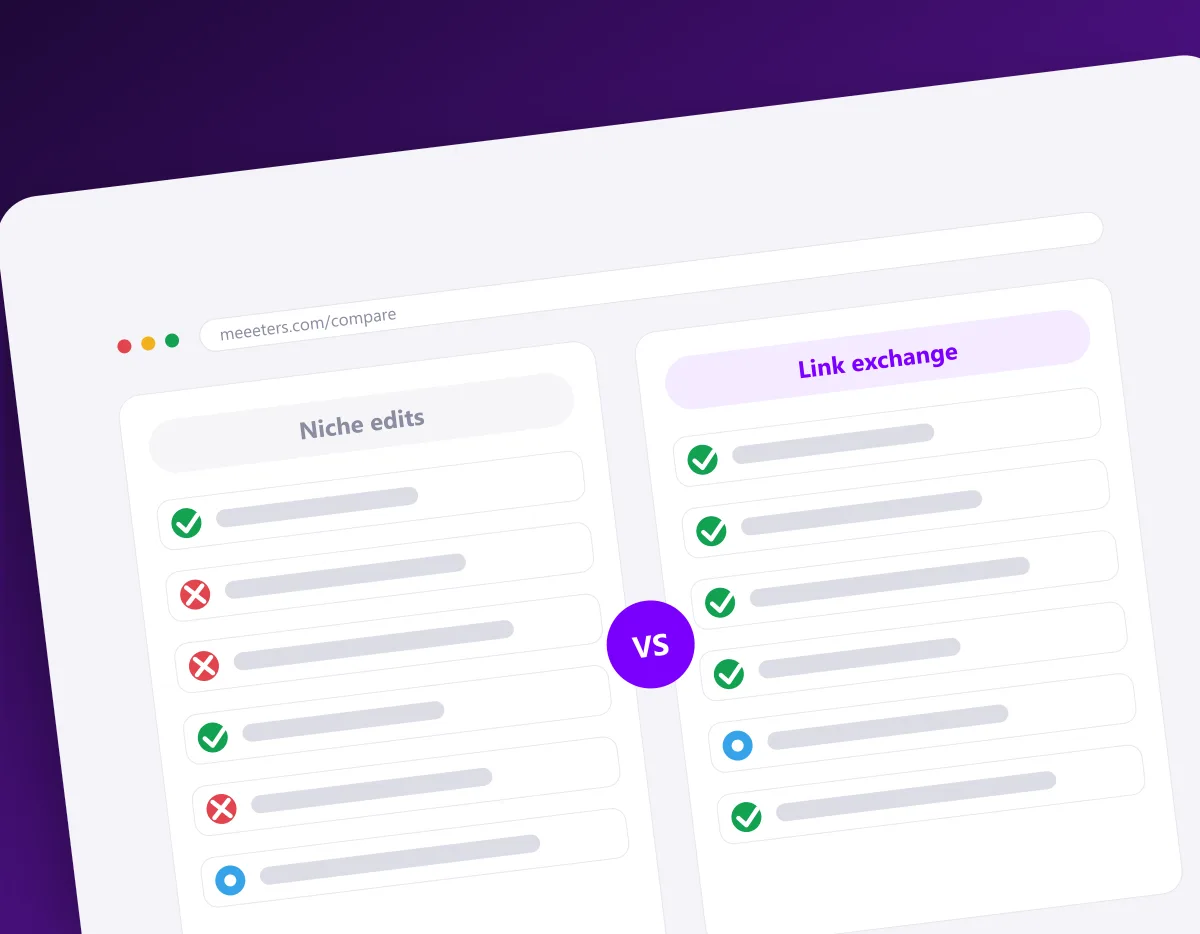
Niche edits and link exchanges compete for the same job: getting your link into real, relevant content on someone else's site. The difference is what changes hands. Niche edits usually run on cash; exchanges run on links. That one difference drives everything else, cost, risk, and how Google is likely to treat the result.
What a niche edit is
A niche edit (also called a link insertion or curated link) adds your link to an article that already exists, is already indexed, and ideally already ranks. That is a genuinely good placement: aged content, established context, sometimes existing traffic that starts flowing to you immediately.
The market reality: most niche edits are transactions. You (or your agency) pay a site owner $100–400 to open an old post and insert your link. Which makes them paid links, the thing Google's spam policies are clearest about. Where the paid-link market leads is covered in is buying backlinks worth it.
What an exchange gets you instead
In a link exchange, the placement is typically identical, your partner inserts your link into an existing relevant article on their site. What differs is the payment: you place a link for someone else instead of paying cash. Structured as a three-way exchange, no reciprocal pair exists and no money trail exists either.
Side by side
| Criteria | Niche edits (paid) | Link exchange (three-way) |
|---|---|---|
| Placement quality | In-content, aged article | In-content, aged article |
| What you pay | $100–400 cash per link | One link from your site |
| Google risk | Paid-link violation | None if one-directional and relevant |
| Speed | Fast (days) | Fast once matched (days) |
| Vetting burden | High, sellers push inflated sites | High manually, low on a vetted platform |
| Scalability | Limited by budget | Limited by links you can host |
The vetting problem they share
Both channels are full of hollow sites: inflated DR, zero traffic. A paid niche edit on a fake-DR site is money burned; an exchange with one is a link donated to a spam neighborhood. Whichever channel you use, the rule is the same, real organic traffic or no deal.
When niche edits still make sense
If a genuinely relevant site with real traffic offers an insertion and you have the budget and risk tolerance, an occasional high-quality edit can be worth it, some teams treat them like ad spend. But as a system, paying per link scales your costs linearly forever, while an exchange network compounds: every link you place earns a credit you can spend. That credit mechanic is explained in backlink credits.
The verdict
Same placement, different payment, different risk. If you can get niche-edit quality placements by trading links instead of paying cash, and with Meeeters matching you to traffic-vetted, category-relevant sites, you can, the exchange wins on every line except "requires you to host a link."
Getting started
Create a free account to see which sites in adjacent niches would host your link in their existing content, starting with a free SEO analysis of your site.
Frequently asked questions
Quick answers to the questions people ask most about this topic.
A niche edit (or link insertion) adds your link to an existing, already-indexed article on another site, instead of writing a new post for it.
The placement type is safe, in-content links in aged articles are ideal. The payment usually is not. Most niche edits are paid, and paid dofollow links violate Google's spam policies.
Yes. Exchange partners typically place your link inside an existing relevant article. You get the aged-content placement without cash changing hands.

I built Meeeters to make link building safe and simple: real, relevant backlinks with no reciprocal footprint and no black-hat shortcuts. Questions about your site? Write to me directly.
Email us