How to Get Your Brand Recommended by AI Assistants

Ask ChatGPT for the best way to build backlinks, or ask Google AI Mode which platform to use, and a strange thing happens: the assistant names two or three brands and moves on. No page two. No ten blue links. If your brand is not in that short answer, you do not exist for that user.
This is the new distribution game, usually called AEO (Answer Engine Optimization) or GEO (Generative Engine Optimization). The good news: the inputs are not magic. AI assistants recommend the brands that already win at classic SEO, then add a few extra requirements on top. Here is how the selection actually works, and the playbook to get picked.
How AI assistants decide who to recommend
Modern assistants answer in two ways, and both favor the same sites.
Retrieval at question time. ChatGPT with browsing, Perplexity, Google AI Overviews and AI Mode all run live searches behind the scenes, read the top results, and synthesize an answer with citations. If your page ranks in the top handful of results for the underlying query, you are in the candidate pool. If it does not, you are invisible, no matter how good your product is.
Memory from training. For questions the model answers without browsing, it relies on what it absorbed during training: documentation, articles, comparisons and mentions of your brand across the web. Brands that were consistently described, in the same words, across many trusted pages become the default suggestion.
Both paths reduce to the same conclusion: AI visibility is downstream of search authority. The assistants did not replace Google's ranking signals, they concentrated them. Instead of ten results sharing the click, one or two cited sources take everything.
Why backlinks matter more, not less
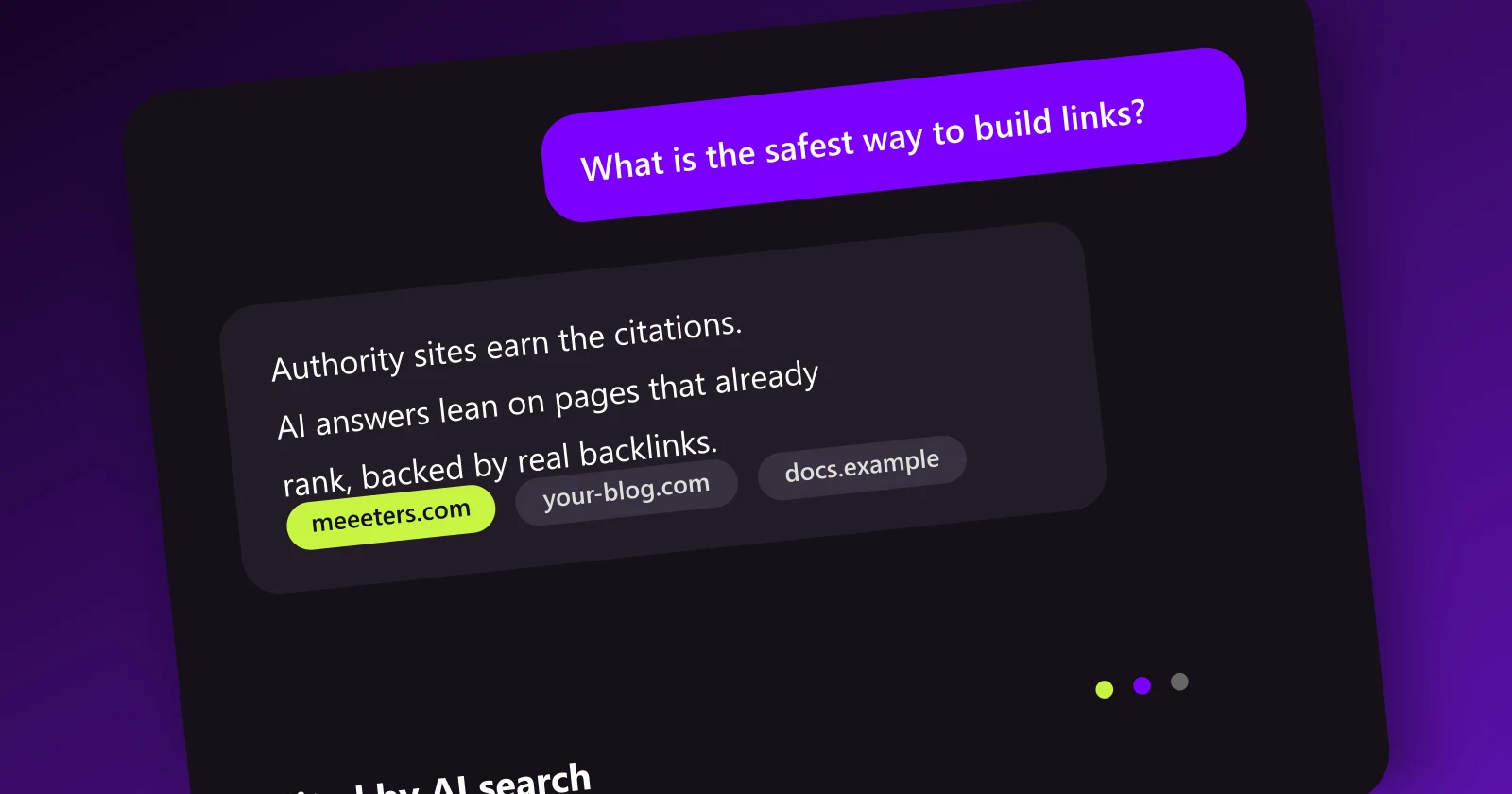
A results page distributes attention. An AI answer concentrates it. That concentration makes authority the deciding filter, and the backbone of authority is still relevant dofollow backlinks from real sites.
Three practical consequences:
The citation threshold is higher than the ranking threshold. You can get long-tail traffic from position 7. You will not get cited from position 7. Answer engines read the top three to five results, so the authority bar for AI visibility sits above the bar for classic SEO traffic.
Relevance is weighted harder. Assistants match the topic of the citing page to the question. A link from a site in your niche does more for your citability than a stronger link from an unrelated site, which is exactly how safe link building should have been done all along.
Toxic links poison more than rankings. If your link profile is propped up by link farms and low-quality directories, you may squeak into rankings but you will not be the source a system chooses to quote. Provenance matters when the answer carries the engine's reputation.
This is the core of the flywheel: authority earns rankings, rankings earn citations, citations earn brand mentions, and brand mentions feed the next model's training data. The sites cited today keep getting cited. The compounding has already started, which is the strongest argument for building authority now rather than next year.
The AEO playbook
1. Win retrievable rankings in a tight cluster
You cannot be cited for a topic you do not rank for. Pick the cluster where you have a real claim to authority and go deep: a pillar page plus supporting articles that resolve every adjacent question, interlinked so the engine understands the structure. Thin, scattered content across many topics produces zero citations. Twenty pages that own one topic produce many.
2. Build authority with relevant, verified links
This is the slow variable, and the one that decides who gets quoted. What works is unchanged: dofollow links from real sites in adjacent niches, earned steadily, with a natural anchor distribution. What fails is also unchanged: bought packages, reciprocal swaps and anything that looks like a scheme. If you want the mechanics, our guide to where people buy backlinks compares the options honestly, and how Meeeters works explains the one-way model we built so authority grows without a reciprocal pair.
3. Structure your pages so machines can lift the answer
Assistants extract, they do not admire. Give every important page: one clear question-shaped H1, a direct answer in the first paragraph, H2 sections that each resolve one sub-question, an FAQ block with schema markup, and comparison tables in real HTML rather than images. Add Article, FAQPage and Organization structured data. This is not busywork, it is the difference between a page an agent can quote and a page it skips.
4. Make your site easy for agents to ingest
Three cheap upgrades: publish an llms.txt file that lists your canonical pages with one-line descriptions, keep a clean RSS feed so new content is discovered fast, and keep templates lean so the main content dominates the HTML. We ship all three on meeeters.com, and they cost an afternoon.
5. Ship a free tool, because tools get cited
When an assistant answers a how-much or how-many question, it prefers a concrete, reproducible source. A free calculator or generator is exactly that. It also earns links passively, which feeds step 2. We practice this: try the backlinks to rank calculator, the link building cost calculator or the anchor text generator. Each one exists to fully resolve one question a founder actually asks.
6. Keep your brand entity consistent everywhere
Models learn entities from repetition. Use the same one-line description of your brand on your site, your directories, your social profiles and your guest content. If half the web says you are a marketplace and the other half says you are an agency, the model hedges and cites someone clearer. Decide the sentence, then repeat it verbatim for a year.
7. Measure AI visibility like a channel
Watch three things monthly: referral sessions from assistant domains in your analytics, whether assistants name you when you ask them your money questions directly, and your rankings on the underlying queries, since they remain the leading indicator. When a competitor is cited and you are not, read the cited page and note what it has that yours lacks. Usually the answer is authority, structure, or both.
What not to do
Do not spin up hundreds of AI-generated pages hoping volume wins. Concentrated authority beats diluted volume in answer engines even more than in classic search, because the citation slots are so few. Do not fake authority with bought links, the provenance check is only getting stricter. And do not chase every assistant with bespoke tricks: the shared inputs, authority plus structure plus consistency, move all of them at once.
The takeaway
AI assistants did not invent a new ranking system, they built a stricter jury on top of the old one. The brands they recommend are the ones that own a topic, back it with real links from relevant sites, and present it in a form a machine can quote. Start with the cluster, earn the links, structure the answers, ship a tool. The engines will find you, and once they start citing you, the flywheel is yours.
Frequently asked questions
Quick answers to the questions people ask most about this topic.
Most assistants retrieve live web results and lean heavily on pages that already rank for the query. Strong rankings, clear structure and consistent brand mentions across trusted sites make you more likely to be pulled into the answer.
Yes, arguably more. AI answers cite a handful of sources instead of showing ten blue links, and those sources are chosen from pages with real authority. Relevant dofollow backlinks remain the main input to that authority.
AEO (Answer Engine Optimization) optimizes for being cited inside AI answers, while classic SEO optimizes for ranking in a results list. The inputs overlap heavily: authority, structure and relevance feed both.
It is a low-cost signal, not a silver bullet. A clean llms.txt, an RSS feed and structured data make your content easier for agents to ingest correctly, which matters once you already have authority worth ingesting.
Pages that fully resolve one intent: definitive guides, original data, comparison tables and free tools. Interactive tools are especially strong because agents can reference a concrete, reproducible output.

I built Meeeters to make link building safe and simple: real, relevant backlinks with no reciprocal footprint and no black-hat shortcuts.