Referring Domains vs Backlinks: The Difference (and Which to Grow)

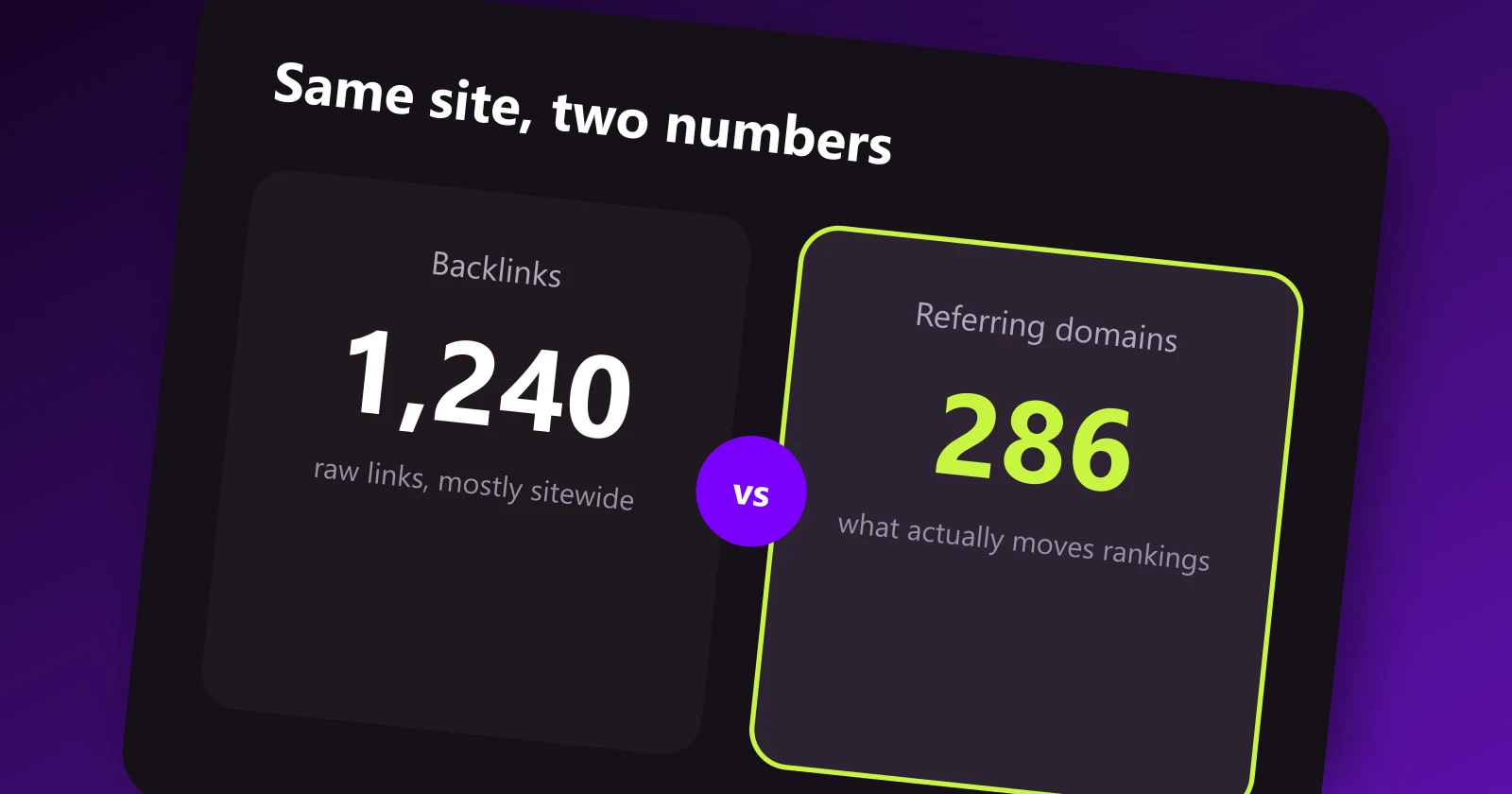
Open any backlink tool and you will see two numbers side by side: backlinks and referring domains. On most sites they are wildly different. We regularly analyze sites through Meeeters that show 15,000 backlinks and 90 referring domains, and their owners almost always quote the first number, because it is bigger and feels better.
It is also the wrong number. Of all the metric confusions in SEO, this one has the most direct impact on strategy, because the two numbers suggest opposite plans. Chasing backlinks leads you to squeeze more links out of sites that already link to you. Chasing referring domains leads you to win over new sites. Only one of those correlates with rankings. Let us take it from the definitions.
The definitions, with a concrete example
A backlink is a single hyperlink from a page on someone else's website to a page on yours. Every individual instance counts once. Page A links to you twice? Two backlinks. If you want the full anatomy of one, we broke it down in what is a backlink.
A referring domain is the unique website at least one of those backlinks comes from. However many links a site gives you, it counts as exactly one referring domain.
Concrete example. Say three things happen to your site this month:
- A niche blog mentions your guide in one article. 1 backlink, 1 referring domain.
- An industry partner adds you to their "recommended tools" sidebar, which renders on all 800 pages of their site. 800 backlinks, 1 referring domain.
- A journalist cites your data in a news piece. 1 backlink, 1 referring domain.
Your tool now reports 802 new backlinks and 3 new referring domains. Which number described what actually happened? Three websites decided you were worth linking to. That is the real event, three independent editorial decisions made by three separate humans. The 800 is a rendering artifact of one of those decisions, repeated by a template.
Why 1,000 backlinks can equal 1 referring domain
The sidebar case above is the classic one, and it is worth understanding the mechanics because it explains most of the inflated numbers you see.
Websites have templates. Anything placed in a template element (sidebar, footer, header, blogroll) appears on every page that uses the template. Crawlers index each page separately, and each page's copy of the link is technically a distinct backlink. So one webmaster's single decision, made once, in one CMS widget, produces:
- 1,000 backlinks if the site has 1,000 pages
- 2,000 backlinks after the site doubles its archive
- 0 backlinks the day they redesign and the widget disappears
That last line matters: sitewide links also vanish sitewide. Profiles heavy on sitewide links live on a cliff edge, one redesign away from "losing" thousands of links overnight, which is one of the most common false alarms in link monitoring.
Google understood template links decades ago. Its systems distinguish boilerplate links from editorial ones, and repeated links from a single domain are largely consolidated toward a single vote. Nobody outside Google knows the exact dampening, but every serious experiment and every ranking study points the same direction: the 800th link from one domain moves approximately nothing.
Diminishing returns: the second link from the same site
Even outside sitewide templates, repeat links from one domain follow a steep curve of diminishing returns.
Think of links as votes. The first time a relevant site links to you, it casts a vote: an independent publisher, with its own audience and its own authority, endorses your page. Powerful signal. The second link from the same site is the same voter raising their hand again. There is some incremental value, a second link can pass equity to a different page of yours, from a different context, and that is legitimately useful for spreading authority across your site. But it is a fraction of the first link's value, and the fifth link from that domain is a fraction of a fraction.
Rough mental model, at the level of precision SEO deserves:
- Link 1 from a domain: full value. A new independent endorsement.
- Links 2-3: worthwhile if they point to different pages with different, natural anchors.
- Links 4-10: marginal. Fine when organic, pointless to pursue.
- Links 11+: noise. If you are asking a friend's site for an eleventh link, the time was better spent anywhere else.
This is why "get more links from sites that already love us" feels productive and is not. The outreach is easy precisely because the value is spent.
What actually correlates with rankings
Every large-scale ranking study of the last decade, across Ahrefs, Backlinko, Semrush and others, lands on the same finding: referring domain count correlates with rankings more strongly than raw backlink count. Pages that rank #1 do not merely have more links, they have links from more unique websites than the pages below them.
The intuition holds up from first principles too. PageRank-style systems measure endorsement across the web's graph. Fifty independent sites endorsing you is evidence distributed across fifty nodes of the graph, fifty editorial decisions, fifty audiences. Five thousand links from three sites is three decisions wearing a costume.
Correlation is not a quota. The actual number you need depends entirely on your keyword's competition, which is why the practical method is competitive: pull the referring domain counts of pages currently ranking for your target query and treat that range as the bar. We walked through that exercise, with realistic numbers per difficulty tier, in how many backlinks you need to rank.
One necessary nuance: domain diversity only counts when the domains are real. A hundred referring domains from scraper sites and directories is diversity in name only. The correlation studies measure profiles dominated by genuine sites, and quality gates everything: relevance, real organic traffic, editorial placement. Diversity is the multiplier, not the substitute.
How tools count them differently
Comparing numbers across tools confuses everyone eventually, so here is why the same site shows different counts everywhere:
| Tool behavior | What it means for your numbers |
|---|---|
| Index size and crawl freshness | Each tool (Ahrefs, Semrush, Majestic, Moz) runs its own crawler. Bigger index = more links found, including more junk. Numbers are never comparable across tools. |
| Live vs historical links | Some views count only links seen alive at last crawl; historical views include dead ones. Check which mode your report is in before panicking or celebrating. |
| Subdomain handling | blog.site.com and site.com: one referring domain or two? Tools differ, and settings change the split. |
| Deduplication rules | Some tools collapse multiple links from one page, some count each anchor separately. |
| Nofollow inclusion | Counts typically include nofollow links; the ratio hides behind a filter. Worth splitting, since they pass different value, as covered in dofollow vs nofollow. |
| Google Search Console | Shows a sample of what Google knows, capped exports, no dofollow labels. Different number again, but the only first-party one. |
Practical rules: pick one tool and track your trend inside it, never compare absolute numbers across tools, and use referring domains as the headline metric in whichever tool you use, since it is the most stable of the counts. Our backlink checker comparison covers which tool fits which budget.
How to check your own numbers, step by step
Ten minutes, free options included:
- Pull the free baseline from Google Search Console. Links report, "Top linking sites" is your referring domains list, and the total links figure sits above it. If GSC is not set up, our Search Console guide gets you verified in minutes.
- Or pull both numbers from a backlink tool. Every major tool shows backlinks and referring domains side by side on the overview screen. Free tiers cover this level of detail.
- Compute your ratio. Backlinks divided by referring domains. Note it somewhere; the trend matters more than today's value.
- Identify your sitewide sources. Sort referring domains by number of links. Any domain sending you hundreds or thousands of links is a template placement. Two or three of these usually explain the whole gap between your two numbers.
- Count your real domains. Skim the referring domains list and mentally strike the scrapers, stat aggregators and domain-info sites. What remains, sites with actual audiences, is your true count, and for most sites it is sobering. This is the number competitive analysis should use.
- Set the tracking habit. Once a month, note new referring domains gained and lost. That single row of numbers tells you more about your link building than any dashboard.
The fuller version of this exercise, with quality scoring per domain, is the backlink audit process. But even the ten-minute version reframes most people's understanding of their own profile.
Four profiles, decoded
Real patterns we see in analyses, and what each one actually means:
"120,000 backlinks, 200 referring domains." A widget, a badge program or a handful of footer credits. The six-figure number is three template decisions. Strategy: ignore the big number entirely, evaluate the 200 domains for quality, and start growing that count with editorial placements.
"900 backlinks, 850 referring domains, DR jumped last month." Near 1:1 at speed is rarely organic. Check the new domains: if they are comment pages, expired-domain blogs and profile links, someone bought a package (perhaps a previous owner, perhaps an overenthusiastic freelancer). The inflated metric will not hold, and metrics inflated this way never do.
"70 backlinks, 45 referring domains, five years old." A quiet honest profile. This site's problem is not quality, it is volume of real endorsements. Every hour should go into earning first links from new relevant domains, and competitive gap analysis will list exactly which ones.
"3,000 backlinks, 400 referring domains, half the domains inactive." A profile with history: links earned over years, many now rotting on dead pages. The cheapest wins here are reclamations of formerly live links before chasing anything new.
The common thread: the backlink number never changed a single decision. The referring domain list, its quality and its trend decided everything. When you evaluate your own profile, or anyone else's, train yourself to skip the first number entirely and ask three questions in order: how many domains, how many of them are real, and is the count growing.
What a healthy ratio looks like
There is no official ideal ratio of backlinks to referring domains, but after enough audits the patterns are readable:
- Roughly 2:1 to 10:1 (backlinks to referring domains): typical healthy profile. Sites naturally pick up a few extra links from some domains, plus a couple of small sitewide placements.
- 20:1 to 100:1 and beyond: dominated by sitewide links. Not a penalty pattern by itself, footer credits and partner widgets exist legitimately, but the profile is more fragile and the impressive backlink number is mostly air.
- Near 1:1 at scale: thousands of domains each linking exactly once can be natural (viral content, news syndication) but at low quality it is also the fingerprint of comment spam packages. The ratio raises the question; the domain quality answers it.
The ratio is a diagnostic, not a target. You never optimize the ratio itself; you read it to understand what your headline numbers are made of, which is exactly the exercise in the audit process linked above.
One more reading tip: check the ratio per page, not just per site. If your homepage holds 95% of your backlinks and your money pages have two referring domains each, the profile is top-heavy, and the pages that need to rank are the ones starving. Deep links, links pointing at specific internal pages, are consistently the scarcest and most valuable kind, and a domain that links to one of your guides is often more useful than another generic homepage mention.
The practical implications for your strategy
Everything above compresses into one strategic sentence: spend your link building effort on domains that have never linked to you, and spend nothing on squeezing more links out of domains that already have.
What that looks like in practice:
- Change your dashboard metric. Track new referring domains per month, not total backlinks. The moment you change the metric, your instincts about where to spend outreach time fix themselves.
- Stop over-farming friendly sites. The partner who already links to you three times is a relationship to maintain, not a link source to milk. The fourth link is worth close to nothing; the awkwardness of asking is real.
- Study who links to your competitors but not to you. This is the highest-signal prospect list that exists: domains that demonstrably link to sites like yours. The step-by-step version is in how to check competitor backlinks, and the gap report (domains linking to two competitors but not you) is the single best outreach list in SEO.
- Prefer editorial placements over template placements. One in-content link from a relevant article beats a sidebar link on the same site: more context, more clicks, and it survives redesigns.
- Diversify domain types gradually. Blogs, industry publications, tool roundups, local sites, partners. A profile where every referring domain is the same type of site is weaker than the same count spread across types.
- Verify your new domains are real. Before celebrating a new referring domain, check it has organic traffic and a human audience. Ten real new domains a quarter beat a hundred scraper entries, and this quality bar is the difference between diversity that ranks and diversity that decorates a report.
How fast should referring domains grow?
Once you track the right metric, the next question is pace. There is no universal quota, but there are honest reference points.
For a small site doing consistent, manual link building, two to five new relevant referring domains per month is a realistic, sustainable rate. That sounds modest next to the numbers agencies pitch, but run the compounding: 36 to 60 new real domains a year transforms the competitive position of most small sites, because their competitors are usually not doing the work at all.
Three principles matter more than the exact number:
Consistency beats bursts. Ten new domains every month for a year reads like a site earning attention. A hundred and twenty domains landing in one month, then silence, reads like a campaign, and it is the kind of velocity spike worth explaining in an audit. Natural profiles grow like audiences do: steadily, with occasional peaks tied to visible events like a launch or a piece of press.
Match the pace to your content. Referring domains follow linkable moments. A site publishing original data quarterly has a reason to gain 30 domains in a good month. A five-page local services site does not, and forcing that pace means buying it, with everything that implies.
Never sacrifice the quality gate for the count. The month you start counting scrapers and directories to hit a target is the month the metric stops meaning anything. Keep the bar where it started: real site, real traffic, relevant to your niche, editorial placement. A month with two links that clear the bar beats a month with twenty that do not.
And measure against your actual competition, not against ambition. If the sites ranking for your money keywords have 80 referring domains and you have 30, the gap is 50 real domains, and at four a month that is a one-year project. Knowing that number turns link building from an anxiety into a plan.
How Meeeters optimizes for exactly this
This distinction is baked into how we built Meeeters, because the whole point of the network is to grow the number that matters.
Meeeters finds you a dofollow backlink from a relevant, traffic-vetted network member, and the matching deliberately routes it as a new referring domain: a site that is not one you already link to, and in practice a site that has not already linked to you, because a repeat domain would add diminishing returns. Every link is editorial and in-content rather than template-based, and each one is verified over time: page live, link present, dofollow intact. No reciprocal links, no PBNs or spammy sites.
One backlink, one new relevant referring domain. That is the metric-honest version of link building, and it is the opposite of the 15,000-backlinks-from-90-domains profile we opened with.
If you want to know your real numbers, both of them, run a free SEO analysis: it shows your referring domains as they stand, and your first placement in the network puts your first new verified domain in motion.
Frequently asked questions
Quick answers to the questions people ask most about this topic.
A backlink is one individual link from a page on another site to yours. A referring domain is the unique website those links come from. If a blog links to you from 500 pages via its sidebar, that is 500 backlinks but only 1 referring domain.
Referring domains. Ranking studies consistently find domain diversity correlates with positions much more strongly than raw link counts, because each new domain is an independent vote while repeat links from the same domain add steeply diminishing value.
It depends entirely on the keyword. Check the referring domains of the pages currently ranking for your target query and aim for that range with more relevant, higher-quality domains. For low-competition keywords that can be under 10; for competitive commercial terms it can be hundreds.

I built Meeeters to make link building safe and simple: real, relevant backlinks with no reciprocal footprint and no black-hat shortcuts.
Related searches, answered
What people actually type before landing here, with the short answer and where to read more.
- Referring domains
- A referring domain is one website linking to you, however many times it does so.What a backlink is ›
- What are referring domains used for?
- They are the growth number to track: 50 links from one site are worth less than 5 links from five sites.Measuring link building ›
- Domain backlinks
- Total backlinks inflate easily through sitewide footers and templates, which is why the raw count misleads.How DR gets inflated ›
- What is a referring domain in SEO?
- It is the unit almost every authority score is built on, including domain rating.What a good domain rating is ›
- How many referring domains do you need?
- Enough to match the pages already ranking. That number is a competitive one, not an absolute.An honest answer ›
- Do more referring domains always help?
- Only when they are relevant. Twenty domains from your niche beat two hundred from unrelated directories.Finding relevant partners ›