Linkable Assets: 9 Content Types That Actually Earn Backlinks

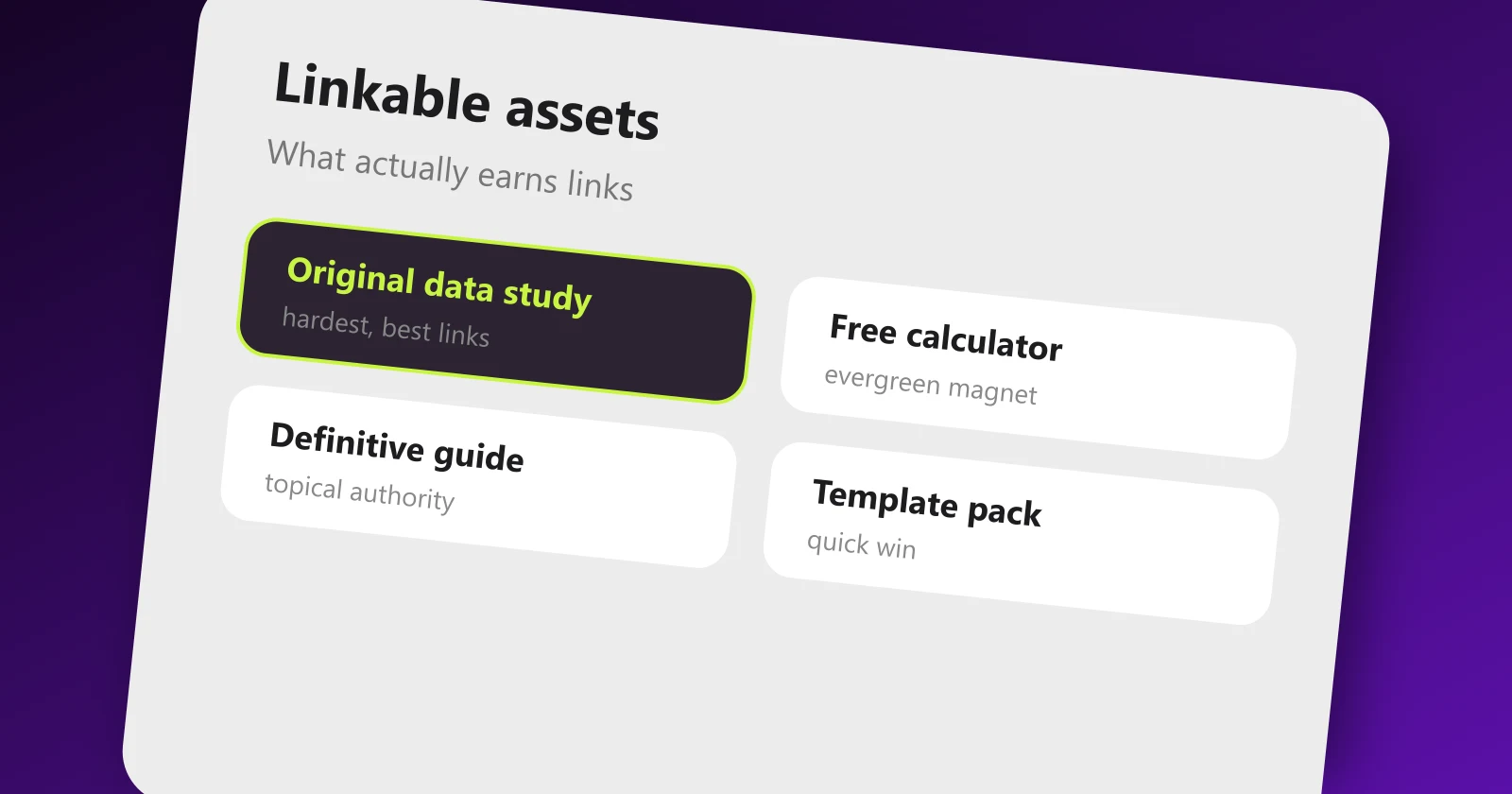
Ask a hundred site owners where they want backlinks and most will point at their product pages, pricing page, or homepage. Ask where their existing backlinks actually land and the answer is almost always somewhere else entirely: a statistics roundup, a free tool, a guide someone wrote three years ago that still gets cited monthly.
That gap is the whole game. Links flow to pages that help other writers do their job, and almost never to pages that ask for money. The pages that attract links are called linkable assets, and building the right one is the difference between link building as a grinding outreach chore and link building as something that partly runs itself.
We have built assets for our own projects, watched what earns links across the sites in the Meeeters network, and studied the backlink profiles of hundreds of domains. This guide covers why commercial pages fail, the nine asset types that work with honest difficulty ratings, how to choose based on what you actually have, and why creation is only half the job.
Why product pages do not earn links
Start with the failure mode, because understanding it explains everything that follows.
When a blogger, journalist, or editor links out, they are spending credibility. Every outbound link is an implicit statement to their readers: this is worth your click. Links to data, definitions, and tools make the writer look rigorous. A link to your pricing page makes the writer look paid. So editors do not place it, and when they do, readers discount it.
There is a second, more mechanical reason: product pages give a writer nothing to cite. A citation needs a citable element, a number, a chart, a definition, a method, a tool. Product pages contain features and calls to action, neither of which strengthens anyone else's article. This is why cold outreach pitching commercial pages converts near zero, a pattern we see constantly in campaigns compared across our methods comparison.
The strategic answer is not to abandon your money pages. It is to build assets that earn the links, then route that authority to money pages through internal linking. The asset is the antenna, internal links are the wiring.
The 9 linkable asset types, rated
Here is the full landscape. Difficulty covers time, skill and budget to build. Link potential reflects referring domains a well-executed, well-promoted version typically earns in its first year, based on published studies and profiles we have analyzed.
| # | Asset type | Difficulty | Link potential | Best for |
|---|---|---|---|---|
| 1 | Original data / statistics pages | Medium | Very high | Any niche with numbers |
| 2 | Free tools / calculators | High | Very high | SaaS, finance, health, trades |
| 3 | Definitive guides | Medium | High | Expertise-heavy niches |
| 4 | Visualizations / maps | Medium-High | High | Data-rich, visual topics |
| 5 | Templates / checklists | Low | Medium | B2B, productivity, operations |
| 6 | Industry surveys | High | Very high | B2B with an audience |
| 7 | Glossaries | Low | Medium | Technical, jargon-heavy niches |
| 8 | Comparison matrices | Low-Medium | Medium | Software, services, products |
| 9 | Contrarian research | Medium | High | Niches full of received wisdom |
Now each one in detail.
1. Original data and statistics pages
The reigning champion. A page that aggregates or produces statistics on your topic, kept current, becomes the citation of record. Every writer covering the topic needs a number, and every number needs a source link. That is a permanent, renewable source of links.
Two viable builds. The aggregation route: collect scattered statistics from studies and reports into one organized, sourced page, like "47 email marketing statistics for 2026". Cheaper, still effective. The original route: publish numbers only you have, from your product data, your customer base, or your own analysis. Far stronger, because you are the primary source and every citation must point at you.
Execution details that multiply results: one statistic per line in copyable form, a clear methodology note, a last-updated date, and an update pass every 6 to 12 months. Stale statistics pages decay, maintained ones compound.
2. Free tools and calculators
The highest ceiling in the list. A genuinely useful free tool, a mortgage calculator, a salary benchmarker, a code formatter, an ROI estimator, earns links for years because it delivers ongoing utility rather than one-time information. Resource pages love tools, forums recommend them, and guides embed links to them as a service to readers.
The difficulty rating is honest: you need development time, and the tool must be actually good. A janky calculator earns nothing. The scoping trick is to solve one narrow calculation completely rather than building a Swiss army knife. Narrow tools also match specific search queries, so they rank on their own and earn links from people who found them organically, no pitch required.
If you have engineering capacity, this is usually the best hours-to-links conversion available. If you do not, skip it rather than shipping something half-working.
3. Definitive guides
The classic 10x resource: the single most complete, most current treatment of a topic that matters in your niche. When it genuinely is the best available, it accumulates links as the default reference, the page people send beginners to, the "further reading" link at the bottom of a hundred articles.
The honest warning: this category is the most saturated, because it was the default recommendation of a decade of content marketing and the Skyscraper Technique industrialized it. A definitive guide works in 2026 only if it contains things a competent writer with an AI assistant cannot produce: first-hand experience, original examples, real numbers, expert input. Length alone earns nothing anymore.
Choose a topic with proven link demand, verify with a backlink checker that existing guides on it have referring domains, then beat them on substance, not word count.
4. Visualizations and maps
Take data that exists as tables and make it visible: an interactive map of costs by region, a timeline of industry consolidation, a chart pack of adoption trends. Visual assets earn links for a distinctive reason: writers embed or reference them to make their own articles more engaging, and each embed carries an attribution link.
Maps deserve special mention because they attract regional coverage. A "cost of X by state" map can earn links from dozens of local outlets, each covering their own region's number. That multiplication effect is hard to get any other way.
The difficulty sits in design and data work rather than writing. A mediocre infographic, and the internet has millions, earns nothing. The bar is clarity plus a dataset worth seeing.
5. Templates and checklists
The workhorse. A genuinely useful template, a project brief, an audit checklist, a contract template, a launch checklist, earns steady links from roundups, how-to guides, and resource pages, because recommending a ready-to-use document is an easy win for any writer.
Difficulty is low: you likely already have these documents internally. Productize what you actually use, clean it up, host it on a real page with context rather than a bare download, and it becomes citable. Link potential is medium rather than high, but the effort-to-return ratio is excellent, which makes templates the right first asset for most small sites. This is also the asset type most likely to earn free backlinks with no outreach at all, purely through search and sharing.
6. Industry surveys
Run a survey of your industry, customers, or community, publish the results as a report, and you own original data nobody can get elsewhere. Annual surveys compound: "State of X 2026" becomes an anticipated publication, pre-earning links from everyone who cited last year's edition.
The difficulty is real and mostly about distribution of the survey itself: you need a few hundred credible respondents for the numbers to mean anything, which requires an email list, a community, or partners willing to share. The write-up also needs statistical honesty, sample size disclosed, methodology explained.
If you can clear those bars, surveys are the strongest asset in B2B. Journalists cite them, competitors cite them, conference speakers put them on slides. Each citation is a link you never had to ask for.
7. Glossaries
Define every term in your niche, one clean page per term or one organized hub. Glossaries earn links because writers constantly need a definition link, "what is programmatic SEO" or "what is a load-bearing wall", and they link to whichever site owns the clearest definition.
Low difficulty, medium reward, with a bonus: glossary pages rank for high-volume definitional queries and feed answer engines, so they pull traffic as well as links. In jargon-heavy niches, law, finance, medicine, engineering, software, a well-built glossary quietly becomes one of the most linked sections of the site. Keep definitions genuinely clear and neutral: a glossary that turns into a sales pitch loses its citability.
8. Comparison matrices
A big, honest, maintained comparison of the options in your space: every CRM by feature and price, every framework by performance, every material by cost and durability. Writers link to comparisons to avoid building the table themselves, and readers share them because they solve a real decision.
The critical word is honest. A comparison rigged to crown your own product earns no links because everyone can see the rig. Include competitors fairly, disclose your position, and keep the data current. Difficulty is low to medium, mostly maintenance: an outdated comparison sheds links to whoever publishes a fresher one.
9. Contrarian research
The specialist play: take a piece of received wisdom in your niche and test it with data. "We analyzed 1,000 cold emails and personalization did not matter" or "we measured page speed against rankings across 500 sites and found almost no correlation". Whether the finding confirms or refutes, genuine analysis of a debated question earns links from both sides of the argument.
Contrarian angles earn attention disproportionate to their production cost because they are inherently newsworthy, which makes them the natural fuel for digital PR campaigns. The requirement is that the research is real. A hot take without data is an opinion post, and opinion posts earn shares, not citations.
How to choose: match the asset to your resources
Nine options is eight too many to start with. The right choice depends on three questions.
- What do you have that others do not? Proprietary data from your product or customers points to statistics pages, surveys, or contrarian research. Engineering capacity points to tools. Deep practitioner experience points to definitive guides and templates. Design skill points to visualizations. Inventory what is already lying around: most companies are sitting on at least one dataset or internal document that would be an asset with two days of packaging.
- What does your niche actually cite? Check the backlink profiles of the most-linked pages in your space. If everyone cites statistics, build statistics. If resource pages dominate, build the tool or template those pages want to list. The evidence of what earns links in your niche is public, use it before betting 40 hours.
- How much time can you honestly commit? Under 10 hours: template, checklist, or glossary. 10 to 40 hours: statistics aggregation, comparison matrix, or a focused guide. 40 plus hours with skills or budget: tool, survey, or original research. An ambitious asset abandoned at 70% earns exactly zero links, so scope to what you will finish.
The pattern we recommend for most small and mid-size sites: ship one low-difficulty asset first, a template or glossary, to learn the promotion motion cheaply. Then invest in one high-ceiling asset per quarter or per half, usually data or a tool, once you know how promotion works in your niche.
Promotion is half the work
Here is the number most guides omit: a linkable asset with zero promotion earns links at a crawl, because nobody links to pages they have never seen. Budget roughly as many hours for promotion as for creation. The good news is that promoting a real asset feels completely different from begging for links to a blog post. You are showing people something useful, and conversion rates reflect that.
The promotion stack, in order of effort:
- Resource page outreach. Hundreds of curated "best resources for X" pages exist in every niche, and their entire purpose is listing assets like yours. Find them, check they are maintained, and pitch a one-line addition. Our guide to resource page link building covers the full process, and this is the highest-converting outreach that exists because you are giving curators exactly what they curate.
- Citation replacement. Find articles citing weaker or outdated sources for claims your asset covers better, and suggest the upgrade. This is the Skyscraper motion applied with a real asset behind it, which is when it actually works.
- Digital PR. If your asset contains news, original numbers, a surprising finding, a striking map, pitch it to journalists and industry newsletters. One pickup in a major outlet often cascades into dozens of secondary links. The full playbook is in our digital PR guide.
- Communities and newsletters. Share where your niche actually gathers, forums, Slack and Discord groups, subreddits, with the asset framed as the useful thing it is. Community shares rarely carry direct SEO weight, but they put the asset in front of the people who do link: writers, curators, newsletter authors.
- Your own channels. Email list, social, internal links from your highest-traffic pages. Free, immediate, and it seeds the discovery loop everything else feeds.
One more distribution channel is the network you already participate in. Within Meeeters, an asset page makes an ideal link target when exchanging: partner sites need something genuinely worth linking to in editorial context, and a statistics page or free tool is exactly that. One placed link earns a credit, the credit becomes a verified backlink from a relevant, traffic-vetted site, and your asset gives the whole exchange a natural editorial home.
The mistakes that kill otherwise good assets
Having watched many assets launch, we see the same five failure patterns account for most of the disappointments.
- Building for yourself instead of for linkers. The asset question is never "what do we want to say", it is "what do writers in this niche need to cite". An elegant thought-leadership essay earns shares; a scrappy table of current prices earns links. When in doubt, choose citable over impressive.
- Burying the citable element. If your key statistic lives in paragraph fourteen of a narrative, nobody will find it, and nobody links to what they cannot find in a skim. Lead with the numbers, use descriptive headings, and make every chart and stat quotable in one line.
- Gating the asset. An email-gated report earns leads and almost no links, because writers do not link readers into a form. If lead capture matters, publish the findings openly and gate only a supplementary deep-dive PDF. The open version does the link earning.
- Launching once and walking away. Promotion is not a launch week, it is a standing motion: every new article on the topic, every fresh resource page, every journalist covering the theme is a new opportunity that did not exist at launch. Fifteen minutes of promotion per week for six months beats forty hours in week one.
- Letting it rot. An asset with 2024 data in 2026 is not an asset, it is a liability that sheds links to fresher competitors. Put a recurring update task in the calendar the day you publish. The refresh usually takes a tenth of the original build time and preserves the entire accumulated link equity.
None of these mistakes is expensive to avoid. All of them are expensive to make after 40 hours of build time.
Measuring asset performance
An asset is an investment, so measure it like one. Three numbers, checked monthly for the first six months, then quarterly:
- Referring domains earned. The headline metric. Pull it from any backlink tool and watch the trend, not the weekly noise. A healthy asset shows a promotion spike in months one and two, then a steady passive drip as it ranks and circulates.
- Referring domains per hour invested. Divide total referring domains by hours spent on creation plus promotion, and compare across your assets. This is the number that tells you which asset type to build next, and it varies wildly: a template built in 8 hours that earns 20 domains beats a guide built in 60 hours that earned 35.
- Authority routed to money pages. The asset is the antenna, so verify the wiring: every asset should internally link to the 2 or 3 commercial pages it supports, and those pages' rankings are the downstream KPI. Our full framework for this sits in how to measure link building.
Give an asset six months before judging it. Links compound as the asset ranks, gets cited, and gets found by the next writer through the last one's citation. The best assets we have seen earn more links in year two than year one, entirely passively.
Start with what you have
The takeaway: stop pitching pages that ask for money and build one page that helps writers do their job. Audit what you already own, a dataset, a checklist, an internal doc, expertise nobody has written down, pick the asset type that matches it, and budget as much for promotion as creation.
If you want to see what your current profile looks like before choosing, run a free SEO analysis: it maps your backlinks and strongest pages, and from there you can earn your first verified backlink through the Meeeters network while your first real asset takes shape.
Frequently asked questions
Quick answers to the questions people ask most about this topic.
A linkable asset is a piece of content created specifically to attract backlinks: something other sites cite because it makes their own content stronger, like original statistics, a free calculator, or a definitive reference. It earns links passively over time, unlike ordinary blog posts that need a pitch behind every link.
Original data consistently wins. Statistics pages, industry surveys and data studies earn the most referring domains per page because writers and journalists need numbers to cite and always link to the source. Free tools and calculators are second, because they deliver ongoing utility that reference pages cannot.
Because linking to a product page is an endorsement of a purchase, not a citation. Writers link to things that make their content more credible or useful: data, definitions, tools and references. A product page offers the linker nothing except the appearance of being paid to promote you, so editors avoid it.

I built Meeeters to make link building safe and simple: real, relevant backlinks with no reciprocal footprint and no black-hat shortcuts. Questions about your site? Write to me directly.
Email us