How Many Backlinks Per Month Is Safe? (Link Velocity Explained)

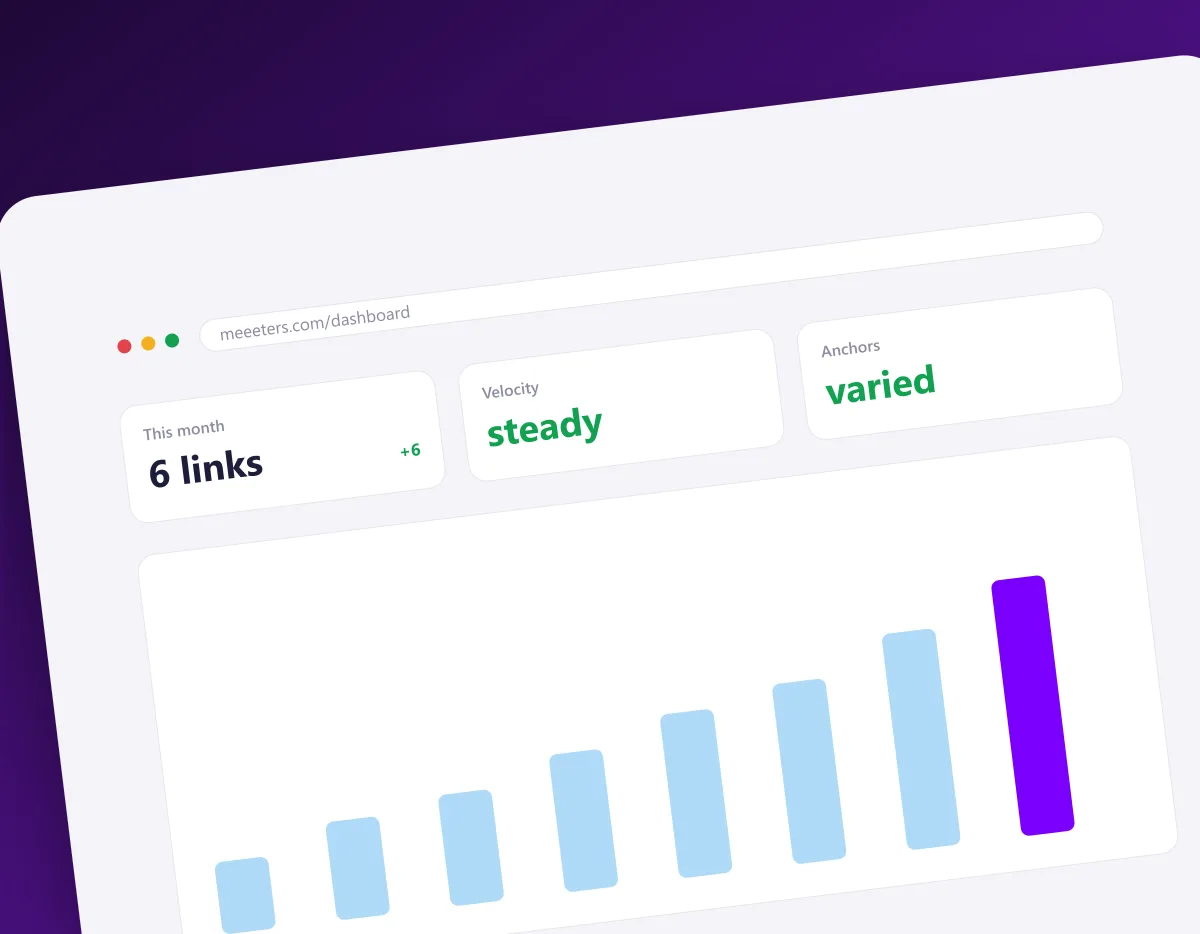
Ask "how many backlinks per month is safe" in any SEO community and you will get answers from "five" to "unlimited." Both are half right. There is no published limit, sites get thousands of links in a day from a press moment and rank better for it. What triggers scrutiny is not volume, it is unexplainable volume. Here is how to think about link velocity, with realistic benchmarks.
Velocity is a pattern, not a quota
Google's systems evaluate link profiles over time. A natural profile grows in a way its content explains: steady accumulation, occasional spikes when something notable happens. A manipulated profile grows in bursts that nothing on the site explains, twenty links appearing in a week on a site that published nothing, from domains that share no audience with it, with suspiciously similar anchors.
That is why velocity questions are really pattern questions. Fifty links from a product launch covered by tech press: explainable. Fifty exchanged links in a week on a dormant blog: not.
Realistic benchmarks by site profile
These are not Google rules, they are paces at which quality link growth never looks like anything other than a site earning its place.
| Site profile | Safe monthly pace | Notes |
|---|---|---|
| Brand new (0–6 months, DR < 10) | 3–8 quality links | Foundation phase, relevance matters most |
| Growing (DR 10–30) | 8–20 quality links | Mix of exchange, content, mentions |
| Established (DR 30–50) | 20–50 links | Profile can absorb variance |
| Authority (DR 50+) | Effectively unlimited | Natural inflow dominates anyway |
Two qualifiers. First, these assume quality: one link from a real site with traffic is worth more than twenty directory entries, and low-quality links are a bigger risk than fast links. Second, consistency beats totals, 6 links a month for a year builds a healthier profile than 72 links in January and silence after.
What actually flags a profile
- Bursts with no cause. The spike itself is fine; the missing explanation is not.
- Repeated anchors across new links. Ten new links with the same money anchor in one month is a Penguin-era signal that still applies, see anchor text for link exchanges.
- Uniform link type. All footer links, or all from the same platform, or all reciprocal pairs.
- Wrong neighborhood. Fast growth from sites with no traffic or inflated DR compounds the problem.
How this applies to link exchanges
Exchanges are the easiest channel to overdo, because the bottleneck is willingness, not effort. If you have credits or eager partners, you can place ten links this week, that does not mean you should. Spread placements out, vary anchors, and keep them relevant. A pace of one to two exchanged links per week sits comfortably inside every benchmark above, and it compounds: how long the effect takes to show is covered in how long does SEO take.
On Meeeters, pacing is built into the model, you earn credits by placing links and spend them as matches arrive, which naturally produces the steady, relevant accumulation that never trips a pattern.
Getting started
Not sure what pace your site can absorb? Run the free SEO analysis, it reads your current authority and matches you with a realistic exchange rhythm.
Frequently asked questions
Quick answers to the questions people ask most about this topic.
Roughly 3 to 8 quality, relevant links a month is a pace nothing will ever question. The limit is less about the number and more about whether growth looks explainable.
A sudden spike with no visible cause, especially from low-quality or irrelevant domains with repeated anchors, is the pattern that looks manipulated. Volume plus a real cause, like press coverage, is fine.
Google has never confirmed a velocity threshold. But link spam systems evaluate patterns over time, and a profile that grows in unexplainable bursts is a pattern.

I built Meeeters to make link building safe and simple: real, relevant backlinks with no reciprocal footprint and no black-hat shortcuts. Questions about your site? Write to me directly.
Email us