Is Link Exchange Worth It? The ROI vs Every Other Link Building Method

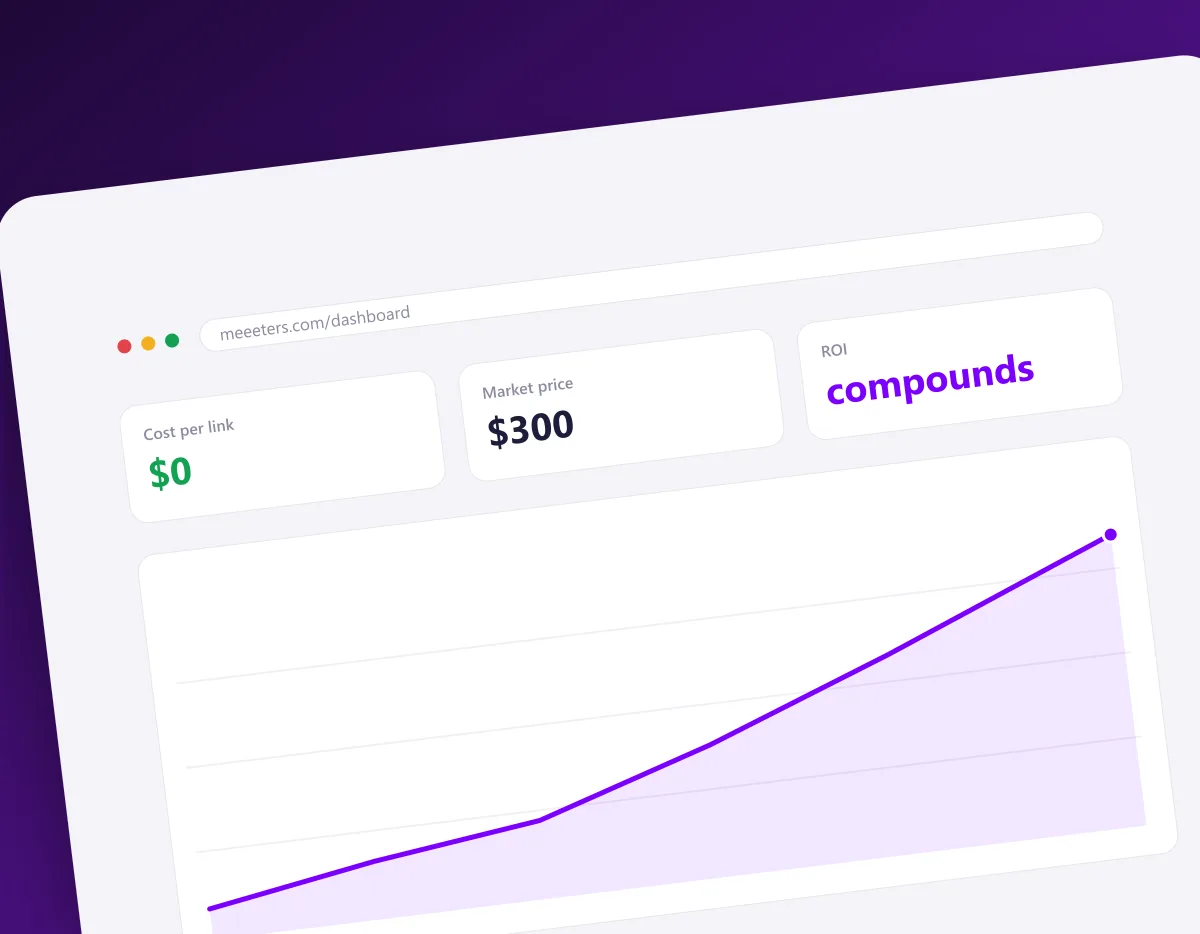
Every link building method ends up priced in one of three currencies: cash, hours, or links. Whether link exchange is "worth it" is just the question of which currency you can best afford, and whether your exchanges are structured well enough to hold their value. Here is the math.
The cost per quality link, by method
| Method | Cash per link | Time per link | What can void the value |
|---|---|---|---|
| Buying / niche edits | $100–500 | Low | Paid-link risk, fake sites |
| Guest posting (in-house) | ~0 | 4–8 h | Scale + keyword anchors |
| Agency / services | $150–500+ | Low | Quality varies per order |
| Cold outreach (earned) | ~0 | 5–15 h | Low hit rate |
| Digital PR | High (retainer) | High | Misses are total losses |
| Link exchange (three-way) | 0 | Minutes–1 h | Reciprocal structure, bad partners |
The per-method economics are unpacked in how much link building costs and the methods comparison. The pattern is consistent: everything except exchange bills you in money or workdays.
What a link is actually worth
Backlinks remain among the strongest ranking correlates, Backlinko's ranking factors study found the number of referring domains correlates with position more than almost anything else. Concretely: if a $300 niche edit is the market price for one relevant dofollow link, then a method producing an equivalent link for one hosted link plus a few minutes has an ROI the paid market cannot approach. And rankings compound: a link earned this month keeps contributing for years.
The exchange's real price: the link you give
The honest accounting: in an exchange you spend a dofollow link from your site. That has a cost, you are sharing authority. Three things keep it cheap:
- Cross-niche partners mean the link you give never boosts a competitor, see same-niche vs cross-niche.
- Editorial placement of an outbound link to a relevant, real site costs you essentially nothing in SEO terms; linking out to good resources is normal site behavior.
- One-for-one, with a credit system, each hosted link converts into exactly one earned link. The exchange rate is fixed and transparent.
When link exchange is NOT worth it
- Done reciprocally. Devalued pairs, wasted effort, the footprint problem.
- With unvetted partners. A link from a fake-DR ghost is worth zero; the link you gave was real. Negative ROI per trade.
- As your only channel. A profile that is 100% exchanges is itself a pattern. Keep other methods in the mix.
- If your site is empty. Partners want placement in real content. Publish first, trade second.
The verdict
Structured properly, three-way, cross-niche, traffic-vetted, verified, link exchange is the best cost-per-link deal in link building, and the compounding kind: every link you host earns one back. Unstructured, it is the fastest way to accumulate worthless links. The structure is the product: Meeeters exists to make the properly-structured version the default rather than the exception.
Getting started
Run the numbers on your own site: the free SEO analysis shows your current authority and what a steady exchange rhythm would add to it, before you spend a franc on any other method.
Frequently asked questions
Quick answers to the questions people ask most about this topic.
Yes, per link it is the cheapest quality method, one hosted link and minutes of work. The condition is structure, three-way trades with traffic-vetted, adjacent-niche sites.
A relevant dofollow link contributes to rankings that compound for years. Against a $150-500 per-link market price, any method that gets equivalent links for near-zero cash has a structurally better ROI.
If done reciprocally (devalued links), with fake-DR sites (worthless links), or as 100% of your profile (pattern risk). Structure and mix decide the outcome, not the method.

I built Meeeters to make link building safe and simple: real, relevant backlinks with no reciprocal footprint and no black-hat shortcuts. Questions about your site? Write to me directly.
Email us