Automated SEO Tools: The 6 Categories (and Where Each One Ends)

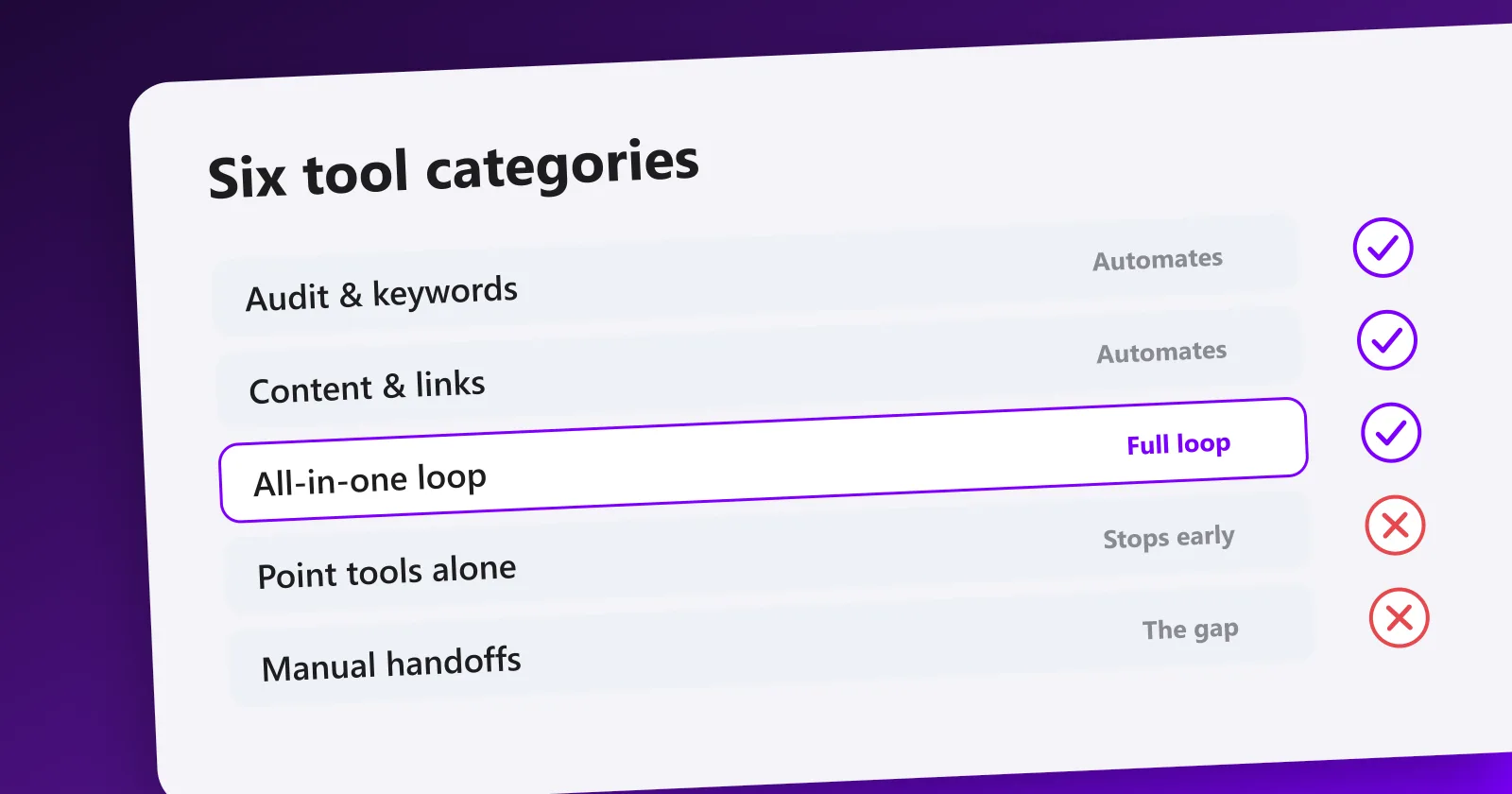
The automated SEO tools market looks crowded until you sort it. Almost every tool sits in one of six categories, and each category automates one part of the loop and stops at a handoff. The mistake teams make is buying five point tools that each automate a step, then doing the handoffs between them by hand, which is where the time actually goes. Here is the map.
1. Audit and monitoring tools
What they automate: crawling your site, flagging technical issues, tracking rankings and surfacing quick wins. Where they stop: at the report. They tell you what is wrong and hand you a list. The fix is still yours to plan, write and ship. A great audit that ends in a dashboard is a diagnosis without a treatment.
2. Keyword research tools
What they automate: pulling search volume, difficulty and competitor keywords at scale. Where they stop: at the spreadsheet. You get 5,000 keywords and no page. Turning keywords into a prioritized content plan, mapped to your site's gaps, is manual unless the tool also knows your architecture.
3. Content generation tools
What they automate: drafting articles from a keyword or brief. Where they stop: at the draft, and this is the category to watch. A tool that drafts from a bare keyword produces pages in a vacuum. A tool that drafts from your site's audit produces pages that fill real structural gaps. The difference is the brief, not the writing. And any tool that auto-publishes without review is selling you the exact profile Google penalizes.
4. Link building tools
What they automate: finding prospects, tracking outreach, verifying placements. Where they stop: wildly, depending on the tool. The safe ones automate the busywork (finding relevant sites, drafting outreach, checking that a placed link is really dofollow) and keep you in control of every request. The dangerous ones automate the link itself, inserting reciprocal links between customers' sites. That is a link scheme at machine scale, and it is a footprint Google detects. Automate the outreach, never the link.
5. Technical SEO tools
What they automate: rendering checks, structured data validation, Core Web Vitals, log analysis. Where they stop: at the alert. They tell you a page renders as an empty shell or that structured data is missing; implementing the fix is engineering work. Essential for large sites, overkill for a 50-page site whose real blockers are content and links.
6. All-in-one platforms
What they automate: the handoffs. Instead of automating one step and dropping you at a spreadsheet, an all-in-one connects audit to plan to draft to publish to link. Where they stop: ideally, at your review and your publish button, which is exactly where they should. The value is not any single step, it is that nothing falls through the gap between steps.
How to actually choose
Do not ask "what is the best automated SEO tool". Ask "which handoff is killing me". If your audits never become pages, you need content automation wired to the audit. If your pages never rank, you need link building in the same loop. If you are stitching five point tools together by hand, the point tools are the problem.
Meeeters is built as the all-in-one for exactly this: the SEO automation pipeline turns your audit into a page queue, drafts each page, and publishes to your CMS as drafts you approve, while the link building network earns the authority those pages need, on one dashboard, for less than a single agency retainer. For the checklist on evaluating any content tool safely, see what to look for in an automation tool.
Start with your own audit
The right stack depends on your actual bottleneck, and you find that in a report. Run the free SEO analysis to see which handoff is costing you the most, then automate that one first.
Frequently asked questions
Quick answers to the questions people ask most about this topic.
The grind: site audits, keyword research, content drafting, CMS delivery, rank tracking and technical monitoring. What should stay human is judgment: deciding which pages deserve to exist, editing drafts, and pressing publish. Tools that automate the judgment too are where penalties come from.
There is no single best, there are six categories and the right question is which loop you are automating. Point tools automate one step; all-in-one platforms automate the handoffs between steps. If your bottleneck is turning an audit into published, ranking pages, an all-in-one that covers audit, content and links beats a drawer of disconnected point tools.
The tools are not the risk, unreviewed volume is. Google's scaled content abuse policy targets mass pages published to manipulate rankings, regardless of who wrote them. Any tool that keeps a human review step and delivers drafts rather than auto-publishing stays on the safe side.
For most small and mid-size sites, yes, if it covers the full loop: audit-driven page planning, drafting, publishing and link building. Agencies still earn their fee on forensic technical work, migrations and penalty recovery. For recurring content and authority building, an automated platform does the job at a fraction of the retainer.

I built Meeeters to make link building safe and simple: real, relevant backlinks with no reciprocal footprint and no black-hat shortcuts. Questions about your site? Write to me directly.
Email us