Scaled Content Abuse: What It Is and How to Stay Out of It

In March 2024, Google introduced a spam policy with an unusually blunt enforcement debut: alongside the update, manual actions deindexed hundreds of sites: not demoted, removed. Most had the same profile: thousands of AI-generated articles, published on autopilot, that nobody had ever read. The policy is called scaled content abuse, and if you automate any part of your content production, it is the one document worth understanding properly.
The definition, precisely
Google defines scaled content abuse as generating many pages whose primary purpose is manipulating search rankings rather than helping users. Three details in that definition do the heavy lifting:
"Many pages." This is a policy about scale. One mediocre article is a quality problem; five thousand mediocre articles are a spam signal. The abuse is using volume itself as the ranking strategy.
"Primary purpose." Intent is the test. Pages that exist because a keyword tool said they could rank, rather than because your business has something to say, fail it. This is why the policy catches human content farms as readily as AI pipelines: the $5-per-article mill and the GPT loop produce the same inventory.
"However it is produced." The policy explicitly does not care whether the text came from a model, a freelancer or a scraper stitching other sites together. Google wrote it this way on purpose, replacing the older "automatically generated content" policy that tools were lawyering around. The question of whether AI content is against the guidelines has a clean answer: no. This policy is what is actually forbidden.
How enforcement actually works
Two mechanisms, and the distinction matters.
Manual actions. A human reviewer flags the site; the site drops partially or entirely out of the index. This is what hit the March 2024 batch. Manual actions come with a Search Console notice and a reconsideration process, and they are reserved for clear-cut cases, which unreviewed AI inventory tends to be, because fabricated statistics and self-similar phrasing make the pattern obvious at a glance.
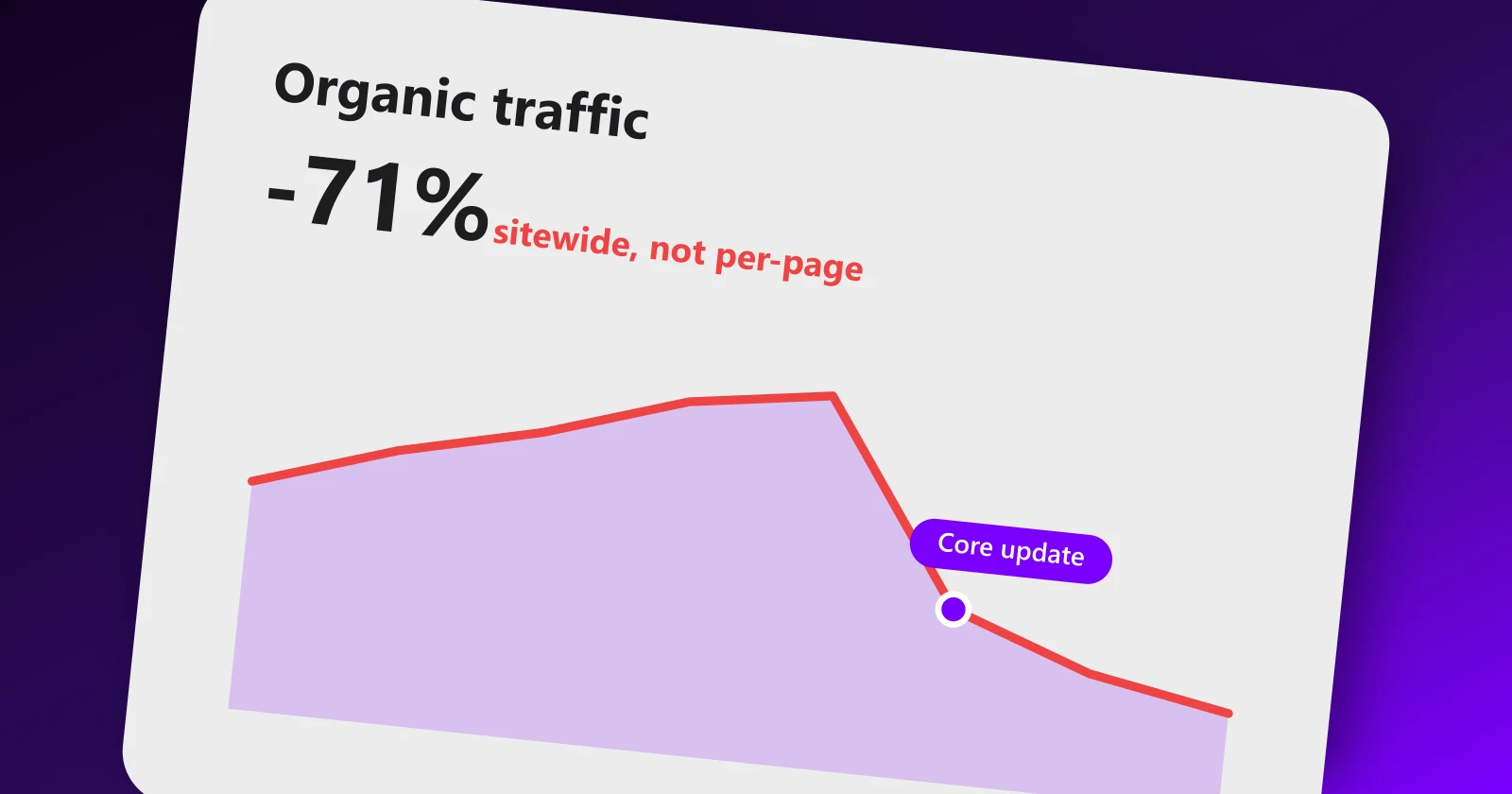
Algorithmic suppression. The quieter, more common outcome. Core updates evaluate domains holistically, and a domain where most pages are thin drags down everything on it, including the good pages. Site owners describe the same sequence: traffic grows for months while the pipeline runs, then a core update lands and the whole domain steps down 60–90%. No notice, no reconsideration button, just a domain whose quality signals collapsed. Recovery requires actually removing the inventory and waiting.
The sitewide nature of both is the point most automation tools skip. You are not risking the AI pages; you are risking the domain they sit on.
The three tests that keep you safe
Every page that ships through an automated pipeline should pass all three:
-
Selection: did a human decide this page should exist? Not a keyword list: a decision. The strongest version is structural: your site's audit shows a gap (a missing service page, an unanswered question in your topic cluster), and the page fills it. Pages selected by strategy survive; pages selected by search volume alone accumulate into the exact inventory the policy describes.
-
Review: did a human read it before it went live? Every fact checked, fabrications cut, generic filler replaced with what only you know. This is the step that cannot be automated, and the step whose absence defines every penalized site. Our guide to editing AI drafts covers the ten-minute version.
-
Standing: can this site credibly say this? Publishing outside your expertise because generation is free is how a plumbing site ends up with 400 articles about crypto. Stay inside the topics where your business has real experience: it is also where content actually converts.
A pipeline that enforces these three tests is a workflow; a pipeline without them is a liability with a delay timer.
Volume is not the crime, but it is the tell
Nothing in the policy caps how much you publish, and large sites legitimately ship hundreds of pages. But volume beyond your review capacity is self-incriminating: if you publish 150 articles a month with one part-time editor, the math says nobody is reading them. That is why capped, reviewable throughput (a handful of drafts a day, each requiring explicit human approval) is not a product limitation. It is the compliance model. Eight pages you shaped beat a hundred and fifty you did not read, in risk and usually in traffic.
And remember what volume cannot buy: authority. Competitive rankings are decided by content and backlinks, which is why scaling content while ignoring link building produces big, flat sites. If you want to know which pages your site is actually missing, and how your authority compares, run a free SEO analysis first and scale from the audit, not from a keyword dump.
Frequently asked questions
Quick answers to the questions people ask most about this topic.
There is no magic number; sites publish hundreds of genuinely useful pages safely. The question Google's systems effectively ask is whether each page would exist without rankings. Volume becomes dangerous when it outruns your capacity to review and stand behind every page.
No. Programmatic pages built on real data that resolve real queries (store locators, statistics pages, comparisons) are legitimate. Programmatic pages that wrap the same thin paragraph around a swapped keyword are exactly what the policy targets.
Google shipped the scaled content abuse policy alongside a core update and issued manual actions that deindexed hundreds of sites, many built on unreviewed AI content. It remains the clearest demonstration that enforcement is sitewide, not per-page.
Yes, but slowly. Recovery means removing or rewriting the low-value inventory, demonstrating restored quality across the domain, and waiting for reassessment, often a core update cycle or more. Prevention is dramatically cheaper.

I built Meeeters to make link building safe and simple: real, relevant backlinks with no reciprocal footprint and no black-hat shortcuts.