An SEO Automation Workflow That Survives Core Updates

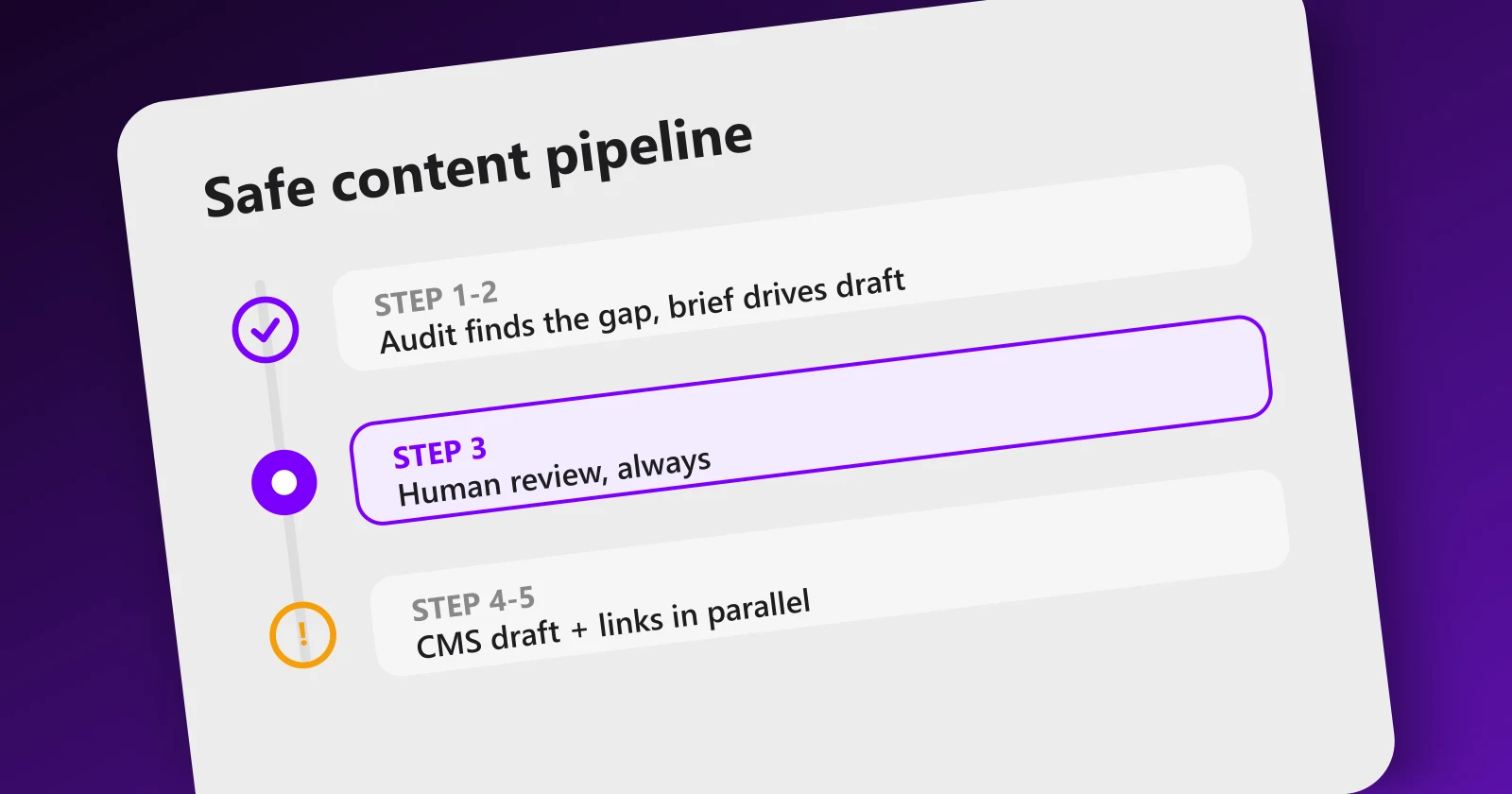
Most automated content setups fail in one of two directions. The cautious version automates nothing and produces two articles a month, hand-wrung over and beautifully irrelevant to what the site actually needs. The reckless version automates everything, floods the domain with unread pages, and donates its rankings to the next core update. The workflow below is the middle path we built Meeeters around: automate the grind, keep the judgment.
Step 1: Select pages from an audit, not a keyword list
The failure mode of nearly every penalized site starts here: pages chosen because a tool said the keyword was rankable, not because the site needed the page. Invert it. Start from a crawl of your own site (its structure, its topic silos, its gaps) and let the missing pages reveal themselves: the service page your structure implies but never built, the question every competitor answers and you don't, the cluster satellite that would complete a silo.
Selection from structure has two properties selection from keywords lacks: every page has a reason to exist beyond rankings (which is precisely the test in Google's scaled content abuse policy), and every page lands inside your site's real expertise. This is why the Meeeters audit outputs recommended pages, each with its silo, format and search intent, rather than a keyword dump. A free SEO analysis gives you this list in a few minutes.
Step 2: Generate drafts from a structural brief
A draft is only as good as its brief. "Write an article about X" produces the interchangeable filler you have already read a hundred times. A structural brief tells the generator what the page is for: which silo it belongs to, what intent it resolves, which sibling pages it should link to, what the business actually offers.
Two hard rules belong in the generation layer, not in the editor's memory:
- No invented facts. Forbid fabricated statistics, fake case studies and imaginary testimonials at the prompt level. What the model cannot know, it must not claim.
- Write in the site's language. Multilingual sites should generate in the primary locale and tag drafts for routing, not translate as an afterthought.
Step 3: Review everything. This step is the workflow.
Every safe automation pipeline and every penalized one differ at exactly this point. A human reads the draft, cuts what is generic, verifies what is factual, and adds the details only the business knows: real numbers, real examples, the voice. Budget ten focused minutes per page; our editing guide breaks down where those minutes go.
Because review is the bottleneck, cap generation at review capacity. If your team can review five pages a day, generating fifty is not 10x productivity, it is a queue of liabilities. This is why volume caps in a content tool are a feature: they keep the pipeline honest.
Step 4: Deliver to the CMS as drafts, never as published posts
Automate the delivery, not the decision. Approved drafts should land in your CMS as drafts (WordPress via a connector, custom stacks via a signed webhook, anything else via markdown), with a human pressing publish inside the CMS. The publish button is the accountability boundary: as long as it is yours, no runaway pipeline can fill your domain while you sleep.
If your tool's pitch includes "publishes automatically while you sleep," that is not a feature, that is the risk profile described in the enforcement history. The tool-selection guide covers the other red flags.
Step 5: Build the authority in parallel
Here is the ceiling nobody's content dashboard shows: a perfectly executed content workflow earns relevance, not authority. On any query with competition, the ranking is decided by content quality and backlinks, and links are the slower variable, so starting them "after the content is done" means starting six months late.
Run link acquisition as a parallel track from day one: relevant, dofollow, verified links from real sites, earned steadily. The safe mechanics are covered in our link building silo; the short version of why Meeeters pairs both in one dashboard is that pages and links are halves of the same system, and the sites that win ship them together.
The workflow, on one line
Audit finds the gap → brief drives the draft → human reviews → CMS receives a draft → links make it rank. Automate steps that move text; never automate the two that exercise judgment. That is the entire difference between a content engine and a time-delayed penalty.
Frequently asked questions
Quick answers to the questions people ask most about this topic.
Gap detection, brief creation, drafting, formatting and CMS delivery. The two decisions that must stay human are what deserves to exist (selection) and what ships (review and publish).
Auto-publish removes the review step, and unreviewed volume is the exact profile of scaled content abuse. Delivering drafts into your CMS keeps the speed while keeping you the editor of record.
As many as you can genuinely review and stand behind, which for most small teams is five to fifteen. Publishing cadence matters less than the consistency of quality across the domain.
Yes. Content earns relevance, links earn authority, and competitive queries require both. Plan link acquisition alongside content production, not after it.

I built Meeeters to make link building safe and simple: real, relevant backlinks with no reciprocal footprint and no black-hat shortcuts. Questions about your site? Write to me directly.
Email us