SEO Automation Tools: What to Look For (and What to Avoid)

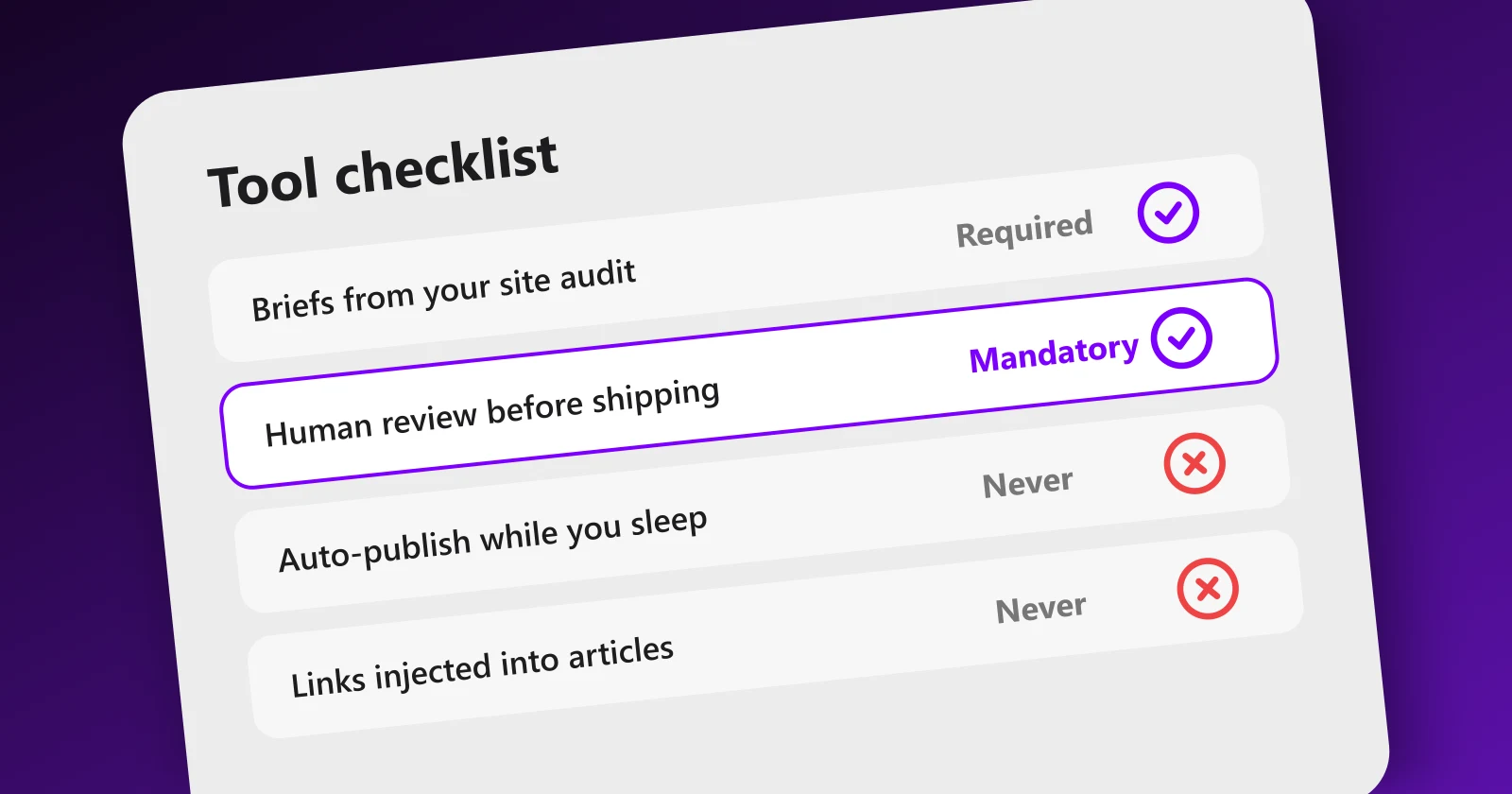
Every automated SEO content tool demos the same way: a keyword goes in, a finished article comes out, and the room is impressed. The differences that matter are invisible in the demo: they are in where the tool puts the human, and they decide whether you bought a productivity gain or a time-delayed penalty. Here is the checklist we would use to evaluate any tool in this category, including ours.
Green flags: what a safe tool looks like
1. Briefs come from your site, not a keyword database. The single biggest quality lever sits before generation. A tool that crawls your site and recommends the pages your structure is missing produces content with a reason to exist, the test at the heart of Google's scaled content policy. A tool that starts from "enter a keyword" produces content in a vacuum, and no amount of generation quality fixes a page that shouldn't exist.
2. Review is mandatory, not optional. The honest tools make you read the draft: it opens in a review panel, and nothing moves until you approve it. This is not friction, it is the compliance model, the editing pass is where generated text becomes content.
3. Delivery lands as CMS drafts. Automation should end at your CMS's draft folder (WordPress connector, signed webhook, or markdown), with the publish button staying inside your CMS, pressed by you. The publish decision is the accountability boundary; a good tool refuses to cross it.
4. Volume is capped, and the tool tells you to publish less. A cap of a handful of drafts per day is a feature: it pins generation to review capacity. Any vendor whose pricing page celebrates "150 articles a month" is selling you the exact inventory core updates are built to suppress. Eight pages you shaped beat a hundred and fifty you didn't read.
5. It never touches your links. The tool writes your content and only your content. Which brings us to the red flag that deserves its own section.
The red flag that outranks the others: link injection
Some content platforms bundle a "backlink exchange" that automatically inserts links between their customers' articles: your article links to a stranger's site, theirs links back to yours, no human involved. This is a reciprocal link scheme executed at machine scale, on your domain, with your name on it. It violates Google's link spam policies, it leaves a uniform, detectable footprint across every member site, and it stacks a second penalty risk on top of the content one.
Links and content are both essential, but they must never write into each other. Link building done safely is deliberate: relevant sites, verified placements, no reciprocal pair, the mechanics live in our link exchange silo. That separation is a hard rule at Meeeters: the network never inserts a link into anyone's article, yours included.
The rest of the red-flag list
- "Publishes while you sleep." Auto-publish removes the one step that separates a workflow from a pipeline.
- Volume as the headline metric. The pitch tells you what the tool optimizes. If it's article count, quality control was not the design goal.
- Confident fake facts. Generate a test draft in your field and check the statistics. A tool without hard rules against invented data outsources fact-checking to your least attentive future self.
- No language awareness. If your site is French and the tool's samples are all English-first, drafts will read like translations. Generation should target your site's actual locale.
- Per-article pricing. Credits create the incentive to publish everything you paid for, reviewed or not. Flat pricing with a fair-use cap aligns the tool with restraint.
The question no content tool answers
Even the best-behaved tool on this checklist produces pages, and pages alone don't win competitive queries: backlinks decide those. If a content tool's roadmap never mentions authority, it is selling you half a system and letting you discover the other half at month six, when the traffic plateaus.
That gap is why Meeeters was built as one dashboard: the audit finds the missing pages, the drafts fill them with you as editor, and the link network earns the authority that makes them rank. See what your own site is missing with a free SEO analysis: the audit and recommended pages are free, before any tool decision.
Frequently asked questions
Quick answers to the questions people ask most about this topic.
Auto-publish. Any tool whose pitch is publishing without you removes the review step, and unreviewed volume is the exact profile Google's scaled content abuse policy targets. The convenience is the liability.
A brief from a keyword database produces pages your site has no reason to host. A brief from your own site's audit produces pages that fill real structural gaps, inside your expertise, with obvious internal links. Same generator, completely different risk and results.
It is a link scheme running on your domain. Automatically inserted reciprocal links between network members are detectable, violate Google's link spam policies, and put every participating site at risk. Content tools and link networks must never write into each other.
Yes, when they automate the grind (gap detection, drafting, delivery) and structurally protect the judgment (selection and review). The time savings are real; the failures come from tools that automate the judgment too.

I built Meeeters to make link building safe and simple: real, relevant backlinks with no reciprocal footprint and no black-hat shortcuts. Questions about your site? Write to me directly.
Email us