How to Edit AI Drafts Into Content That Actually Ranks

The publish button is not where AI content goes wrong. It goes wrong ten minutes earlier, when someone skips the read-through. Every penalized "scaled content" site shares one trait: nobody edited anything. And every team quietly winning with AI assistance shares the opposite one: a short, ruthless, repeatable editing pass. Here is that pass, in the order that catches the most damage per minute.
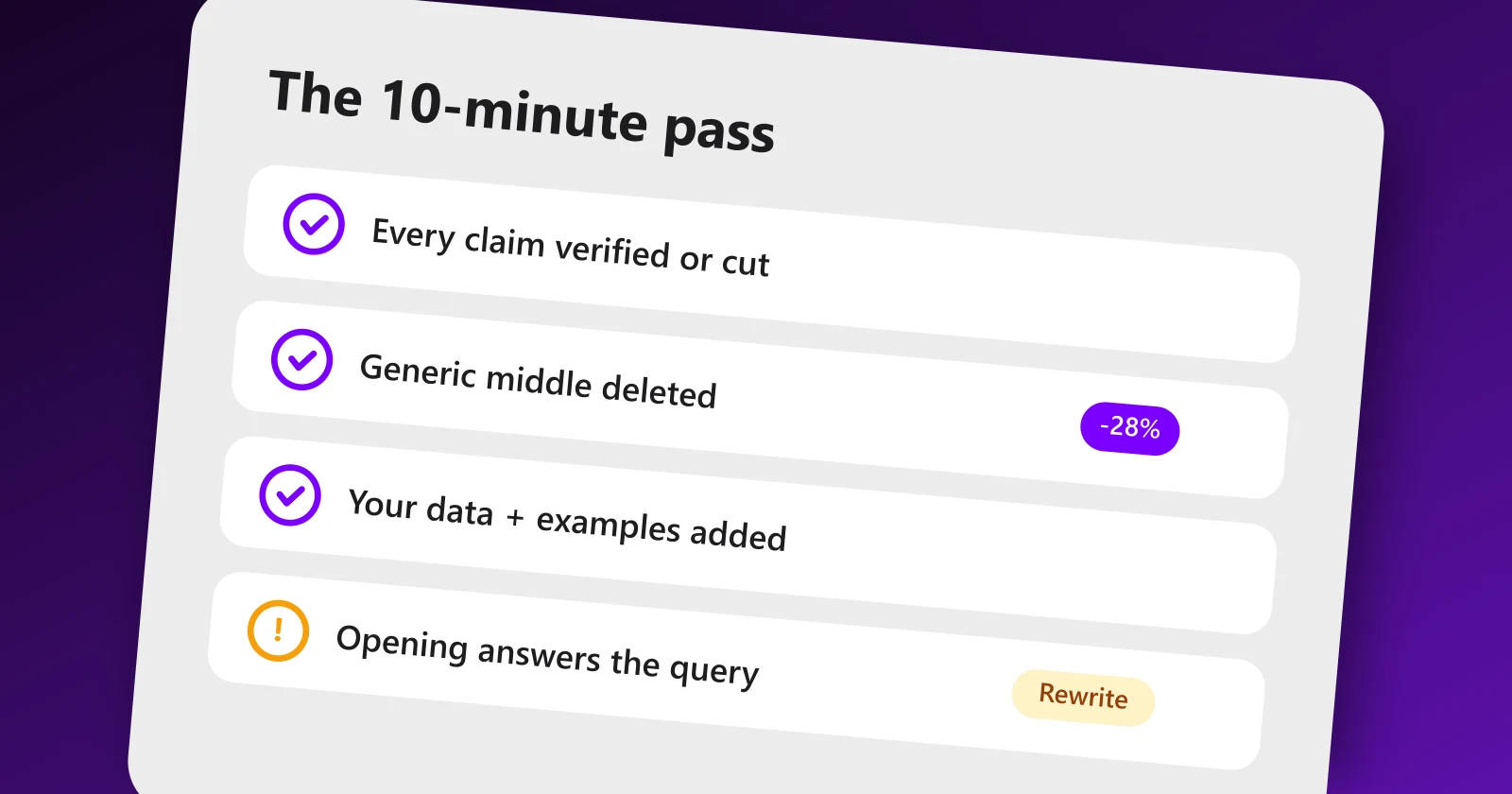
Minute 0–3: Verify every claim, cut what you can't
Models fabricate with total confidence: statistics, study citations, product specs, dates, quotes. This is the single highest-risk feature of generated text, so it goes first while your attention is fresh.
Rule: every number, name and factual claim gets a source you checked, or it gets deleted. No exceptions for plausible-sounding ones: plausible is what models are optimized to produce. If your generation layer already forbids invented statistics, this pass is fast. If a claim matters to the argument but you can't verify it, replace it with what you actually know: your own data, your own cases.
This step alone separates you from the sites that got caught. Fabricated facts are how reviewers spot scaled content abuse at a glance.
Minute 3–5: Delete the generic middle
Generated drafts pad. You will find throat-clearing openings ("In today's fast-paced digital landscape..."), definitions of things your readers obviously know, and both-sides paragraphs that hedge into saying nothing.
Cut without mercy:
- Any paragraph that could appear on a competitor's site unchanged. If it is true of everyone, it argues for no one.
- Restatements. Models love saying the same thing three ways. Keep the sharpest one.
- Hedges that dodge the question. "It depends on your unique situation" is a refusal to be useful. Take a position: that is what expertise reads like.
A draft that shrinks 20–30% in this pass is normal and good. Density is a quality signal to readers, and readers are the quality signal to Google.
Minute 5–8: Inject what only you know
This is the pass that makes the page yours, and it is where rankings are actually won. Generated text is a competent summary of what already ranks, which by definition adds nothing to the index. You add the delta:
- Your numbers. Real prices, real timelines, real results from your own work. One first-hand data point outweighs three paragraphs of summary.
- Your examples. The client situation, the edge case, the mistake you watched someone make. Experience is the E in E-E-A-T that a model cannot fake for you.
- Your position. Where the generic advice is wrong for your audience, say so and explain why. Divergence from the template is what earns citations and links.
If you have nothing to add to a section, ask whether the page passed selection to begin with: pages inside your real expertise always leave you something to say.
Minute 8–9: Fix the internal links
A page ranks as part of a structure, not alone. Check that the draft links to its silo hub and two or three sibling pages with descriptive anchors, and that the links point where you'd send a reader, not just where a keyword matched. If the page fills a gap your audit identified, the right neighbors are usually obvious. (Internal linking has its own leverage: our guide covers it.)
While you're in the links: external references you added during fact-checking should point to primary sources. Citing well is an authority signal in both directions.
Minute 9–10: Rewrite the opening to answer immediately
Generated openings warm up; search visitors and answer engines want the answer in the first two sentences. Rewrite the top so that someone who reads nothing else leaves with the core answer, then let the rest of the page earn the readers who stay. This is also what gets you quoted in AI answers, where only the direct passage gets cited.
What editing cannot do
A perfectly edited page on a domain with no authority still loses to a mediocre page on a domain with strong backlinks: on competitive queries, authority is the tiebreaker and often the whole game. Editing is half the system; link building is the other half. If you want to see which of your pages are close and just need the push, a free SEO analysis shows where your content is already good enough and your authority isn't.
Frequently asked questions
Quick answers to the questions people ask most about this topic.
About ten focused minutes for a standard article once you follow a fixed checklist. Dramatically less than writing from scratch, but never zero: zero is the number that gets sites penalized.
Facts. Every statistic, date, name and claim gets verified or cut. Models fabricate confidently, and one invented number a reader catches destroys the credibility of the whole domain.
No. Rewrite the opening, the claims and the sections where your real experience diverges from the generic answer. Serviceable connective prose can stay; readers and rankings respond to substance, not to whether you retyped every sentence.
Wrong goal. Google does not judge authorship, it judges helpfulness and accuracy. Edit to add verified facts and first-hand specifics, and detectability stops mattering because the page is genuinely useful.

I built Meeeters to make link building safe and simple: real, relevant backlinks with no reciprocal footprint and no black-hat shortcuts.