Is AI-Generated Content Against Google's Guidelines?

Ask ten people whether AI content is allowed by Google and you will get ten confident, contradictory answers. The confusion is profitable: it sells both the "publish 100 articles while you sleep" tools and the "AI content will get you penalized" consulting. The actual policy is shorter and more useful than either pitch.
What Google's policy actually says
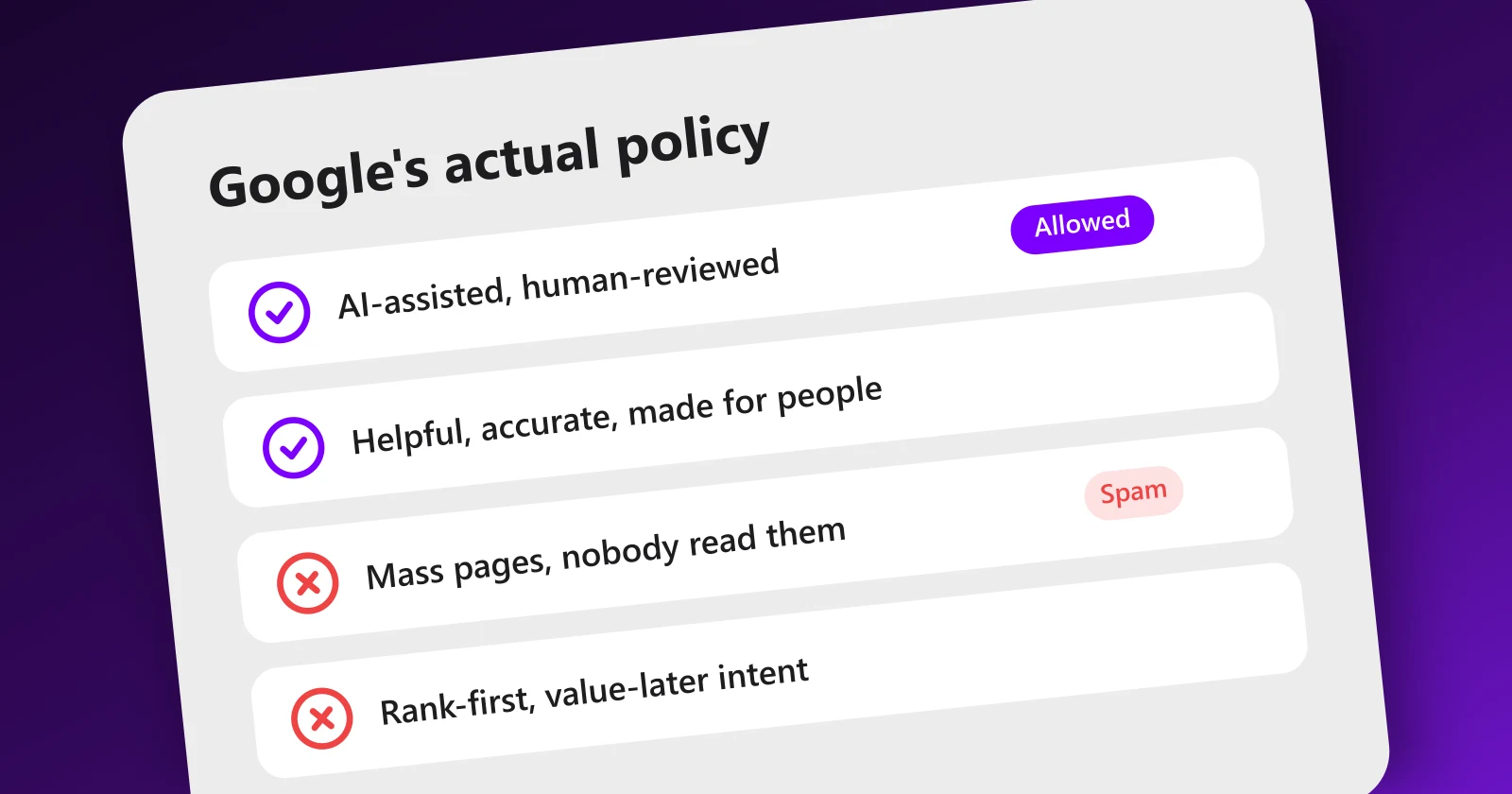
Google's guidance on AI-generated content has been consistent since early 2023: content is evaluated on whether it is helpful, reliable and made for people, however it is produced. Its spam policies name the real offense, scaled content abuse: generating many pages whose primary purpose is manipulating rankings rather than helping users.
Read that carefully, because both halves matter:
- The tool is not the violation. AI-assisted pages that are accurate, useful and reviewed are explicitly fine. Google's own guidance points to its long-standing position on automation: automation has always been allowed when it produces helpful content (think weather pages, sports scores, transit schedules).
- Human authorship is not a defense. A content farm paying writers $5 per article to churn out unread filler violates the same policy. "A human wrote it" saves nobody.
The policy is about intent and quality control, not authorship. That is why "is AI content against the guidelines" is the wrong question. The right question is: would this page exist if it could not rank?
Where the line actually sits
In practice, sites get hit when they cross from assistance into abandonment. The pattern that gets caught looks like this:
- No selection. Pages generated from a keyword list, not from any judgment about what the site should say. A hundred queries in, a hundred pages out.
- No review. Nobody read the output before it went live. Fabricated statistics, invented sources and near-duplicate paragraphs ship straight to production.
- No expertise. The site publishes about topics it has no standing in, because the tool made it free to do so.
Flip each of those and you have the compliant version: a human decides which pages deserve to exist, a human reviews every draft before publishing, and the content stays inside the site's real expertise. That is the difference between a workflow and a pipeline, we cover the full setup in our SEO automation guide.
Why detection is the wrong thing to worry about
A common objection: "Google cannot reliably detect AI text, so I am safe." Both halves are wrong.
Google does not need to detect authorship, because it does not judge authorship. Its systems measure the things that thin content fails at regardless of who wrote it: originality, accuracy, whether users are satisfied, whether the site as a whole shows expertise. A core update does not run a GPT-detector; it re-evaluates whether your domain deserves its rankings. Sites that scaled unreviewed content have watched their entire domain sink, good pages included, because sitewide quality signals dragged everything down.
Meanwhile the inverse is also true: carefully edited AI-assisted pages are indistinguishable from human writing in the ways that matter, because a human made them matter. Editing the draft is the step that converts generated text into content.
The part the content tools don't mention
Even perfectly compliant content does not rank by itself. Content earns relevance; it does not earn authority. On competitive queries, the pages that win have both: they answer the query well, and they sit on domains with real backlinks from relevant sites.
This is where pure content automation quietly fails its customers. You can publish thirty clean articles a month and stall on page five, because every competitor has the same articles and more referring domains. The fix is not more content, it is pairing content with link building, which is exactly why Meeeters puts audit-driven drafts and a verified, non-reciprocal link network in the same dashboard.
Bottom line
AI content is allowed. Scaled, unreviewed, rank-first content is not, whoever wrote it. Keep a human deciding what to publish and reviewing what ships, stay inside your expertise, and build the authority that makes the content worth indexing. If you want to see where your site actually stands before publishing anything, start with a free SEO analysis.
Frequently asked questions
Quick answers to the questions people ask most about this topic.
Not for being AI-written. Google penalizes content that is unhelpful, inaccurate or mass-produced to manipulate rankings. Human-written spam gets the same treatment. The signal is quality and intent, not authorship.
Detection is unreliable and Google has said it does not try to classify authorship. What its systems measure is whether content is helpful, original and satisfying. Thin AI content fails those checks the same way thin human content does.
Google does not require disclosure. What it requires is accountability: a real author or organization standing behind the accuracy of the page. Bylines, editing and factual review matter more than a disclaimer.
Publishing at scale without review: hundreds of pages nobody read, targeting queries the site has no expertise in, often padded with fabricated details. That pattern is what the scaled content abuse policy and core updates are built to catch.

I built Meeeters to make link building safe and simple: real, relevant backlinks with no reciprocal footprint and no black-hat shortcuts.