Programmatic SEO vs Scaled Content Abuse: Where the Line Is

Two sites each publish 5,000 pages from a template. One is Zillow, whose city and street pages are some of the most useful real-estate content on the web. The other loses its entire organic footprint in the next core update. Same tactic, opposite outcomes, which is why "programmatic SEO" and "scaled content abuse" get confused so often, including by people selling one disguised as the other.
The same mechanics, a different payload
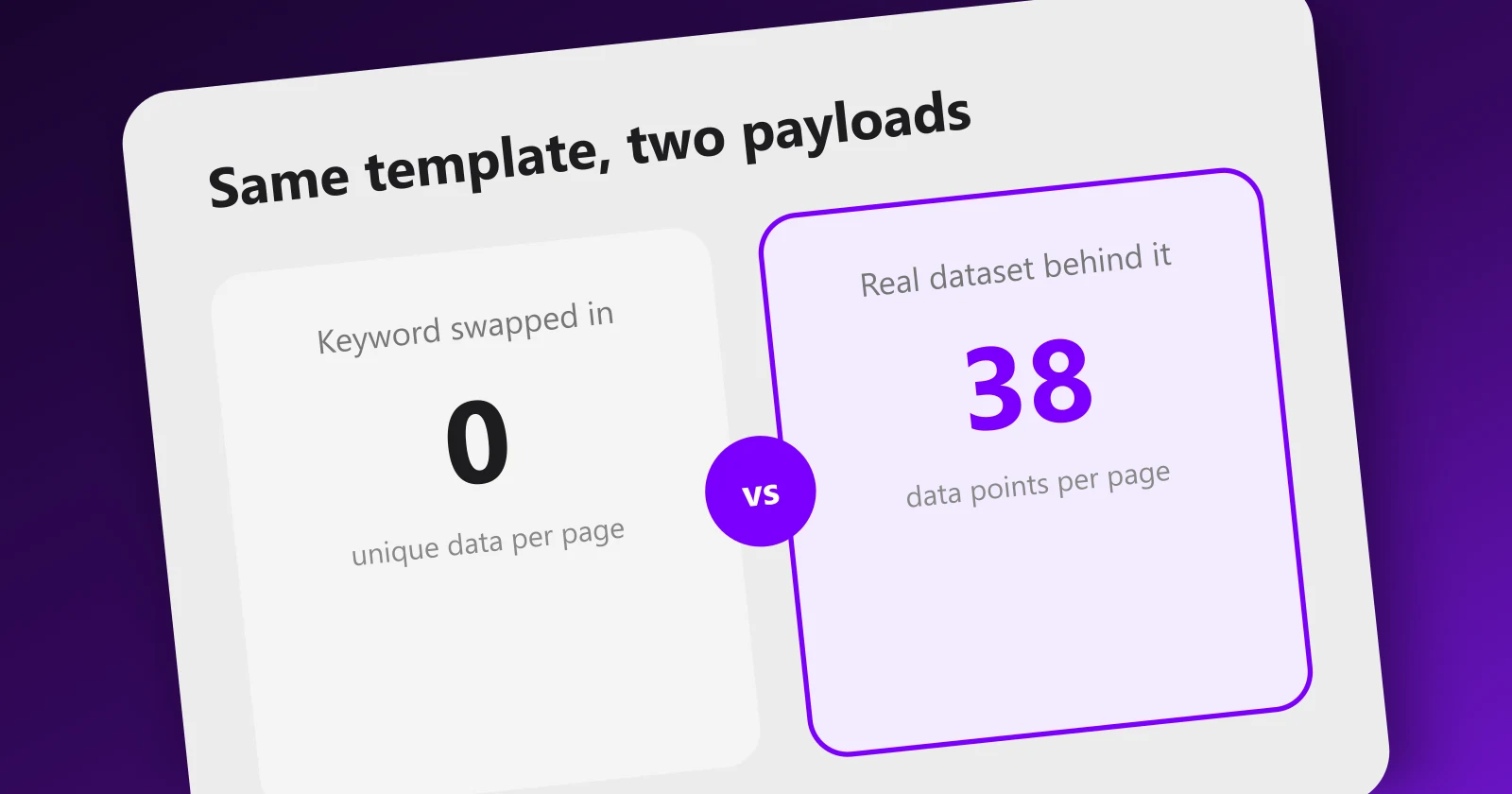
Programmatic SEO (pSEO) is a template plus a dataset: one page design, many rows of data, each row becoming a page that targets a long-tail query. The mechanics are identical to what spam operations do. The entire difference is the payload, what fills the template:
- Legitimate pSEO fills it with page-specific data. Zillow's page for one street shows that street's listings, prices and trends. Wise's page for one currency pair shows that pair's live rate and fees. Remove the template and the data still answers the query; the template is just delivery.
- Scaled abuse fills it with the same words plus a swapped keyword. "Best CRM for dentists" and "best CRM for plumbers" wrap identical paragraphs around a different noun. Remove the template and nothing remains, because nothing was ever there. Google's older name for this pattern, doorway pages, predates AI by fifteen years; generation just made it cheap.
AI blurred the line because a model can now write unique-looking filler for each page. Do not be fooled by surface uniqueness: a thousand differently-worded pages that all contain the same information are still doorways. Uniqueness of information, not of phrasing, is what separates the categories.
The three tests
Before scaling any template, run each prospective page through the same tests that separate a workflow from a pipeline:
1. The data test. Does this page contain facts the sibling pages don't: numbers, availability, locations, comparisons pulled from a real dataset? If your "dataset" is a keyword list, you have no dataset; you have a spam plan.
2. The existence test. Would this page exist if it could not rank? Store locators, price indexes and statistics pages serve users who arrive directly. Pages that only make sense as search bait fail the intent half of the spam policy by definition.
3. The resolution test. Does the page fully answer its query, or does it exist to bounce the visitor somewhere else? A visitor landing on "link building for dentists" should find dental-specific answers, not the generic guide with a dental hat on.
Pass all three and volume is not just safe, it is the whole point: each page wins a long-tail query nothing else answers. Fail them and every additional page adds sitewide risk, because quality is judged across the domain, not per page.
Practical guardrails when you scale
- Ship data-rich pages first. Launch the subset where your dataset is deep, measure, then extend. A staged rollout also keeps indexing digestible.
- Set a thinness floor. Decide the minimum unique data a page needs to go live; noindex or skip rows below it. An empty template is worse than no page.
- Interlink into your structure. Programmatic pages should live inside a silo with a hub, like every other page: orphaned page-clouds are both a UX and a crawl signal problem.
- Remember what templates cannot earn. A thousand pages produce zero authority on their own. The programmatic sites that dominate pair their page inventory with real backlink profiles: links are what turn a long-tail library into rankings, which is exactly the link building half of the system.
If you are weighing a programmatic play, start by auditing what your site's structure already supports: a free SEO analysis maps your existing silos and authority so you can see whether the foundation is ready to carry a thousand new pages, or whether it needs links first.
Frequently asked questions
Quick answers to the questions people ask most about this topic.
No. Templates and automation are explicitly fine when each generated page is helpful: think Zillow's city pages or Wise's currency pairs. The violation is scale without page-level value, whatever tool produced it.
Volume itself is not capped, but index everything gradually and watch quality signals. Launching thousands of near-empty pages at once wastes crawl budget and looks exactly like the pattern the spam policy targets. Ship the data-rich subset first.
Doorway pages are near-duplicate pages each targeting a keyword variation while funneling users to the same destination, the classic failure mode of lazy pSEO. If two of your pages differ only by the keyword in the H1, they are doorways.
Yes. Quality is evaluated sitewide, so thousands of thin templated pages drag down the domain that hosts them, including your good pages. Prune or noindex programmatic pages that have no unique data.

I built Meeeters to make link building safe and simple: real, relevant backlinks with no reciprocal footprint and no black-hat shortcuts. Questions about your site? Write to me directly.
Email us