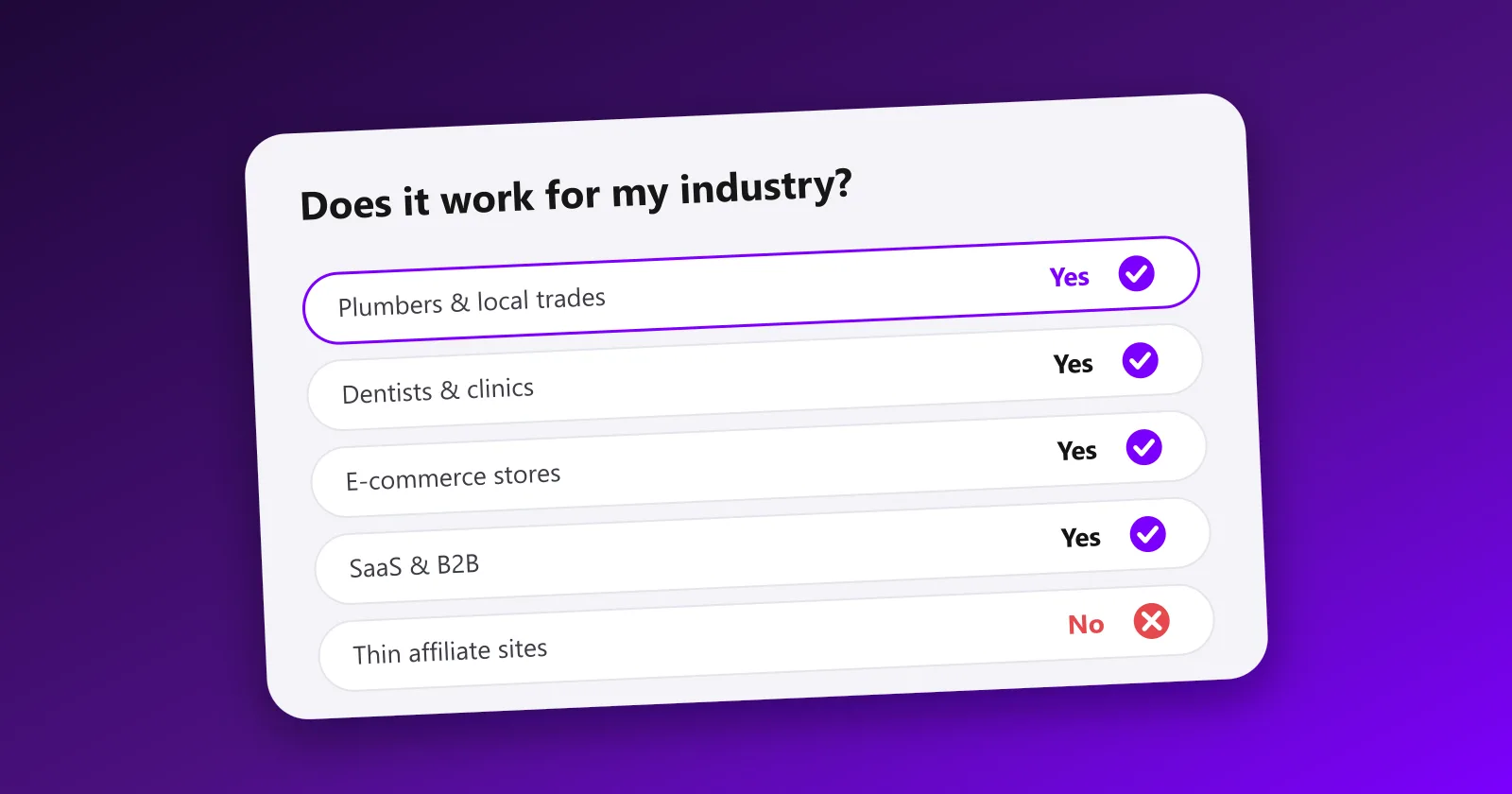
Does SEO Automation Work for My Industry? Plumbers to SaaS

Short answer: yes. SEO automation is not an industry-specific trick, it is a method: scan the site, find the keywords your customers actually type, publish pages that answer them, earn the links that make those pages rank. That loop is the same for a plumber in Geneva and a SaaS in San Francisco. What changes by industry is the keywords, the content angle and the competition, and those are exactly the parts the scan figures out for you.
Here is what the loop looks like in the industries we get asked about most.
Local trades: plumbers, electricians, HVAC, roofers
The best-kept secret of local SEO is how weak the competition is. Most trade websites are five pages built once and never touched. Meanwhile customers search constantly: "water heater replacement cost", "why is my radiator cold at the bottom", "emergency electrician open now".
Automation fits trades perfectly because the owner has zero time for marketing. The scan detects the niche and service area, the keyword step surfaces the questions locals actually ask, and the articles answer them one by one. A plumber does not need 10,000 visits a month; twenty pages answering real emergency-and-cost questions can own a city's queries. The free SEO analysis shows those gaps in minutes.
Dentists, clinics and health practices
Health queries are high-intent and high-volume: "how much does a crown cost", "invisalign vs braces", "does teeth whitening damage enamel". The catch is that health content must be accurate and reviewed, which is why the workflow matters more here than anywhere: drafts you approve, never auto-published pages you have not read. That review step is built into the workflow, and for a practice it is non-negotiable.
Restaurants, hotels and hospitality
Hospitality lives on searches like "best brunch in [city]" and increasingly on AI answers: people ask ChatGPT where to eat. Ranking there is less about your menu page and more about being the answer to neighbourhood questions, and about showing up when AI assistants recommend places. Fewer articles, more local authority. The loop is the same, the volume is just lower.
E-commerce stores
E-commerce is where content gaps are the widest. Product pages alone rarely rank; the buying-intent queries ("best running shoes for flat feet", "how to choose a standing desk") belong to guides and comparisons. Automation maps your catalog to those queries and fills the gap between your products and the questions people ask before buying them. At catalog scale, doing this by hand is the reason most stores never do it.
SaaS and B2B
SaaS is the native habitat of SEO automation: comparison pages, alternative pages, integration guides, "how to X" content aligned to features. Competition is real, so the differentiator is consistency and links. Publishing two good pages a week for six months beats a burst of ten pages in January, and none of it ranks without authority, which is where link building carries the loop.
Real estate, agencies, freelancers and everyone else
Real estate wins on neighbourhood and process questions ("closing costs in [state]", "renting vs buying in [city]"). Agencies and freelancers win on proof-of-expertise content that turns into inbound leads. If your customers search before they buy, and they do, the method applies. The scan's job is precisely to detect your niche and find your version of these queries, whatever the industry: that is what the tool automates.
What actually changes by industry
Three things, all handled by the scan rather than by you:
The keywords. A plumber's money queries are urgent and local. A SaaS's are comparative and global. The keyword step reads your site, detects the niche and pulls the queries that match your intent profile, not a generic list.
The content angle. Trades need cost-and-emergency answers, health needs reviewed accuracy, e-commerce needs buying guides, SaaS needs comparisons. The drafts follow the angle of your niche because they are briefed by your site's audit, not by a bare keyword.
The pace and the links. A local trade can win with a handful of pages and modest authority. A SaaS in a crowded category needs steady publishing and a real backlink engine. Same loop, different throttle.
The one honest "no"
SEO automation does not fix a business that search cannot help. If you have no product yet, if all your work comes through referrals and you want it that way, or if your site exists only to arbitrage affiliate clicks with nothing original to say, automation gives you volume without value. Google's scaled content policies exist precisely for that last case, and no tool should help you speedrun a penalty.
For everyone else, the question is not whether your industry is compatible. It is which twenty queries your customers are typing right now that nobody in your market has answered.
See what it finds in your niche
The fastest way to answer "does it work for my industry" is to run it on your site. The free SEO analysis scans your pages, detects your niche and shows the exact queries it would go after, before you commit to anything.
Frequently asked questions
Quick answers to the questions people ask most about this topic.
Yes, and local trades are one of the best fits. Plumbers, electricians, HVAC and roofers compete on local queries like 'water heater replacement cost' or 'emergency plumber near me' where most competitors have thin websites. An automated scan finds those gaps, and a steady stream of pages answering real customer questions wins them. No SEO knowledge is needed on your side.
No. The point of automation is that the tool does the expert work: it scans your site, detects your niche, picks the keywords, writes the pages and delivers them as drafts you approve. Your only job is the judgment calls: does this page describe my business correctly, and do I want to publish it.
Industries where customers search with clear questions and competitors publish little: local services (trades, clinics, studios), niche e-commerce, B2B SaaS and professional services. If your customers type questions into Google or ask AI assistants for recommendations, there are rankings to win, and automation wins them faster than a monthly agency retainer.
When search is not where your customers are, or your site has nothing original to offer. A pre-launch startup with no product, a business driven entirely by referrals or a marketplace storefront you do not control gains little. And a thin affiliate site publishing at scale is exactly the profile Google's scaled content policies target, automation only accelerates the penalty.

I built Meeeters to make link building safe and simple: real, relevant backlinks with no reciprocal footprint and no black-hat shortcuts.