How Many Articles Should You Publish per Month for SEO?

Type this question into any AI content tool's marketing page and the answer is always the same: more. Thirty articles a month, ninety, "publish while you sleep." Ask the sites that got wiped in a core update and the answer changes. The honest version is that cadence is not a strategy input at all: it is an output of two constraints, and you can compute yours in a minute.
Constraint one: your review capacity
Every article that ships unread is a small deposit in the scaled content abuse risk account, because unreviewed volume is precisely what the policy and the March 2024 enforcement targeted. So the first ceiling is simple: your cadence is the number of drafts a human on your team can genuinely review: facts verified, filler cut, first-hand detail added. That editing pass costs about ten focused minutes per page once it is routine.
Do the math for your team. A solo founder with two content hours a week reviews eight to ten pages a month, so that is the cadence, regardless of how many drafts the tooling could produce. AI moved the bottleneck from drafting to review; it did not remove it. This is also why a safe workflow caps generation at review speed instead of celebrating raw output.
Constraint two: your authority
The second ceiling is quieter. Content earns relevance, but competitive rankings are decided by authority: backlinks from relevant domains. A site with 15 referring domains publishing 60 articles a month is not doing SEO; it is building a large site that ranks for nothing, because every serious query on its list is held by domains with ten times the link profile.
Match content volume to authority stage:
- New site (DR under ~20). Four to eight articles a month, all inside one silo, so the cluster develops topical depth instead of scattering. Spend the saved time on link building: at this stage, one relevant referring domain moves you more than five extra articles.
- Established site (DR ~20–40). Eight to fifteen a month across two or three silos, filling the gaps your audit shows. Content and links in parallel, always.
- Authority site (DR 40+). Higher volumes genuinely pay here, because your existing authority lets new pages rank quickly: this is where the compounding lives, and why big sites seem to "get away with" volume. They are not exempt from the quality bar; they just clear the authority bar you don't yet.
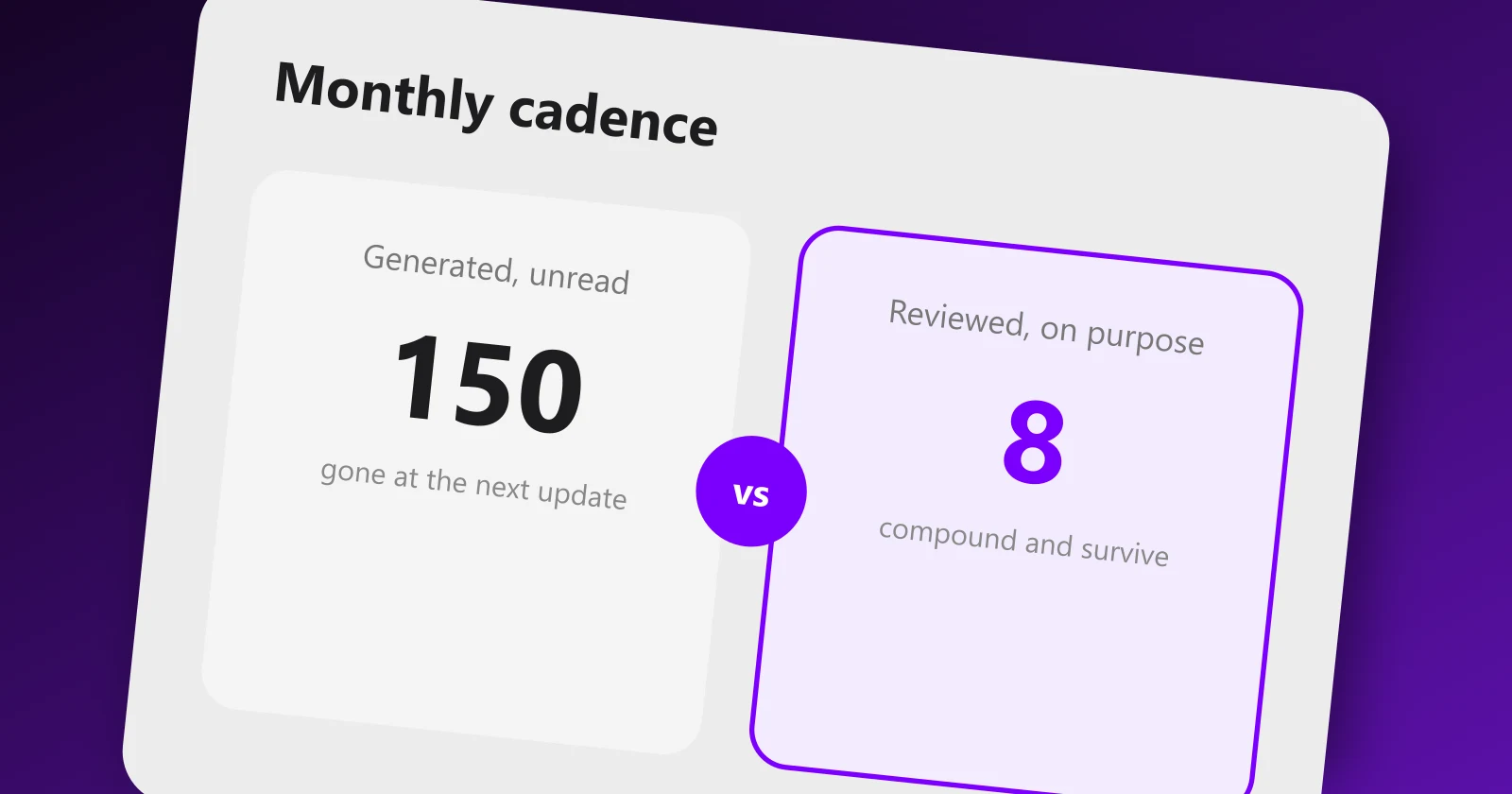
Why 8 beats 150
Put the two constraints together and the popular promise inverts. One hundred and fifty unreviewed articles a month produce: thin pages that drag sitewide quality signals, crawl budget spent on filler, zero additional authority, and a domain-shaped target for the next core update. Eight reviewed articles produce: eight pages that each fill a real structural gap, each carrying something only you could say, on a site whose quality signals stay coherent.
The traffic curves match the logic. Volume sites spike while the pipeline runs, then step down 60–90% at re-evaluation. Review-bound sites compound slowly and keep what they earn. Slower is not a compromise; it is the version that survives measurement.
Find your number
Your cadence = min(review capacity, what your current silos actually need). The second half of that formula comes from your site, not from a guess: a free SEO analysis maps your structure and tells you exactly which pages are missing, so your monthly output is a to-do list rather than a quota. Fill the gaps, review everything, and let the link side of the system carry the ambition your article count no longer has to.
Frequently asked questions
Quick answers to the questions people ask most about this topic.
Only while each article targets a real gap and gets reviewed. Google has no volume bonus; it evaluates quality per page and across the site. Past your review capacity, additional volume adds risk faster than traffic.
Four to eight genuinely useful articles a month, concentrated in one topic silo, beats daily publishing spread thin. Early on, authority is your bottleneck, so pair every content sprint with link building.
Freshness matters for time-sensitive queries and regular publishing keeps crawlers returning, but there is no cadence signal that rewards daily posting. Consistency of quality beats frequency of output.
Only if you can review every draft to the same standard. AI removes the drafting bottleneck, not the review one, and unreviewed daily output is the profile Google's scaled content policy describes.

I built Meeeters to make link building safe and simple: real, relevant backlinks with no reciprocal footprint and no black-hat shortcuts.