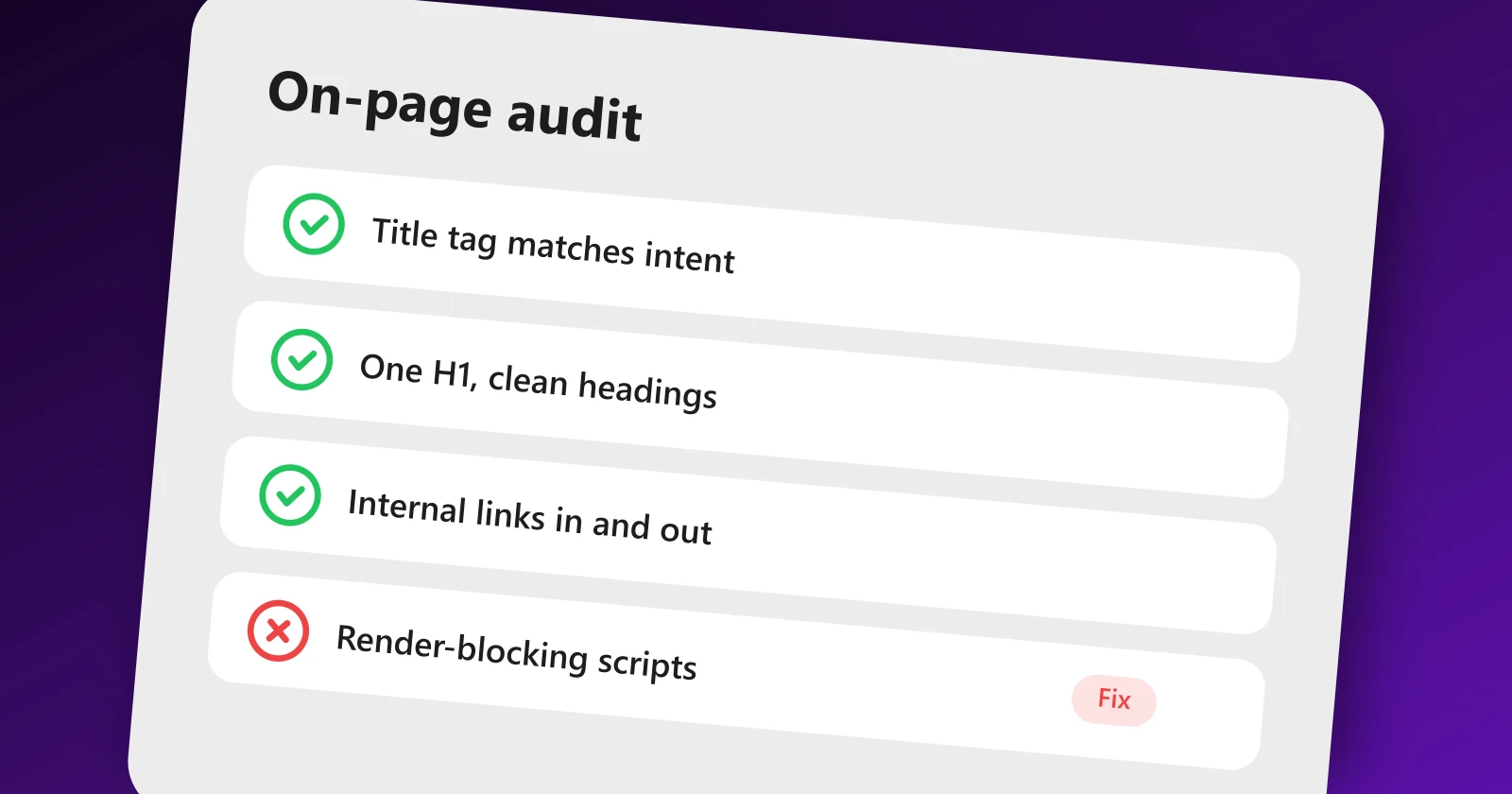
On-Page SEO Checklist: 15 Checks Before You Chase a Single Backlink

Backlinks get most of the attention in SEO, and they matter, but they are amplifiers, not repairs. A page that targets the wrong intent or takes six seconds to load will not rank no matter how many links point at it. Run this checklist before you spend a single hour on link building.
Content and intent
1. Match the search intent
Search your target keyword and look at what actually ranks. If the results are listicles and you wrote a product page, you lose before you start. Match the format Google already rewards: guide, list, comparison, tool or product page.
2. Answer within the first 100 words
State the direct answer immediately, then expand. Readers and search engines both reward pages that resolve the query fast. This is also what makes your page quotable by AI search engines.
3. Cover the subquestions
Scan "People also ask" for your keyword and make sure each relevant subquestion has its own section. One page that fully resolves a topic beats three thin ones, and thin overlapping pages create cannibalization problems of their own.
4. Show first-hand experience
Google's quality systems favor content with real experience behind it: your own data, screenshots, test results, client numbers. Generic rewrites of the top 10 results have no edge, especially since AI made them free to produce.
Structure and markup
5. One clean title tag
Under 60 characters, keyword near the front, a reason to click. The title tag remains the single strongest on-page relevance signal.
6. One H1, logical H2s
One H1 that matches the topic, H2s that mirror the subquestions people search. Headings are the skeleton Google uses to understand and excerpt your page.
7. A short descriptive URL
/on-page-seo-checklist beats /blog/2026/07/post-id-8231. Set it once and never change it without a redirect.
8. Meta description that sells the click
It is not a ranking factor, but it moves click-through rate, and CTR is money. Around 150 characters, include the promise of the page.
9. Schema markup where it fits
Article, FAQ, HowTo, Product: structured data helps search engines parse the page and can win richer results. Keep it accurate; marking up content that is not on the page can backfire.
Links
10. Internal links in and out
Every page needs 2 or 3 contextual internal links pointing to it and should link out to your related pages. This is how authority from your backlinks reaches the rest of the site; the full method is in our internal linking guide.
11. Sensible external links
Linking out to genuinely useful sources is a quality signal, not a leak. Cite primary sources, not competitors targeting your keyword.
Technical
12. Speed under control
Core Web Vitals are a lightweight ranking signal but a heavy conversion signal. Compress images to WebP, cut unused scripts, lazy-load below the fold. Details in our site speed guide.
13. Mobile first, literally
Google indexes the mobile version. Test the page on a real phone: readable font sizes, no horizontal scroll, tap targets that work.
14. Indexable and canonical
Check the page is not blocked by robots.txt, has no stray noindex, and declares a canonical URL. Obvious, and still one of the most common failures.
The multiplier
15. Give the reader a next step
Every page should lead somewhere: a related guide, a tool, a signup. Pages that end in a dead end waste the traffic they earn.
After the checklist: earn the links
Once a page passes all 15 checks, backlinks become the bottleneck, and that is the right time to solve it. How many links you need depends on the keyword, but the order of operations never changes: intent, page quality, then authority.
Start by measuring where you are: get a free SEO analysis of your site, then earn your first verified editorial backlink through the Meeeters network.
Frequently asked questions
Quick answers to the questions people ask most about this topic.
On-page SEO is everything you control on the page itself, content quality, titles, headings, internal links, images, speed and structured data. It is the counterpart to off-page SEO, which is mostly backlinks.
Yes. Links multiply what is already there. A page that matches intent and is technically clean converts every new backlink into movement; a broken page wastes them.
Revisit your important pages every 3 to 6 months. Refresh outdated facts, update the year in titles where relevant, add sections for new subquestions, and check that speed has not regressed.

I built Meeeters to make link building safe and simple: real, relevant backlinks with no reciprocal footprint and no black-hat shortcuts.
Related searches, answered
What people actually type before landing here, with the short answer and where to read more.
- SEO checklist
- A checklist is only useful in order. Indexation first, then intent, then the on-page details.When Google is not showing your site ›
- Basic SEO checklist
- The basics that still move rankings: one clear H1, a title that matches the query, and internal links pointing in.Internal linking ›
- Website SEO checklist
- Run it per template, not per page. Fixing one blog layout fixes every article at once.How Google sees your site ›
- SEO content checklist
- Before publishing, check the page answers the query in the first hundred words. Everything else is secondary.Writing a post that ranks ›
- Technical SEO checklist
- Crawl, render, index. If any of the three fails, no on-page work will show up in results.The technical walkthrough ›
- On-page SEO checklist for old posts
- Updating an existing page that already has impressions beats publishing a new one from zero.The content refresh playbook ›