What Is a Semantic Silo? (And How to Build One That Holds)

Publishing twenty good articles on twenty unrelated things gives you twenty isolated pages. Publishing twelve articles on one thing, linked together, gives you a block that ranks as a unit.
That block is a semantic silo, and it is one of the few structural ideas in SEO that survives every algorithm update, because it is not a trick. It is what a genuinely well-covered topic looks like.
The shape
Every page links up to the pillar and across to its siblings. None of them links out to another silo.
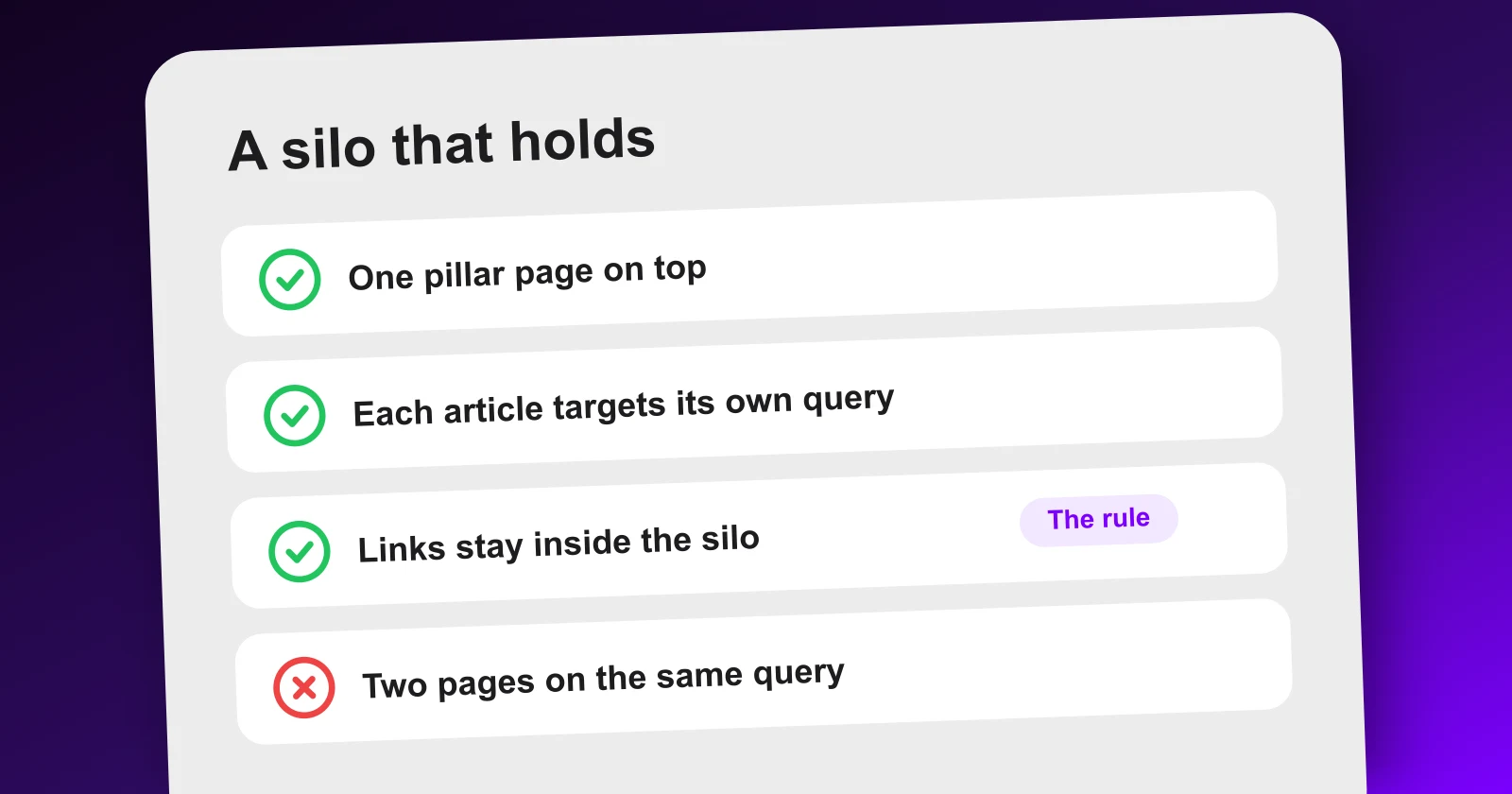
Three parts, and all three are required:
- A pillar. The page that covers the topic broadly and sits at the top. It is what you would send someone who knows nothing about the subject.
- Articles that each target their own query. Not variations of the pillar: distinct questions, each with its own search demand and its own intent.
- Links that stay inside. Every article links up to the pillar and across to its siblings.
Miss the third and you have a category page with orphans under it, which is the most common version of a silo that does not work.
Why it works
Two reasons, and they are independent of each other.
Coverage reads as expertise. A single page on "CRM for freelancers" is one opinion. A pillar plus ten articles that answer the pricing question, the comparison question, the migration question and the objections is a body of work. Search engines have been rewarding that shape for years, and AI assistants, which summarise rather than list, reward it harder: they need to find the whole answer in one place to cite it.
Authority concentrates instead of leaking. Every internal link passes a share of a page's standing. If your best
article links to eleven unrelated posts, that share scatters. If it links to its siblings, it accumulates where you
want it. This is the part folders cannot do for you, and the reason a tidy /crm/ directory with no internal links
changes nothing.
Deciding what belongs
The useful test is not "is it the same theme". It is: would the same person, in the same week, want to read both?
Someone comparing CRMs also wants to know what they cost and whether a spreadsheet would do. That is one silo. That same person is not, in the same week, reading about your company's hiring process. Same site, different silo.
When you are unsure, look at the query rather than the title. Two pages belong in the same silo when their queries come from the same intent at a different depth. They belong in different silos when the reader is at a different stage of a different problem.
The two things that break a silo
Cross-links to unrelated silos. A link from a CRM article to your pricing page is fine, it is a conversion path. A link from a CRM article to your unrelated guide on invoicing law dilutes both. If you find yourself linking across constantly, your silos are probably drawn in the wrong place.
Several pages chasing the same query. This is cannibalisation and it is the most common self-inflicted wound in content SEO. Twelve articles all effectively targeting "link building service" do not rank twelve times. They compete, they split the links pointing at them, and Google picks one, often not the one you would have picked.
The fix is unglamorous: merge the duplicates into the strongest page, redirect the rest, and give the survivors genuinely different queries.
How Meeeters builds them
This is the part of the product that is hardest to see from the outside, so here is what actually happens.
The free analysis crawls your site and groups your existing pages into the silos they already form, whether you intended them or not. Most sites discover they have four or five real topics and a long tail of orphans.
From there, each keyword it finds is attached to a silo before anything is written. That attachment decides three things at once: the URL the page will get, which existing pages it will link to, and which pages will link back to it. When an article is drafted, its internal links are already in the text, pointing at the pillar and at its siblings, because the silo was decided first and the writing came second.
The rule the system enforces is the one above: links stay inside the silo. Not as a style preference, as a constraint in the code. It is the difference between a blog with categories and a site that reads as an authority on something.
You can see your own silos, and the pages missing from each one, on the free plan. Nothing to install, and it reads only your public pages.
Frequently asked questions
Quick answers to the questions people ask most about this topic.
A set of pages covering one topic, organised around a pillar page, where the articles link to the pillar and to each other and not across to unrelated topics. The goal is that a search engine reads the whole group as one authoritative block on that subject rather than as separate posts that happen to share a folder.
In practice they describe the same shape: a central page and supporting pages linked together. Silo usually puts more emphasis on keeping links inside the group, cluster on covering the topic completely. If you build either one properly you end up with the other.
Enough to cover the questions a buyer actually asks, which is usually somewhere between five and fifteen. The wrong instinct is to pad it: twelve near-identical pages on the same query compete with each other and split the authority they were meant to concentrate.
It can be linked from two, but it should live in one. A page that belongs everywhere signals a topic to no one, and it forces you to choose a canonical URL anyway. Pick the silo where the buying intent sits and link to it from the other.

I built Meeeters to make link building safe and simple: real, relevant backlinks with no reciprocal footprint and no black-hat shortcuts. Questions about your site? Write to me directly.
Email us