Best Backlink Monitoring Tool Compared: What Actually Changes Your Rankings

TL;DR
- Backlink monitoring tools track incoming links over time, but most show volume without revealing which links actually drive ranking gains
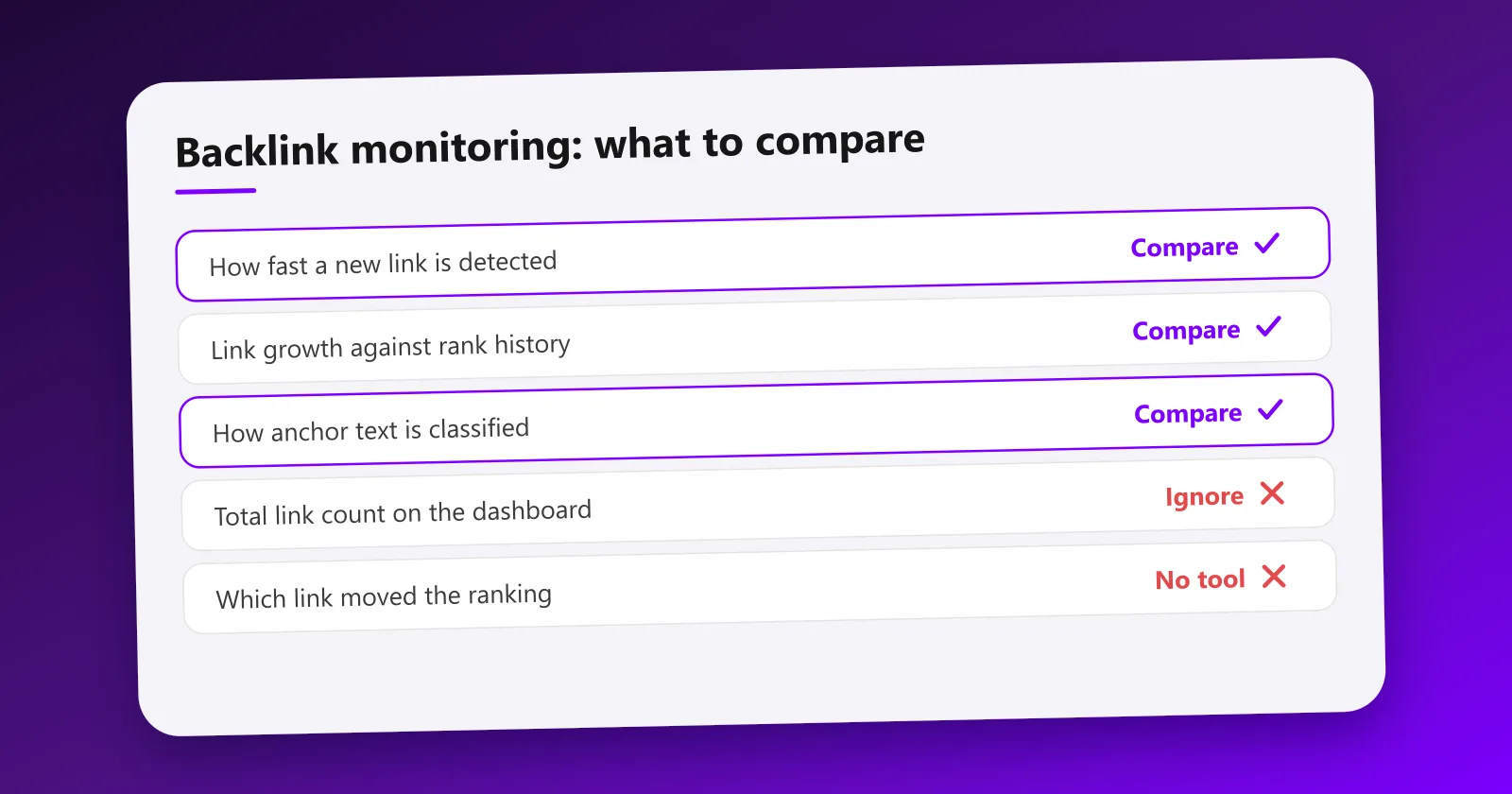
- The gap between "link detected" and "link moves rankings" is where most tools fail; monitoring frequency, anchor text classification, and referring domain authority calculation determine real value
- Setup confusion around baseline dates, filtering noise, and false positive detection costs months of wasted alerts
- Tools optimized for outreach volume differ fundamentally from tools built to answer: "Which new link improved my position on which keyword?"
When you search for a backlink monitoring tool, you're not really looking for another dashboard that counts links. You want to know which links matter, which ones are moving your rankings, and which ones you should investigate further. The problem is that most comparisons focus on features, price, UI, integrations, and miss the core question: does this tool actually tell you whether a link improved your organic traffic?
This article compares backlink monitoring tools through the lens of what they're really built for: outreach speed, rank tracking correlation, or competitive intelligence. You'll see why tool selection depends on your actual workflow, not just its feature list.
What Backlink Monitoring Actually Measures (And Doesn't)
A backlink monitoring tool continuously crawls the web, discovers new links pointing to your domain, and logs them into a database with metadata: referring domain, anchor text, target URL, and (in better tools) link freshness. That's the surface.
But here's what gets skipped in most comparisons: the tool doesn't inherently tell you if that link improved your rankings. It tells you a link exists. Whether it moves the needle on traffic depends on factors the tool itself doesn't always expose: the referring domain's own authority, its content relevance to your topic, the anchor text quality relative to your target keyword, and when the link was detected relative to when your keyword position changed.
Monitoring tools diverge here. Some are built around frequency of detection, showing you new links as fast as possible so you can act on them for outreach. Others are built around correlation to ranking movement, showing you historical link growth against keyword rank history so you can infer causation. A few try to do both and end up mediocre at each.
How Backlink Monitoring Tools Actually Work
Most tools use one of two crawling strategies:
- Index-based discovery: the tool maintains its own web crawl index (or licensed access to one) and matches links found in that index to your domain. Updates happen on a crawl schedule, typically weekly or monthly for standard tools, daily for premium tiers. The advantage is cost control; the disadvantage is detection lag. A competitor's link might go live on Tuesday, but you won't see it until the next crawl cycle.
- Real-time crawling: the tool continuously crawls a subset of high-authority domains (news sites, industry publications, major blogs) and notifies you within hours or days. This catches important links faster but doesn't monitor the full web, only the segments most likely to matter.
Once a link is detected, the tool assigns metadata. This is where quality diverges sharply. A good tool will:
- Classify anchor text not just as "exact match" or "brand" but relative to your actual target keywords and content topic
- Recalculate referring domain authority independently to avoid cascade errors
- Track link velocity over time: are new links accelerating, plateauing, or dropping?
- Flag link quality red flags: links from footer templates, sitewide links, unrelated niches
Basic tools stop at detection and metadata. They show you the link, and you decide if it matters. Better tools add correlation: they overlay link growth on your rank history for keywords in your target set and mark periods where rank movement aligns with link acquisition.
Common Mistakes When Using Backlink Monitoring Tools
Mistaking baseline setup for historical data. When you first activate a backlink monitoring tool, it crawls your domain and establishes a baseline. New links discovered after that are shown as "new." But links that existed before your baseline date are not retroactively discovered unless the tool integrates with a historical index. This creates a false cliff: you'll see a spike in "new links" on day one, then normal discovery afterward. If you don't account for this, you'll misinterpret your link velocity and miss the actual trend.
Treating all detected links as equivalent. A link from a domain with spam history, poor linking patterns, or unrelated content looks identical to a genuine editorial link in many tools' interfaces. The tool shows it as a data point; your job is filtering. Many users don't. This leads to false positives: you spend time investigating links that were never going to help your rankings, or worse, you include them in outreach efforts and damage your brand credibility.
Ignoring detection latency. If your tool detects links on a weekly schedule, a link that goes live on Monday morning might not appear until the following Monday. During that lag, you lose the opportunity to thank the publisher, identify patterns in their coverage, or amplify the link's reach while it's fresh. Some users don't realize they're working with week-old data and make decisions based on stale signals.
Monitoring without a hypothesis. Monitoring tools work best when you know what you're looking for. If you activate the tool and just watch the dashboard, you'll see noise: hundreds of detected links, many irrelevant or low-quality. If you start with a hypothesis, "we're trying to rank for keyword X; we need links from domains in segment Y with anchor text matching Z", you can configure alerts, filters, and reports to surface only the signals that matter to your strategy.
The Gap Between Link Detection and Ranking Impact
Here's the insight that separates experienced practitioners from tool comparisons you read elsewhere:
Link monitoring tools show what happened, not why it mattered. They're excellent at answering "did we get a link?" They're weak at answering "did we move because of it?"
Consider this scenario: your site gains three new links in a week. Your ranking on your primary keyword improves from position 8 to position 5 in the same week. Did the links cause the rank gain? Maybe. But there's also:
- A competitor published weaker content and their page was demoted
- Google's algorithm refreshed and liked your existing content better
- One of the three links came from a low-authority domain you shouldn't credit
- All three links came from one referring domain (not diversified)
A monitoring tool can't isolate causation. It can only show correlation over time. The tools that acknowledge this limitation and offer timeline overlays, rank history and link acquisition in one view, help you build better intuition. The tools that just say "you got a link!" without context won't.
This is why backlink monitoring works best when paired with rank tracking that captures daily movements, not weekly snapshots. You need fine-grained rank data to spot which links align with which rank changes.
Monitoring Tools Built for Outreach vs. Built for Analysis
The market offers two categories, and many users pick the wrong one:
Outreach-focused tools (faster detection, simpler filtering) are built for link builders who want to discover new link opportunities fast, identify the right contact for a publisher, notify them of a broken link or outdated reference, and track whether outreach succeeded. These tools prioritize speed of discovery and contact data over link quality signals.
Analysis-focused tools (deeper historical data, correlation features) are built for in-house SEO teams and strategists who want to understand which link sources actually improve rankings, identify link-building patterns that work, measure backlink ROI over quarters, and defend link-building budgets with data. These tools prioritize historical accuracy, correlation tooling, and filtering depth over speed. They're slower to detect, but the data is higher-fidelity.
Most practitioners need a mix: outreach speed from one tool, analytical depth from another. Treating a single tool as the source of truth for both workflows is why link monitoring often disappoints.
Managing Payment and Risk in Link Monitoring
Backlink monitoring is typically a recurring subscription (annual or monthly). The cost scales with domain size, link volume, and monitoring frequency. For teams coordinating with external link builders or freelancers, there's an additional consideration: who pays for the tool, and how do you verify the link builder actually delivered?
If you're working with external link building partners who need to prove delivery, payment protection frameworks like those used for freelance verification can be adapted to link-building contracts: the tool is paid for, but access is released only after links are independently verified in your monitoring tool within an agreed timeframe.
This creates accountability without requiring the link builder to have a tool subscription themselves. They deliver links; you verify them in your tool; you release payment. Many teams building this workflow manually report better compliance and fewer ghost links.
FAQ
How often should I check my backlink monitoring tool?
Daily checks for ongoing outreach campaigns where you expect weekly link velocity. Weekly or monthly reviews for trend analysis and link quality audits. Setting up automated alerts for high-quality link detections (domain authority above threshold, anchor text matching target keywords) reduces the need for constant manual checking.
Why does my backlink monitoring tool show different link counts than another one?
Different tools crawl different segments of the web and use different definitions of "link." One tool might count sitewide footer links; another might filter them as noise. One might count redirected links; another might not. One updates weekly; another updates daily. Compare tools on methodology (crawl frequency, link definition, domain authority calculation) before concluding one is more accurate. For critical decisions, use the same tool consistently over time; the relative trends will be more useful than absolute accuracy.
Can I use backlink monitoring to find guest posting opportunities?
Indirectly, yes. Monitor competitors' backlink profiles and note which domains are linking to multiple sites in your niche with similar keyword intent. Those domains are likely accepting guest posts or feature mentions. The tool shows you the opportunity; your outreach team does the verification and approach. This is faster than random prospecting but requires filtering to avoid contacting domains that are clearly paid-link networks or irrelevant niches.
What should I do if my monitoring tool detects a link I never agreed to?
Investigate before acting. The link might be from a brand mention or editorial coverage you didn't know about (keep it), a sitewide footer or comment spam link (disavow if low-quality, ignore if unrelated), or a competitor's link farm testing your domain (mark for monitoring and disavow if patterns emerge). Don't panic or remove it immediately. Set a reminder to check its referring domain's health in three months.
Which backlink monitoring tool is best for tracking competitor links?
Any tool with a historical index and competitor domain import works. The advantage goes to tools that let you track multiple competitors simultaneously and compare their link sources to yours. You're not looking for the fastest detection here; you're looking for completeness and filtering depth. Set up a weekly report comparing your new link domains to competitors' to spot whether you're losing share in key referring domains.
How do I know if my backlink monitoring tool is worth the cost?
Bind it to a metric: either outreach success rate (links detected via monitoring that turned into guest posts or brand mentions) or rank correlation (percentage of rank movements that align with significant link acquisitions). If your tool doesn't enable either measurement, you're paying for reporting, not strategy. Audit this quarterly.

I built Meeeters to make link building safe and simple: real, relevant backlinks with no reciprocal footprint and no black-hat shortcuts.