Does Domain Rating Predict Traffic? We Measured 596 Sites. The Correlation Is 0.16

Every link marketplace prices by it. Every outreach email leads with it. Every backlink package sells "DR 50+" as though the number were the product.
So we checked whether it means anything. We took 596 real websites, measured each one's authority score and its estimated monthly organic traffic, and looked at the relationship between the two.
The correlation is 0.16.
What 0.16 actually means
For anyone who does not spend their days in statistics: a correlation of 1.0 would mean domain rating tells you exactly how much traffic a site gets. A correlation of 0 would mean it tells you nothing at all.
0.16 is much closer to nothing than to something. Knowing a site's domain rating leaves you almost as uncertain about its traffic as you were before you looked.
On a logarithmic scale, which is more forgiving because traffic is heavily skewed, it rises to 0.29. Still weak. Still not a number you would bet a budget on.
The two populations that break the assumption
Averages hide things, so here are the sites that make the point concrete.
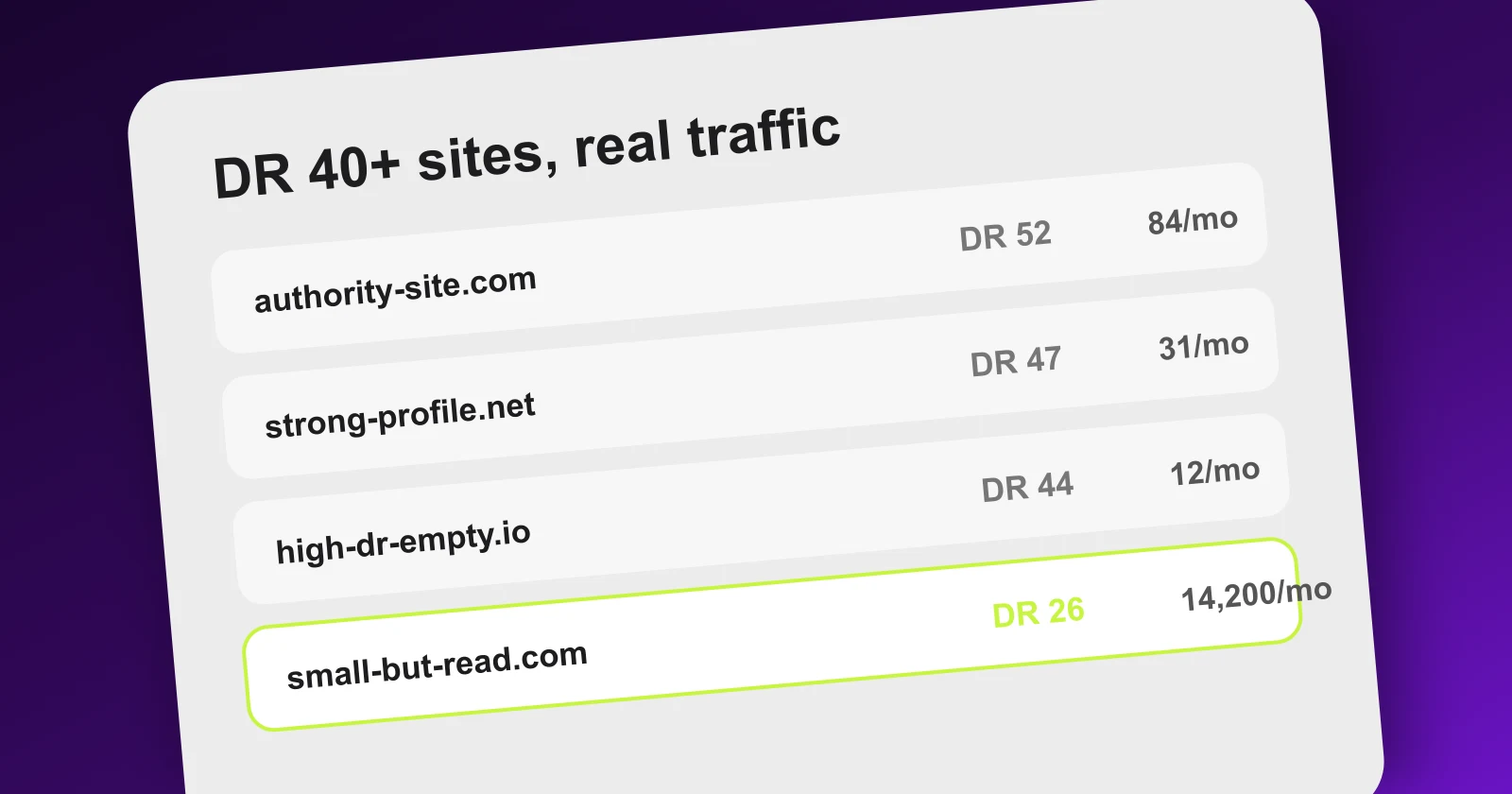
High authority, no traffic. 47 sites in our sample scored DR 40 or above and were getting fewer than 100 organic visits a month. That is 15.5% of everything above 40. On a marketplace listing, these look like premium placements. In reality they have authority and no audience.
Low authority, real traffic. In the other direction, 13 sites scored under DR 30 while pulling more than 10,000 visits a month. Nobody is selling links on those, because the number does not look impressive.
If you have ever bought a link from a DR 55 site and seen nothing happen, this is why. You bought the score, not the audience.
Half the profiles are inflated
There is a second problem sitting underneath the first, and it explains part of why the score misleads.
Across the 596 sites, the median had 962 referring domains and 32,005 backlinks, which works out to roughly 21 links per referring domain.
- Backlinks counts every individual link. One site linking to you from its footer across 5,000 pages counts 5,000 times.
- Referring domains counts each linking site once.
Google treats that footer link far closer to one link than to 5,000. And 50.7% of the sites we measured carried more than 20 links per referring domain, meaning their raw backlink count materially overstates the profile behind it. One site in the sample had 44,769 backlinks from a single domain.
Authority scores are computed from link graphs. When the link graph is inflated, so is the score.
What the distribution looks like
For context on where any given score sits:
| Measure | Value |
|---|---|
| Median domain rating | 40 |
| Mean domain rating | 37 |
| Sites at DR 60 or above | 1.3% |
| Sites below DR 30 | 17.6% |
| Median referring domains | 962 |
| Median backlinks | 32,005 |
The full breakdown of the distribution is in our domain rating study. The short version is that DR 60 is far rarer than link sellers imply, and DR 40 already beats half the field.
So what should you actually use?
Not nothing. Domain rating is a reasonable comparator between similar sites, which is the job it was designed for. Comparing two guest post opportunities in the same niche, it is a useful tiebreaker.
It is a poor target, and a poor forecast. Three things track outcomes better:
- Referring domains. One number, counted once per site, and it moves with rankings in a way the composite score does not. Compare yours against the sites already ranking for your keywords. That gap is your real problem.
- Topical relevance. A link from a DR 25 site your customers actually read is worth more than a DR 60 site with no relationship to your subject. Relevance is not in the score at all.
- Search Console. Impressions and clicks come from Google itself rather than from a vendor's model. Everything else is an estimate of an estimate.
If you want to see where you stand on the first one, the free comparison in how to check competitor backlinks puts your domain next to your competitors and shows referring domains alongside the strength score, so you can see for yourself how differently the two behave.
Method
596 websites, measured in July 2026. For each site we recorded its authority score from professional backlink data, its referring domains, its total backlinks and its estimated monthly organic traffic. Correlation is the Pearson coefficient between authority score and traffic across the full sample, with the log variant computed on log-transformed traffic.
Traffic figures are third-party estimates, which is worth stating plainly: they are models, not measurements, and they are less reliable on small sites. That limitation cuts both ways and does not explain a correlation this weak. If anything, estimation noise on small sites tends to flatter the relationship rather than weaken it.
These are the same numbers behind every metric Meeeters shows, which is why the product leads with referring domains rather than with a score.
Frequently asked questions
Quick answers to the questions people ask most about this topic.
Not directly. Domain rating is a third-party estimate of link authority invented by SEO tool vendors, not a signal Google uses or acknowledges. It correlates loosely with ranking ability because both depend on links, but Google has no access to it and does not compute it.
0.16 across 596 sites, using each site's authority score and its estimated monthly organic traffic. On a log scale it rises to 0.29, still weak. In practical terms, knowing a site's domain rating tells you very little about how much traffic it actually gets.
Frequently. In our data 47 sites, about 16% of those scoring 40 or above, were getting fewer than 100 organic visits a month. High authority with no traffic usually means links without relevant content, or links pointing at a site that never published anything worth ranking.
Yes. Thirteen sites in our sample scored under 30 and were pulling more than 10,000 monthly visits. That combination usually means strong topical focus and content that matches intent precisely, in a niche where competitors have not bothered.
Referring domains, because they count each linking site once and track ranking far more closely than a composite score. Then topical relevance of those links, then your actual impressions and clicks in Search Console, which are the only numbers that come from Google itself.
Because it is a single number that sounds like quality and is comparatively easy to manufacture. Domain rating can be pushed up with cheap links in weeks, which is why half the sites we measured carried inflated backlink counts relative to their referring domains.

I built Meeeters to make link building safe and simple: real, relevant backlinks with no reciprocal footprint and no black-hat shortcuts.