What Is a Good Domain Rating? We Measured 596 Real Sites (Original Data)

"What is a good domain rating?" gets answered with vibes far more often than data. So we pulled the numbers. This is original data: the domain rating of 596 real websites we measured, not a rule of thumb.
To see where your own domain sits before reading further, the domain rating checker returns the score and the referring domains behind it in one pass.
The short answer
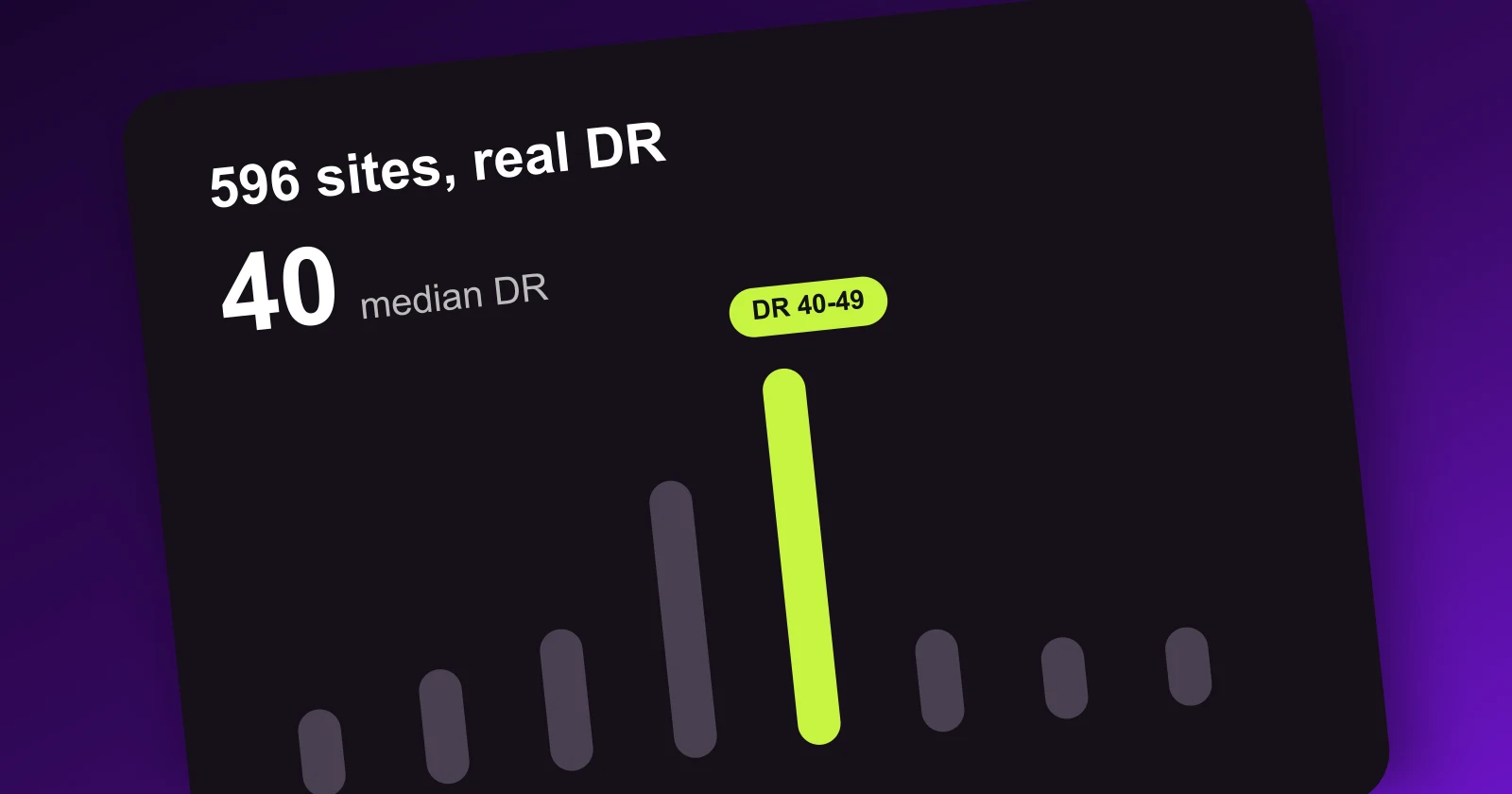
Across 596 sites, the median domain rating was 40, the average was 37, and the ceiling was surprisingly low: only 5 percent reached DR 50 and just 1 percent passed DR 60. A good domain rating is relative to your competitors, but as a benchmark, anything above 40 already beats half the field, and DR 50 puts you in the top 5 percent.
The full distribution
Here is where all 596 sites landed:
| Domain rating | Sites | Share |
|---|---|---|
| 0 to 9 | 9 | 2% |
| 10 to 19 | 36 | 6% |
| 20 to 29 | 60 | 10% |
| 30 to 39 | 187 | 31% |
| 40 to 49 | 275 | 46% |
| 50 to 59 | 21 | 4% |
| 60 to 69 | 7 | 1% |
| 70 to 79 | 1 | 0.2% |
Two things jump out. First, this is not a bell curve centered on a high number. It piles up in the 30 to 49 band, where 77 percent of sites sit. Second, the top is thin air: fewer than 1 in 20 sites cross DR 50, and DR 60 and up is basically a rounding error. The mega-authority sites you compare yourself to are the exception, not the norm.
The finding most people miss: referring domains, not backlinks
We also measured link profiles. The median site had 962 referring domains and 32,005 backlinks. Measured site by site, the median is 21 backlinks per referring domain.
Most of those 32,000 backlinks are repeats: sitewide footer links, multiple links from the same domain, template links. They inflate the backlink count and do almost nothing for authority. The number that actually moves domain rating is the count of distinct domains linking to you, and there the median site sits under a thousand. This is exactly why referring domains beat raw backlinks as a metric.
Methodology
These are 596 domains that passed through Meeeters' analysis, measured with a standard third-party domain rating (the same 0 to 100 scale as Ahrefs DR). It is a sample of sites active in SEO and link building, which is precisely the field you compete in, not a random slice of the whole web. Domain rating is a third-party estimate and can be inflated or faked, so we treat it as directional, not gospel. Data measured July 2026.
What this means for you
- You do not need a huge DR to win. The median is 40 and DR 50 is top 5 percent. You are competing against sites in the 30 to 49 band, not against DR 80 giants. A realistic, high-impact target is moving from wherever you are to the mid-40s.
- Chase referring domains, not backlink counts. A tool that reports "40,000 backlinks" is mostly counting repeats. Ten links from ten new domains beat a hundred from one. Judge your progress by new referring domains.
- The DR 30 to 50 climb is where everyone is stuck. It is the most crowded band on the chart, which means small, real gains in referring domains separate you from the pack.
Where you stand
Guessing your domain rating from a distribution is not the same as knowing it. Run a free SEO analysis to see your site strength and how many referring domains you actually have, then close the gap by adding new ones, the metric this data says matters most. The safest way to add relevant referring domains without the footprint of buying or swapping is a non-reciprocal link network.
Frequently asked questions
Quick answers to the questions people ask most about this topic.
In our data set of 596 real websites the median domain rating was 40 and only 5 percent reached 50 or above. Anything over 40 already beats half the field, and a DR of 50 puts you in the top 5 percent. There is no universal good number, it is relative to your competitors, but 40 to 50 is a strong and realistic target for most sites.
Across the 596 domains we measured, the average domain rating was 37 and the median was 40. The distribution is not a bell curve centered high, it clusters between 30 and 49, where nearly 8 in 10 sites sit.
Higher is generally better for ranking potential, but domain rating is a third-party estimate, not a Google metric, and it can be inflated. Referring domains and relevance matter more than the score itself. A DR 45 site with 900 relevant referring domains beats a DR 60 site with a spammy profile.
In our data the median site had about 962 referring domains and 32,000 backlinks, a median of 21 links per domain measured site by site. Most backlinks are repeats from the same sites, so referring domains, not raw backlink count, are the number that reflects real authority.
Earn links from new referring domains you do not already have, since duplicate links from existing domains add little. Focus on relevant real sites rather than raw volume. A safe way to add referring domains is a non-reciprocal link network, which places editorial links without the footprint of buying or swapping.

I built Meeeters to make link building safe and simple: real, relevant backlinks with no reciprocal footprint and no black-hat shortcuts.
Related searches, answered
What people actually type before landing here, with the short answer and where to read more.
- Domain rating
- Domain rating is a third-party score built from backlinks. Google does not use it and never publishes anything like it.We measured 596 sites ›
- Domain ranking
- There is no ranking of domains. There are rankings of pages, and a strong domain only makes them easier to earn.How long SEO takes ›
- Domain name rating
- The domain name itself carries no score. Exact-match domains stopped being an advantage over a decade ago.SEO for a new website ›
- Domain metrics
- Referring domains and traffic are worth tracking. Composite scores are convenient summaries, not targets.Metrics that matter ›
- Domain trust score
- Trust scores are vendor-specific and not comparable between tools, so never gate a partnership on one number.How sites inflate DR ›
- How is domain rating calculated?
- From the number and strength of linking domains, on a logarithmic scale: 20 to 30 is far easier than 60 to 70.Referring domains explained ›
- What is a good DR for a new site?
- Anything above zero in the first year is normal progress. Under 20, focus on relevance rather than the score.A safe monthly pace ›
- Domain rating vs URL rating
- Domain rating scores the whole site, URL rating scores one page. Pages rank, so URL rating is the closer proxy.Site strength in one gauge ›