SEO for a New Website: The First 90 Days, Week by Week

Launching a website feels like a finish line. For Google, it is a starting gun for a race where you begin unranked, untrusted and invisible. I have launched enough sites now, including meeeters.com, to know that the first 90 days follow a predictable script, and that most founders play it in the wrong order: they chase backlinks before they have pages worth linking to, or they publish twenty articles on a site Google cannot properly crawl.
This is the roadmap I wish someone had handed me: what to do each week, what to skip, and what the numbers should honestly look like at day 90.
The mindset before the plan
Three truths to accept before week 1, because they shape every decision after:
New domains rank slowly, even with great content. Call it the sandbox, call it a trust deficit: a fresh domain has no history, no links and no engagement signals, so Google has no reason to rank it over sites with years of proof. This is not a punishment, it is a cold start. The full timeline question deserves its own discussion, and we wrote one in how long does SEO take, but the summary is: months, not weeks.
The first 90 days are about inputs, not outputs. You are building the machine, not harvesting from it. The metrics that matter in this window are pages indexed, impressions appearing, and first backlinks earned. Traffic is a lagging indicator.
Order matters. Content published on a broken foundation gets crawled badly. Links pointed at weak content get wasted. Foundation, then content, then links. That order is the whole plan.
The 90-day roadmap at a glance
| Phase | Weeks | Focus | What success looks like |
|---|---|---|---|
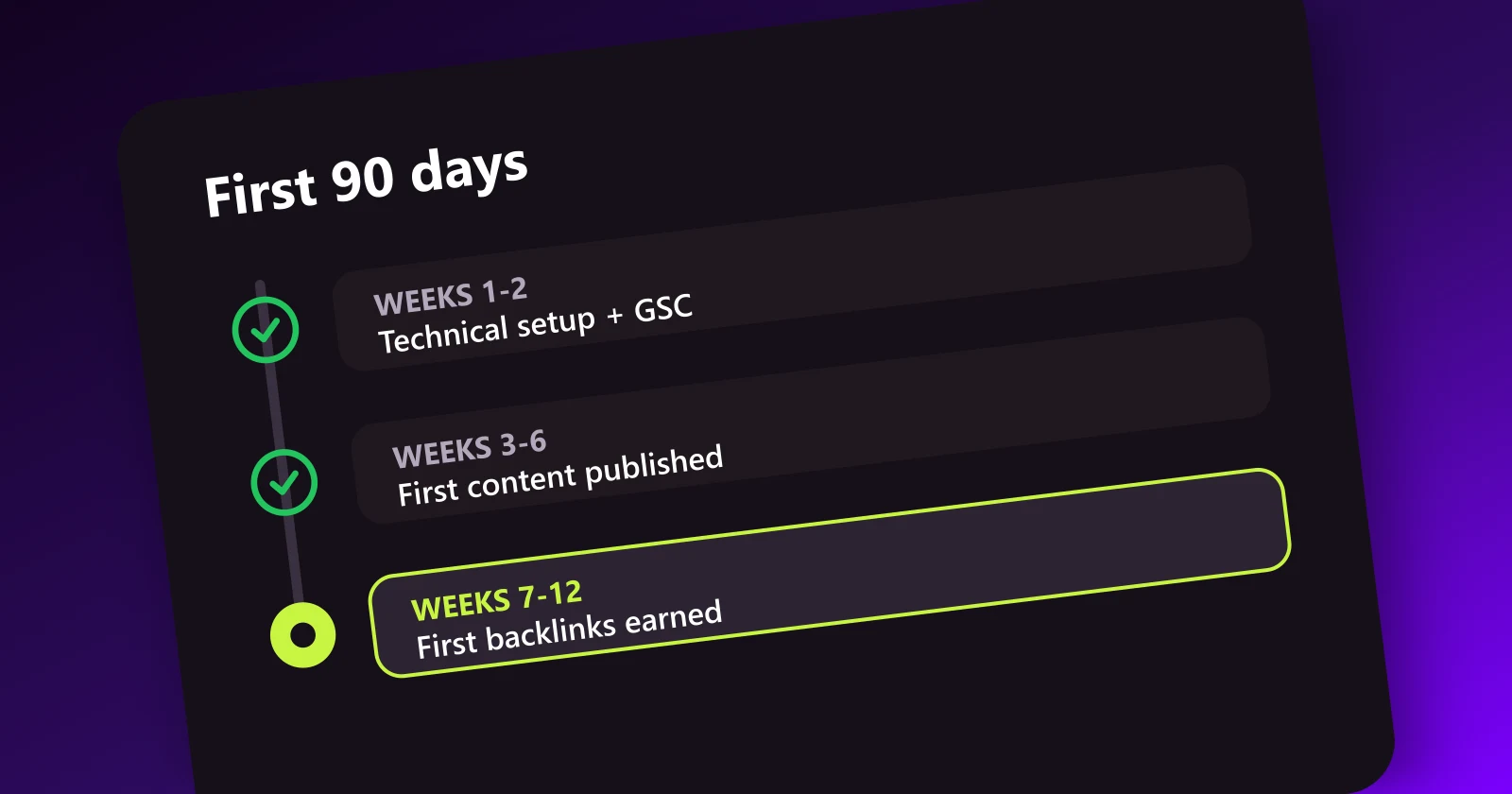
| Foundation | 1-2 | Technical setup, Search Console, site structure | Site crawlable, sitemap submitted, key pages indexed |
| First content | 3-6 | 6 to 10 articles on low-competition keywords | Pages indexed within days, first impressions in Search Console |
| Authority | 7-12 | Internal linking, first backlinks, iteration | 5 to 15 referring domains, first long-tail clicks, impressions climbing |
Now the week-by-week detail.
Weeks 1-2: the technical foundation
Nothing glamorous happens here, and skipping it quietly taxes everything you do later.
Week 1: make the site crawlable and measurable
- Set up Google Search Console immediately. Verify a Domain property via DNS. Do it today even if the site is half-empty: Search Console never backfills data, and the query data it collects becomes your best keyword source later. Our complete Search Console guide covers every step and every report.
- Submit an XML sitemap. Your CMS or framework almost certainly generates one at /sitemap.xml. Submit it in Search Console under Indexing, then Sitemaps.
- Check robots.txt and noindex tags. The classic launch disaster is shipping the staging configuration: a robots.txt that blocks everything or a sitewide noindex meta tag. Two minutes of checking prevents months of confusion.
- Force one canonical version. Pick https plus either www or non-www, and 301-redirect every other combination to it. One site, one address.
- Install analytics. Any privacy-friendly or classic analytics tool works. You need a baseline from day one.
Week 2: structure and speed
- Design a flat, logical structure. Every important page reachable within three clicks of the homepage. Decide your URL patterns now (short, lowercase, hyphens, no dates), because changing URLs later means redirects and lost momentum.
- Write the unglamorous pages. Homepage that says clearly what you do, about page with a real human behind the site, contact page. Google's quality systems and human visitors both look for these trust signals.
- Fix obvious speed problems. Compress images, pick decent hosting, avoid loading 2 MB of scripts. You do not need perfect scores, you need a site that loads in about two seconds on a phone.
- Confirm mobile rendering. Google indexes the mobile version. If content is hidden or broken on a phone, it effectively does not exist.
By the end of week 2, run a simple test: paste your homepage and two key pages into the URL Inspection tool in Search Console and request indexing. Within a week they should be indexed. If weeks pass and Google still ignores the site entirely, something specific is wrong, and we keep a full diagnostic checklist in why your site is not showing on Google so this roadmap does not have to detour into troubleshooting.
Weeks 3-6: first content, aimed at winnable keywords
Foundation done. Now you feed Google something worth indexing, and the single biggest decision of your first 90 days is which keywords you aim at.
Week 3: pick fights you can win
A new site cannot rank for "project management software" or "best running shoes". It can rank for specific, long-tail queries where the current results are weak: forum threads, thin pages, small sites, or nothing dedicated at all.
Spend a full week on keyword selection, not a rushed afternoon:
- List 5 to 10 seed topics your business owns.
- Expand each seed with Google autocomplete and the People Also Ask boxes. These are real queries, free.
- For every candidate, read the actual SERP. If the top 10 contains Reddit threads, thin content or sites as small as yours, it is winnable. If it is wall-to-wall major brands, park it for year two.
- Group keywords by intent into clusters, one cluster per planned page.
This method deserves more depth than one section, so we wrote the complete process in how to do keyword research without expensive tools. For a new site, the filter is simple: winnable beats voluminous, every single time. Ranking number 1 for a 50-searches-per-month query beats ranking number 40 for a 5,000-searches-per-month query, because position 40 is zero clicks.
Weeks 4-6: publish, properly
Target 6 to 10 solid pieces across these three weeks. A sustainable solo pace is one to two per week. For each piece:
- Answer the query completely. Read the top 3 ranking pages, then write something a reader would honestly prefer: more specific, more current, more experienced. Include the subquestions from People Also Ask as H2 or H3 sections.
- Show first-hand experience. Real numbers, real screenshots, real opinions. This is what separates you from the generic content flooding every niche, and it is what both Google and readers reward.
- Get the on-page mechanics right. Keyword in the title, one H1, descriptive headings, a meta description that earns the click. The full list lives in our on-page SEO checklist, and it takes ten minutes per article once it becomes habit.
- Request indexing for each new piece via URL Inspection. On a new domain, discovery is slow by default; this speeds it up.
Resist two temptations. First, do not spread across twenty disconnected topics: 8 articles on one tight theme build topical authority, 8 scattered articles build nothing. Second, do not pause publishing to obsess over rankings. At this stage, checking rankings daily is like weighing yourself hourly during a diet.
What the data looks like at day 45
Expect: all or most pages indexed, impressions in Search Console growing from zero to a few hundred per week, average positions ugly (30 to 80), and clicks close to zero. This is not failure. This is Google discovering you exist and running its first experiments. Impressions before clicks, positions before traffic. The curve always starts this way.
Weeks 7-12: internal links, first backlinks, iteration
You now have a crawlable site with a small library of decent content. Phase three adds the two force multipliers.
Weeks 7-8: wire the site together with internal links
Internal linking is the most undervalued lever on a new site, because it is entirely under your control and costs nothing:
- Make every article link to 2 to 4 of its sibling articles, with descriptive anchors (the target's topic, not "click here").
- Create or strengthen a hub page for your main topic that links down to every related article, and have each article link back up to it.
- Check Search Console's Links report for orphan pages, pages with zero internal links. Fix every one.
- Link from your homepage to your most important cluster. Homepage authority is the strongest you have; spend it deliberately.
This structure decides where your (still scarce) authority flows. The full method is in internal linking for SEO.
Weeks 9-12: earn your first backlinks
Backlinks remain the strongest trust signal Google has, and a new domain starts with none. The goal for the first 90 days is modest and realistic: 5 to 15 referring domains from relevant, real sites. Quality thresholds matter more than counts: one editorial link from a site in your niche with actual traffic beats twenty directory entries.
Where first links realistically come from:
- Easy legitimacy links: relevant industry directories, your professional profiles, local business listings if applicable. Low power, but they establish existence.
- Communities you genuinely participate in: answering questions well (with an occasional relevant link) in niche forums and Slack or Discord groups.
- Guest posts and podcast appearances in your niche: one or two well-placed pieces in 90 days is a fine pace.
- Something worth citing: a small original dataset, a free tool, a genuinely useful template. One linkable asset outperforms months of cold outreach.
- Link exchanges done correctly: swapping links with relevant sites works when it avoids the obvious A-to-B-and-B-to-A pattern. This is exactly the problem Meeeters solves: you give an editorial link to one site in the network and earn a verified link from a different one, so the exchange removes the reciprocal pattern entirely. Safety comes from niche relevance, real traffic and editorial placement, not from any trick. For a new site, it is one of the few ways to get relevant links without a budget or an existing audience.
We compared every early-stage tactic in how to get backlinks for free if you want the full menu. Whatever mix you choose, keep the velocity boring: a few links per month, steadily, from varied sources. A brand-new domain acquiring fifty links in a week looks exactly like what it usually is.
Point the links thoughtfully, too. Your homepage will collect most of them naturally, which is fine, but your two or three most strategic pages each deserve at least one direct external link in this window. A single relevant link to a specific article, combined with the internal links you wired in weeks 7 and 8, is often what nudges that page from position 15 into the top 10.
Weeks 9-12 in parallel: iterate on what Google shows you
While links trickle in, your Search Console data becomes actionable for the first time:
- Open the Performance report, Queries tab, and look for queries where you have impressions at positions 8 to 25.
- Strengthen the matching pages: expand the section that answers the query, add the query phrasing to a heading, point two or three internal links at the page.
- Note queries you get impressions for but never targeted. Google is suggesting your next articles. Write them.
- Keep publishing: one piece per week through week 12, prioritizing whatever the impression data says is closest to working.
This loop, read the data, strengthen, publish, repeat, is the entire job of SEO from here on. The first 90 days just build the machine that makes it possible.
What day 90 honestly looks like
Numbers from real launches, not from agency sales decks. A well-executed new site at day 90 typically shows:
- 15 to 30 pages indexed
- A few thousand impressions per month, trending up
- 30 to 150 organic clicks per month, mostly from long-tail queries
- 5 to 15 referring domains
- 2 or 3 keywords creeping into the top 20
If that sounds underwhelming, here is the part that matters: the trajectory from this base is not linear. The site that shows these modest numbers at day 90 with clean foundations, focused content and real links very often does 10 to 50 times these figures by month 8, because every signal compounds. The sites that stay flat are almost always the ones that skipped a phase: no keyword discipline, no internal structure, or zero links.
And if at day 90 you have zero impressions and zero indexed pages, do not push harder on content, something specific is broken. Start with the indexing diagnostic linked above instead, and fix the leak before pouring in more water.
A measurement cadence that keeps you sane
New-site SEO has a psychological failure mode: the feedback loop is so slow that founders either check obsessively and despair, or stop checking and drift. The fix is a fixed cadence with fixed questions.
Weekly, 10 minutes. Open Search Console, Performance report, last 28 days. Two questions only: are impressions higher than last week, and did any new query appear? On a young site, impressions are your heartbeat. Clicks and positions are too noisy to read weekly, so do not try.
Every two weeks, 20 minutes. Check the Indexing report: did new articles get indexed, and did anything you care about fall out? Then scan the Links report for new referring domains. Log three numbers in a simple spreadsheet: indexed pages, weekly impressions, referring domains. Ninety days of that log tells you more than any dashboard.
Monthly, one hour. The full loop: which queries have impressions at position 8 to 25, which pages should be strengthened, which suggested topics should enter the writing queue. This is also when you allow yourself to look at clicks and celebrate the small absolute numbers, because their growth rate is the real signal.
What you should refuse to do: daily rank checking, comparing your month 2 to a competitor's year 5, and reacting to single-day dips. Organic data on a small site is noisy by nature. One article indexed or one link earned changes your week far more than any fluctuation you can observe.
Adapting the roadmap to your site type
The 90-day skeleton holds for every site, but the emphasis shifts:
- Local businesses should add a Google Business Profile in week 1, treat local directories and review platforms as their first links, and target "service plus city" keywords, which are usually far less competitive than national terms. For many local niches, this alone produces leads inside the 90 days.
- Ecommerce sites should spend weeks 3 to 6 on category page content and buying guides rather than blog posts. Product pages rarely earn links; guides and comparisons do, and they funnel authority to the money pages through internal links.
- SaaS and startups (our own case with Meeeters) get the most from problem-focused long-tail content: every specific pain your product solves is a keyword cluster. Comparison and alternative pages ("X vs Y", "alternatives to X") convert best but often need a few links before they crack page one, so publish them early and let them mature.
- Content and affiliate sites live and die by keyword selection discipline. With no product to differentiate, winnability analysis is the whole game, and the temptation to chase volume instead of winnable queries is the most common cause of a dead-flat month 6.
Whatever the type, the invariants do not move: crawlable foundation first, winnable keywords second, internal structure third, real links fourth.
The mistakes that waste a launch
Five patterns I see repeatedly, each expensive:
- Buying cheap backlink packages in month one. Fifty spam links pointed at a ten-page site does not accelerate anything, and cleanup costs more than the links did.
- Publishing thirty AI-generated articles in week one. Google indexes a few, evaluates them as thin, and starts distrusting the whole domain. Slower and better wins.
- Redesigning instead of publishing. Nobody ranks or fails because of a font choice. Ship content.
- Changing URLs casually. Every URL change on a young site resets that page's small accumulated trust. Decide the structure in week 2, then leave it alone.
- Quitting at week 10 because traffic is flat. The single most common mistake. The flat weeks are the system working as designed: Google is watching whether you persist. Most competitors quit here, which is precisely why persisting works.
Your next 90 days start with a baseline
Everything in this roadmap flows from knowing where you stand: what is indexed, what gets impressions, what is broken. That is a fifteen-minute check when you know what to look for, and it is exactly what our free SEO analysis does for you: it audits your site, shows the keywords and pages to write in your niche, and lets you earn your first verified backlink through the Meeeters network. Foundation, content, links, in that order. Day one is today.
Frequently asked questions
Quick answers to the questions people ask most about this topic.
For most new sites, meaningful organic traffic starts between month 4 and month 8. The first 90 days produce indexing, first impressions, and a few long-tail clicks. If someone promises page-one rankings in 30 days on a fresh domain, they are selling something other than SEO.
Google denies a formal sandbox, but the observed behavior is consistent: new domains rank slower than established ones for months, even with better content. Whether you call it a sandbox, a trust deficit, or a lack of accumulated signals, the practical advice is identical: target low-competition keywords early and build real signals patiently.
Eight to fifteen genuinely useful pieces beat forty thin ones. A realistic solo pace is one to two solid articles per week from week 3 onward. Depth and intent match decide rankings, and a small library of excellent pages also gives other sites a reason to link to you.

I built Meeeters to make link building safe and simple: real, relevant backlinks with no reciprocal footprint and no black-hat shortcuts.