What Is a Backlink Audit: Definition and Why Your Site Needs One

TL;DR
- A backlink audit is a systematic review of all external links pointing to your website, evaluating their quality, relevance, and potential impact on rankings
- It identifies toxic or harmful links that may trigger search engine penalties, as well as high-quality opportunities you can leverage
- The process examines link source authority, anchor text relevance, placement context, and whether links are dofollow or nofollow
- Most sites benefit from audits when launching new SEO initiatives, after a negative ranking shift, or before major domain migrations
A backlink audit is a comprehensive analysis of every external link pointing to your website. It reveals which links help your rankings, which ones pose a risk, and where your competitors are winning backlink real estate you should target.
Unlike a surface-level link count, a proper audit examines the quality and context of each link: the authority of the referring domain, the relevance of anchor text, whether the link sits in natural editorial content or a footer, and whether it carries ranking weight (dofollow) or not. This intelligence lets you decide which links to keep, which to disavow, and where to focus new link acquisition efforts.
The Core Definition: What Gets Audited
A backlink audit inventories all inbound links to your domain and rates each one against criteria that matter to search rankings. It answers three essential questions:
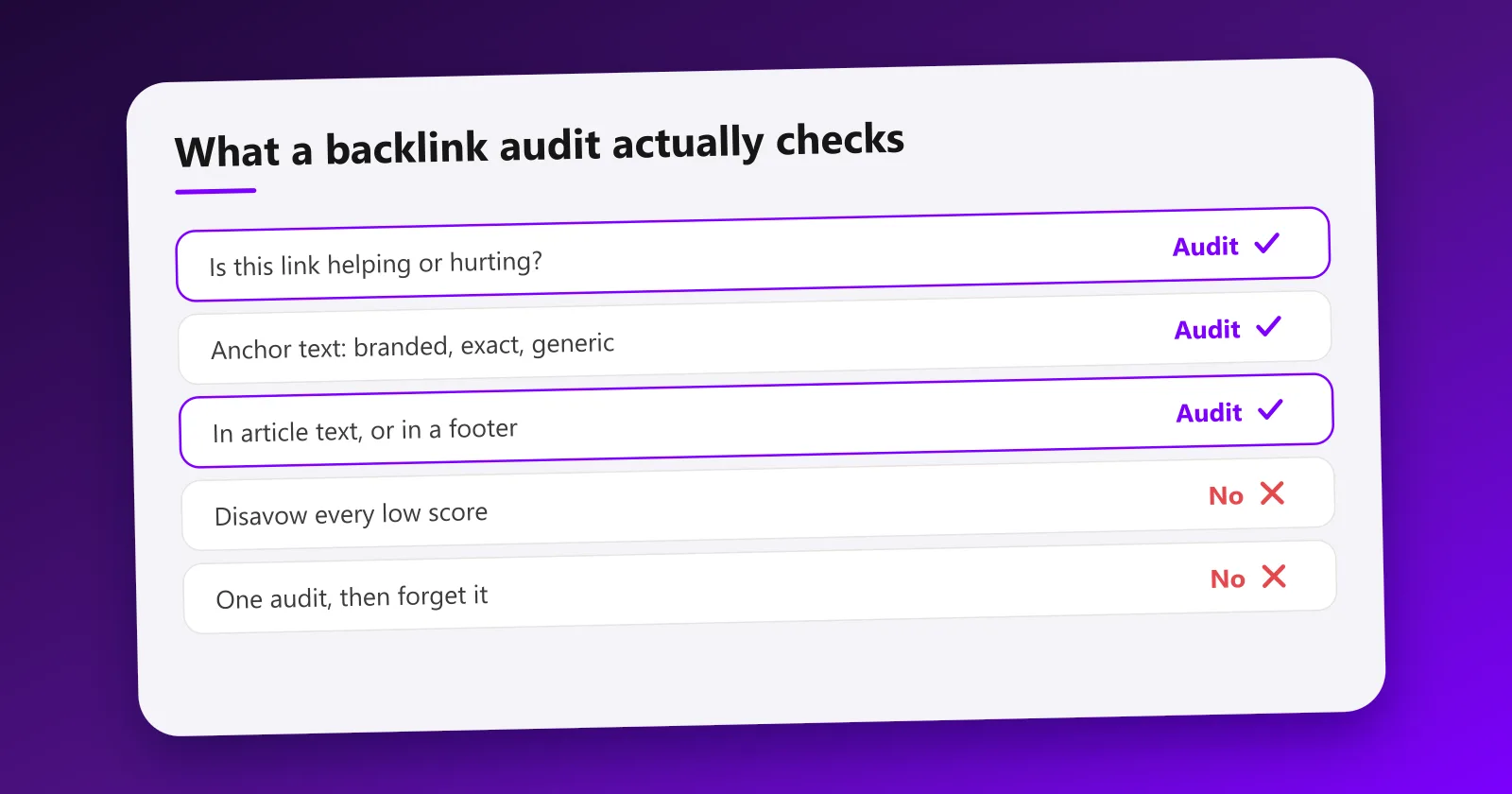
- Is this link helping or hurting? A link from a spammy or unrelated site can signal poor quality to Google, even if you didn't seek it out. A link from a topically relevant, authoritative site almost always helps.
- What anchor text does it use? The clickable text of a link ("SEO tools" vs. "click here") tells search engines what your page is about. Unnatural anchor text patterns can trigger manual review or algorithmic penalties.
- Where does it sit in the page? A link buried in a widget footer carries less weight than one embedded naturally in article text. Context determines trustworthiness.
The audit compiles these findings into a report that separates links by quality tier, flags suspicious patterns, and prioritizes action items. This is not a one-time checklist: as your link profile grows, new links arrive (some unsolicited), and the competitive landscape shifts, an audit's value lies in repeating it quarterly or semi-annually to catch changes early.
How a Backlink Audit Works in Practice
The audit process follows a repeatable sequence:
Step 1: Data Collection. An audit tool crawls backlink databases (which track links discovered across the web) and exports every link pointing to your root domain, subdomains, or specific pages. This includes links that have been live for years and those added yesterday. Most professional tools can access millions of links; the export often runs into thousands for established domains.
Step 2: Authority and Relevance Assessment. Each link source is scored on metrics like domain authority, topical alignment, spam signals, and language. A link from a health blog to your e-commerce shoe site scores lower than a link from a running magazine, even if both have similar authority scores. The audit flags where your link sources cluster and where they diverge from your actual content niche.
Step 3: Anchor Text Analysis. The tool groups anchor text by type: branded (containing your company name), exact-match (containing your target keyword), partial-match (keyword + other words), and generic ("click here," "read more"). A healthy profile has variety; too many exact-match anchors look manipulative and invite algorithmic review.
Step 4: Toxicity Screening. The audit scans for red flags: links from known spam networks, private blog networks (PBNs), link farms, or domains with sudden authority drops. These are flagged for potential disavowal. Some links are obvious (a link from a pharmaceutical spam site); others are subtler (a link from a once-reputable domain that was hacked and filled with unrelated content).
Step 5: Competitive Benchmarking. Many audits include a view of your backlink profile versus competitors' profiles. You see which high-authority sites link to them but not you, which anchor text strategies they favor, and where gaps exist. This benchmarking phase often surfaces acquisition targets: if three competitors have links from the same industry publication and you don't, that publication becomes a prospect.
Step 6: Reporting and Action Plan. The final step synthesizes findings into a prioritized to-do list: disavow toxic links, pursue high-impact prospects, rebalance anchor text, or investigate sudden link loss. A well-structured audit report shows not just what's wrong, but why it matters and what to do next.
Common Mistakes That Derail Backlink Audits
An audit is only valuable if you act on it correctly. Here are the traps that undermine the process:
Disavowing too aggressively. New SEOs sometimes disavow every link with a poor trust score, fearing penalty. In reality, Google ignores low-quality links by default; they don't need disavowal unless they're actively harming you. Disavow only if a link comes from a known spam domain, a hacked site, or a private network, or if you notice a manual action notice in Search Console. Disavowing good links by mistake is harder to reverse and can confuse your link signal.
Ignoring link loss signals. An audit that shows you lost fifty links last month is an early warning. Common causes include site migrations gone wrong (old URLs didn't 301-redirect), referring sites deleting pages, or link removal due to unrelated policy changes. Investigating loss patterns prevents future repeats and can recover broken redirects quickly.
Confusing backlink count with quality. A site with 500 high-quality links will outrank a site with 5,000 mediocre ones. Audits reveal this imbalance. If your competitor has 2,000 backlinks but yours average much lower authority scores, your problem isn't link quantity; it's targeting low-authority sources. Recalibrate your acquisition strategy toward higher-bar prospects.
Overlooking nofollow as valueless. Nofollow links (marked with rel="nofollow") don't pass ranking weight directly, yet they still carry indirect value. Nofollow from high-authority news sites or social platforms builds brand awareness, drives referral traffic, and establishes topical authority. An audit that flags all nofollow as "low-priority" misses this nuance. Treat nofollow links as separate from ranking levers, not as clutter.
Setting and forgetting. An audit is a snapshot. Doing one audit and implementing its findings without repeating the analysis every few months means you'll miss new toxic links, competitive shifts, or your own link velocity changes. Audits only stay actionable if they're cyclical, especially in competitive niches where link ecosystems evolve fast.
Why Toxic Links Don't Always Trigger Penalties (But Can Weigh You Down)
A widespread misconception is that a few bad backlinks cause immediate ranking drops or manual penalties. In practice, Google's algorithms are more forgiving than most people assume.
Google's indexing systems see thousands of spam links daily. Most of them are noise that the algorithm simply discounts rather than penalizes. You might have twenty links from obvious link-selling sites without triggering a manual action notice. However, the algorithm still perceives these links as signals of lower quality, and they contribute to a lower overall trust score for your domain.
Penalties (manual actions) are reserved for patterns that suggest intentional manipulation: buying links in bulk from the same network, participating in private blog networks, or engaging in excessive reciprocal linking schemes. A stray sketchy link or two won't activate a penalty; a coordinated pattern will.
This distinction matters for audit prioritization. You don't need to disavow every marginal link; you need to identify whether your profile contains a pattern of manipulation. An audit reveals this pattern. If 5% of your links come from obvious spam, that's noise. If 40% do, you have a problem that warrants disavowal or deeper investigation into how those links arrived (compromised content, previous vendor's spam tactics, etc.).
Building Your Audit Cadence: When to Audit and What Triggers Urgency
Backlink audits aren't a once-per-year ritual. The right frequency depends on your link velocity, competitive environment, and business goals.
Immediate audit triggers. If you notice a sudden ranking drop across multiple keywords, run an audit immediately. Check Search Console for manual action notices first, but if none appear, a link audit can reveal whether the drop correlates with lost high-authority links, new toxic links, or anchor text anomalies. Similarly, if you inherit a new website or acquire a competitor's domain, audit before redirecting or migrating; you need to know what you're inheriting.
Ongoing cadence. For most sites, quarterly audits strike the right balance. This interval catches seasonal link patterns, competitive moves, and new opportunities without becoming a resource drain. High-velocity sites (those aggressively building links or operating in ultra-competitive niches) benefit from monthly audits. Low-traffic or stable sites might audit semi-annually.
Pre-launch audits. Before a major technical migration, domain consolidation, or redesign, audit your current link profile. This baseline helps you measure whether the migration preserved link equity, or if redirects failed and link value was lost.
Audits also inform link acquisition strategy. If your audit shows competitors cluster around certain publication types or authority tiers you're missing, those become your next targets. If your anchor text is too skewed toward exact-match keywords, you know to diversify future acquisition.
When Link Builders and SEO Agencies Conduct Audits
Link-building agencies and firms providing full-service digital marketing services often conduct audits as the first step of an engagement. This serves two purposes: it establishes baseline metrics to prove later impact, and it surfaces quick-win disavow opportunities or low-hanging competitive gaps. A transparent agency will share the audit findings with you and align the strategy accordingly, rather than running an invisible audit and presenting only recommendations.
If you're hiring an external party to manage your backlink strategy, request that they provide a detailed audit report, not just a summary. This report should list specific links they plan to pursue, competitors they're targeting, and metrics they'll track over time. An audit without transparency is often a sign the agency hasn't done rigorous homework.
The Gap Between Audit Reports and Actual Ranking Impact
Here's a reality check many audits gloss over: identifying a high-quality backlink opportunity and actually securing it are two different challenges. An audit might show you that competitors have links from industry publications you don't, but publications rarely link without a newsworthy angle or genuine relationship.
An audit reveals what you need; it doesn't solve the distribution, outreach, or content problem of getting those links. The best audits pair competitive gap analysis with a realistic assessment of your content's linkability. If you're a SaaS tool and competitors get links from tech blogs, that's actionable because tech blogs link to tools. If you're an e-commerce site and competitors link from industry events, that's actionable if you attend or sponsor those events.
Weaker audits present a wishlist of competitor links without context on how those links were earned. Better audits explain the type of link (news mention, directory, resource page, partnership, sponsorship) so you can map a realistic path to earning similar ones.
FAQ
What's the difference between a backlink audit and a backlink report?
A backlink report is a list of links pointing to your site, typically showing domain authority, anchor text, and link type. An audit goes further: it interprets that data, flags problems, benchmarks against competitors, and prioritizes actions. A report is raw data; an audit is analysis plus a roadmap. Many tools offer reports; fewer offer true audits with actionable insights.
How do I know if a link is toxic and needs disavowal?
Disavow a link if it comes from a known spam domain, a hacked website, a private blog network, or a site that was once legitimate but is now filled with unrelated spam. You can also disavow links with unnatural anchor text if you didn't build them and they appear as part of a larger spam pattern. If you're unsure, check the referring page: does it look like a real website with real content, or is it clearly a link farm or spam hub? When in doubt, leave it; disavowal is irreversible and unnecessary for links that are simply low-quality.
Can a backlink audit prevent Google penalties?
Yes, if it catches patterns early. An audit that reveals 30% of your links come from a private blog network lets you disavow before Google's systems penalize you. Similarly, if your audit shows anchor text is 90% exact-match keywords, you know to diversify before triggering an algorithmic review. Audits are detective work; they spot risks before they become penalties.
How often should I check my backlink profile?
At minimum, quarterly. This catches seasonal trends and competitive shifts in time to respond. If you're actively building links, monthly audits help you measure velocity and quality of your own placements. If your site is stable and you're not investing in link building, semi-annual audits suffice. Always audit after a ranking drop, before a major migration, or when competitors suddenly outrank you.
Should I worry about links I didn't build myself?
Not all of them. Natural links (earned because your content was genuinely good) are always positive. You should worry only if unsolicited links follow a spam pattern: hundreds from the same network, thousands with identical anchor text, or links from irrelevant or clearly spammy domains. Google's algorithm discounts these automatically; only disavow if you spot a coordinated pattern or receive a manual action notice.
What's a site strength score and how does it relate to a backlink audit?
A site strength score is a composite metric that combines backlink quality, domain authority, content quality, and other factors into a single number. A backlink audit feeds into that score by assessing your link profile; an audit showing high-quality, relevant links will improve your strength score, while one revealing toxic links will lower it. The score itself isn't actionable, but the audit that informs it is.

I built Meeeters to make link building safe and simple: real, relevant backlinks with no reciprocal footprint and no black-hat shortcuts.
Related searches, answered
What people actually type before landing here, with the short answer and where to read more.
- Backlink audit
- An audit answers three things: what you have, what you lost, and what you would not want a reviewer to see.The step-by-step audit ›
- Backlink audit report
- Group the report by referring domain and by status. A per-link list is unreadable past a few hundred rows.What to monitor continuously ›
- Backlink audit guide
- Most audits end in no action, and that is the correct outcome for a profile built without paid links.When disavowing is wrong ›
- How often should you audit backlinks?
- Once or twice a year is enough unless you changed agency, bought links, or lost rankings suddenly.What Google punishes ›
- Free backlink audit
- Search Console's links report is free and authoritative for what Google itself has recorded.Using the links report ›