Do AI Content Detectors Work? And Do They Matter for SEO?

Somewhere right now, a marketer is rewriting a perfectly good paragraph for the fourth time because a browser tool says it is "62% AI." The paragraph was written by a human. This is the state of AI content detection: confident percentages, unreliable foundations, and an entire optimization ritual aimed at a signal Google says it does not use.
What detectors actually measure
No tool can see who typed a text. What detectors measure is statistical predictability: how closely the word choices match what a language model would choose. Predictable, low-variance prose scores "AI"; erratic, high-variance prose scores "human."
The problem is that predictability is not authorship:
- Good human writing is often predictable. Clear structure, conventional phrasing and consistent terminology, the things editors enforce, all lower variance. Technical writers, legal drafters and non-native English speakers get flagged constantly, a false-positive pattern documented enough that many universities walked back detector-based misconduct rulings.
- Edited AI writing is often unpredictable. Ten minutes of real editing, cutting filler, inserting your own data and voice, moves generated text past most detectors, not because you gamed them but because the text genuinely changed.
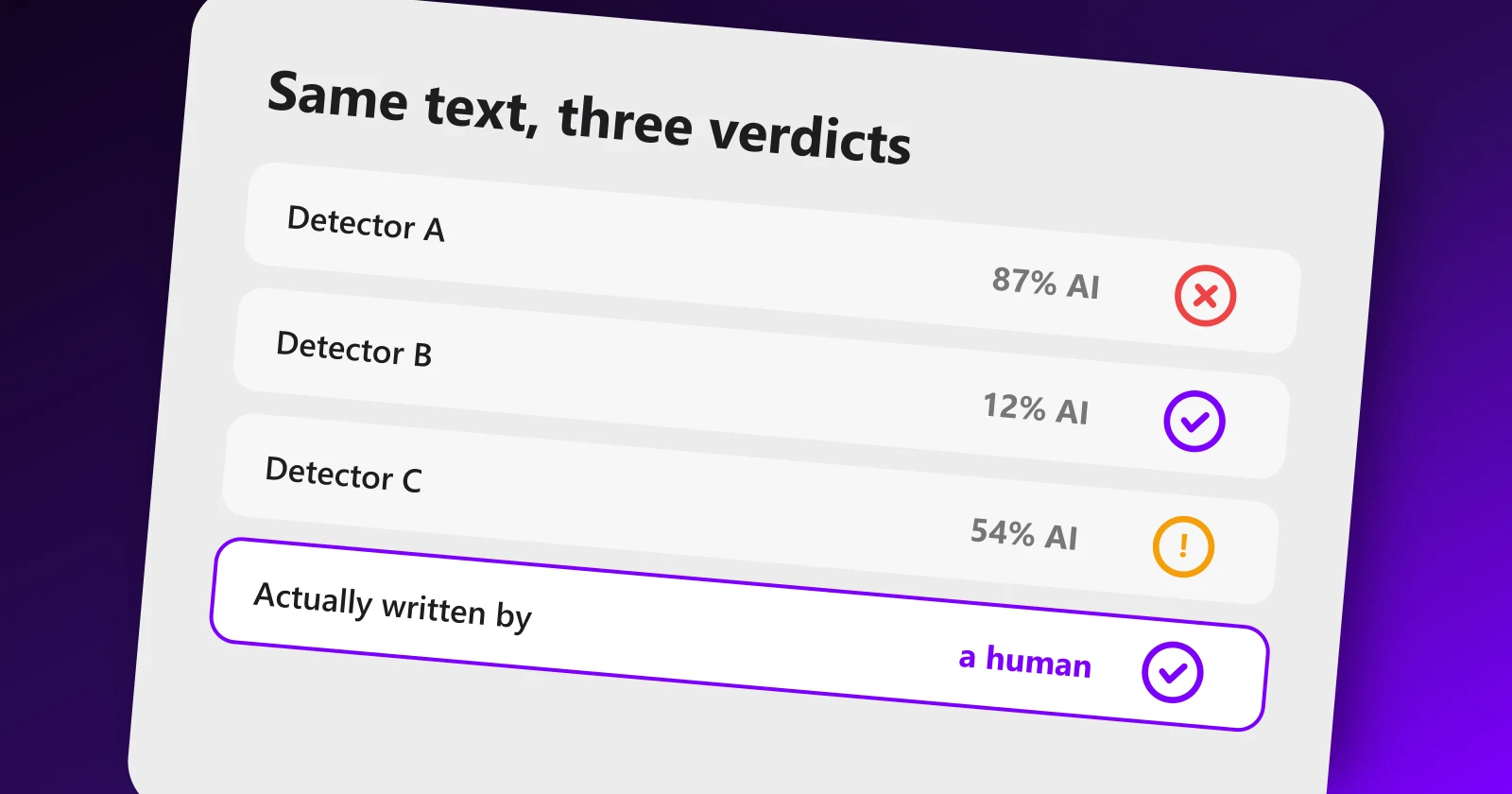
Run the same article through three detectors and you will routinely get three verdicts. A measurement that unstable is not evidence of anything.
What Google actually does
Google has been unusually direct here: it rewards helpful content however it is produced, and its spam policy targets scaled content abuse, mass pages made to manipulate rankings, not authorship. Nothing in its documentation describes an authorship classifier, and the enforcement record backs that up: the sites hit in the March 2024 wave were not caught for "being AI," they were caught for publishing thousands of pages nobody reviewed, a pattern visible without any detector.
Think about Google's incentives and this makes sense. False positives at web scale would demote legitimate publishers by the thousand, and the signals it already has, originality, accuracy, engagement, sitewide quality, catch bad content regardless of its origin. Authorship is simply the wrong variable to police.
The "humanization" trap
An entire tool category now sells the opposite service: rewriting AI text until detectors score it human. Understand what this pipeline optimizes. It takes generated text, degrades its clarity with synonym-swaps and syntax noise, and outputs prose that is less readable but statistically noisier. The page is exactly as thin as before; it just costs more.
This is cargo-cult compliance: treating the detector score as the risk, when the risk was always an unreviewed page with nothing to say. A page can score 100% human and get suppressed for being useless. A page can score 90% AI and rank for years because it is accurate, specific and sits on an authoritative domain. The score is not in the ranking function; quality is.
What to do instead
Take the hour you were going to spend on detection roulette and spend it where rankings are decided:
- Verify and enrich. Facts checked, generic filler cut, your own numbers and examples in. This is the ten-minute editing pass, and it improves the page for readers and rankings simultaneously, detector score is a side effect you never have to look at.
- Publish only pages with a reason to exist. Selection from your site's real gaps, not keyword dumps, the heart of a safe content workflow.
- Build the authority. Content earns relevance; backlinks earn the authority that decides competitive queries. No detector score substitutes for referring domains.
If you want to know where your site actually stands on the variables that matter (structure, missing pages, authority), a free SEO analysis will tell you in minutes, with no percentage theater involved.
Frequently asked questions
Quick answers to the questions people ask most about this topic.
Inconsistent at best. The same text scores differently across tools and across runs, non-native English writers get flagged disproportionately, and lightly edited AI text passes easily. No detector output should be treated as proof in either direction.
Google has stated it rewards helpful content however it is produced and its spam policy targets scaled content abuse, not authorship. Its systems evaluate quality, originality and satisfaction signals, which unreviewed AI content fails on its own.
It is mostly wasted effort. A page can score 100% human and still be thin, generic and unrankable. Use the editing time to verify facts and add first-hand specifics instead; those move rankings, a detector score does not.
Detectors measure statistical predictability. Clear, structured, conventional writing, exactly what good editing produces, looks predictable, so false positives on human text are common and well documented.

I built Meeeters to make link building safe and simple: real, relevant backlinks with no reciprocal footprint and no black-hat shortcuts. Questions about your site? Write to me directly.
Email us