Hit After Scaling AI Content? A Recovery Plan That Works

The pattern is always the same in the forums. Traffic grew for six months while the pipeline published daily, the dashboard was a staircase going up. Then one dated drop, 60 to 90 percent, every page at once. If that is you, skip the denial phase: the site was re-evaluated, the inventory failed, and recovery is a demolition project before it is a construction one. Here is the sequence that works, and the shortcuts that don't.
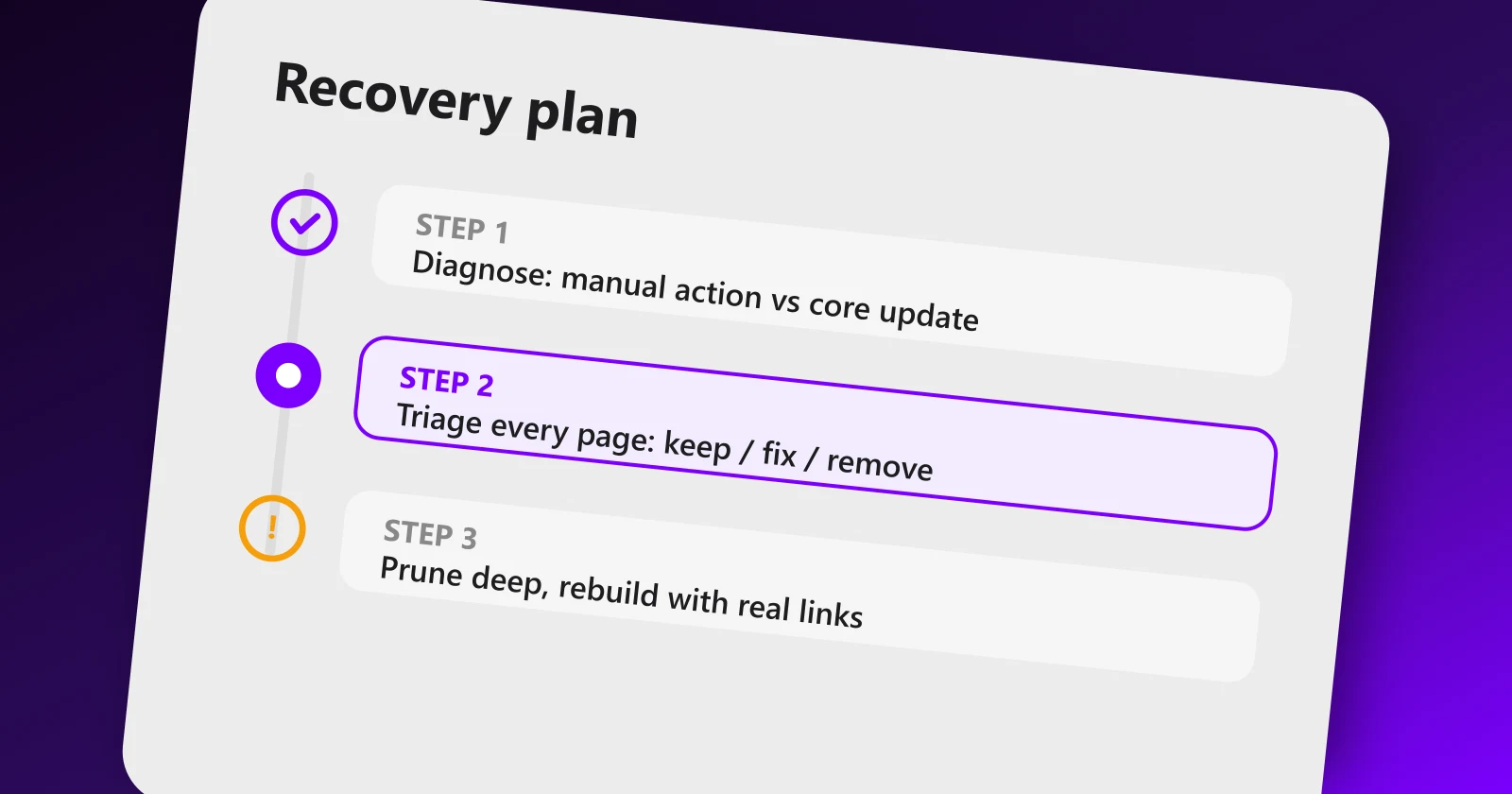
Step 1: Diagnose which enforcement hit you
Open Search Console → Manual Actions. This fork decides your whole plan:
- A manual action is listed (typically naming spam or scaled content abuse): a human reviewed your site. Bad news, but with a door: fix the violation thoroughly and file reconsideration with documentation of what you removed. Reviewers reject cosmetic cleanups, so do the full Step 3 before filing.
- Nothing is listed and the drop aligns with a core update date: algorithmic re-evaluation. No penalty to appeal, no form to file: your domain's quality signals were re-scored with the thin inventory included. The only path is making the site genuinely better and being re-measured, which happens on Google's schedule, usually at later core updates.
Either way, resist the reflex to keep publishing. Adding pages to a site whose problem is unreviewed volume is bailing water into the boat.
Step 2: Triage the entire inventory
Export every URL with its traffic, impressions, referring links and publish source. Sort each into three buckets, and be brutal, because the middle bucket is where recoveries die:
- Keep: pages with traffic, links, conversions or genuine usefulness. These are your site's actual value; protect them.
- Fix: pages targeting real gaps in your structure, currently thin. These get a true rewrite (verified facts, first-hand detail, the full editing pass), not a paraphrase, which changes nothing Google measures.
- Remove: pages with no traffic, no links, no purpose beyond the rankings they no longer have. On a site that mass-published, this is usually 60–90% of the inventory. Delete them, return 410 or redirect to a genuinely relevant page.
The test for "fix vs remove" is the existence test: would you build this page today, from your site's real structure? If the only argument for a page is "it's already written," it goes.
Step 3: Prune completely, then rebuild the signals
Partial cleanups fail, and it is worth understanding why: sitewide quality is effectively a ratio, and keeping four hundred thin pages while rewriting twenty leaves the ratio broken. Every credible recovery story shares the same shape: deep pruning first, then a slower, reviewed publishing cadence that never again outruns review capacity.
While the content side heals, work the variable that mass publishing ignored: authority. Thin-content sites almost always have hollow link profiles, because volume was supposed to substitute for links and never does. Earning relevant, verified backlinks does double duty in recovery: it rebuilds the trust signals that got discounted and gives your surviving pages the push they needed all along. The safe mechanics are in our link building silo; the one-way network model is how Meeeters does it without adding scheme risk to a site that cannot afford any.
Step 4: Wait like a professional
Set expectations in months. Manual actions can clear in weeks after a solid reconsideration; algorithmic recoveries typically register at the next core update or the one after. Use the time to run the workflow you should have had: audit-driven page selection, reviewed drafts, links in parallel. A free SEO analysis is a clean way to restart: it maps what your pruned site is actually missing, so the rebuild publishes from a to-do list instead of a quota, and the next update finds a site worth ranking.
Frequently asked questions
Quick answers to the questions people ask most about this topic.
Check Search Console's Manual Actions report. A listed action names the policy and offers reconsideration. Nothing listed plus a drop aligned with a known update date means algorithmic re-evaluation, which has no appeal, only improvement and time.
Decide per page on value, not authorship. Pages with traffic, links or real usefulness are worth a genuine rewrite with review. Pages with none of those should be deleted and 410/redirected; rewriting hundreds of worthless pages just burns the time you need for recovery.
Plan in months. Algorithmic reassessment typically surfaces at subsequent core updates, so even a perfect cleanup often shows its effect one or two update cycles later. Manual action recoveries move faster once reconsideration is approved.
Rarely. Sitewide quality is the signal that collapsed, and it is a ratio. Keeping hundreds of thin pages while polishing a few keeps the ratio broken. Every documented recovery involves substantial pruning.

I built Meeeters to make link building safe and simple: real, relevant backlinks with no reciprocal footprint and no black-hat shortcuts.