SEO Content Automation Agency Pricing: What Drives the Real Cost (Not Just the Sticker Price)

If you have been collecting quotes for SEO content automation and they range from a few hundred dollars a month to five figures, you are not imagining things. This market has almost no standardized pricing, and two agencies quoting "the same" service can differ by 5x depending on how much human QA sits behind the automation. This article breaks down the actual pricing structures you will encounter, what pushes a quote up or down, and the mistakes that quietly turn a cheap plan into an expensive one six months in.
What does SEO content automation agency pricing actually look like?
SEO content automation pricing typically falls into four bands, depending on how much of the work is pure software versus managed human oversight. A self-serve SaaS-only plan can cost as little as $50 to $300 a month, while a full hybrid agency service with editorial QA, on-page optimization, and internal linking can run $2,500 to $8,000 a month, and enterprise engagements with custom integrations climb higher still.
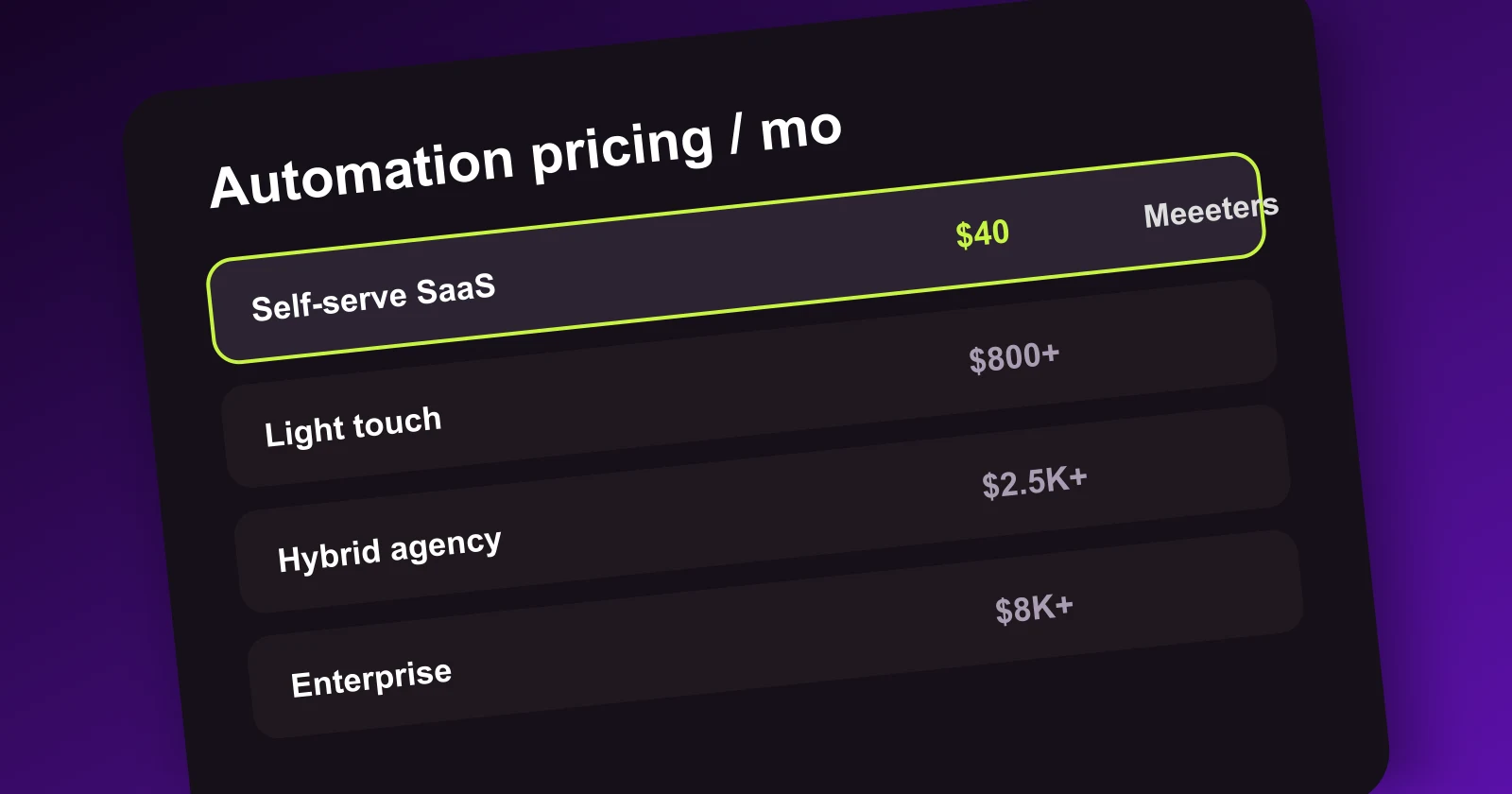
Here is a realistic breakdown, presented as ranges rather than fixed prices, since actual quotes vary by page volume, niche competitiveness, and market:
| Tier | Typical monthly | Usually included | Best fit |
|---|---|---|---|
| Self-serve SaaS only | $50 to $300 | Platform access, AI drafting credits, basic templates, no dedicated human review | Teams with an in-house editor who just needs drafting speed |
| Meeeters (self-serve) | Free, then $40 / mo | Audit-driven page selection, AI drafting, publish to CMS, you review before it goes live | Teams that want audit-driven drafting at a self-serve price |
| Managed automation, light touch | $800 to $2,500 | AI drafting, keyword clustering, one light human edit pass, roughly 10 to 40 pages a month | Startups and small businesses testing content automation |
| Full hybrid agency (automation plus editorial) | $2,500 to $8,000 | AI drafting, senior editor QA, on-page optimization, internal linking, 20 to 80 pages a month | Growth-stage companies that need volume without sacrificing quality control |
| Enterprise / custom | $8,000 to $25,000+ | Custom CMS or API integrations, multilingual or multi-market production, dedicated strategist | SaaS platforms and e-commerce brands with hundreds of pages in scope |
The four market bands are illustrative benchmarks based on common structures, not a quote for any specific engagement. The highlighted row shows Meeeters' actual self-serve pricing.
For reference, Meeeters sits at the self-serve end of that map: free to start, and $40 a month for Pro (which unlocks around 30 AI-drafted articles a month, published straight to your CMS). What makes that band worth a closer look is covered below in "Where Meeeters fits," because the useful question is not which band you land in, but why two vendors in the same band deliver very different outcomes for a similar price.
How these pricing models actually work under the hood
Agencies and SaaS-hybrid vendors in this space generally use one of five pricing mechanisms. Understanding which one you are being quoted lets you compare proposals that otherwise look incomparable.
1. Per-word or per-article pricing
You pay a flat rate per piece or per thousand words, often $0.05 to $0.30 per word depending on the depth of human editing layered on top of the AI draft. This model is easy to budget but, as we get into later, it quietly rewards volume over relevance.
2. Flat monthly SaaS subscription
You pay a fixed fee for platform access, AI credits, and basic tooling like content briefs or keyword clustering, with little to no dedicated human labor included. This is the cheapest entry point and the one most likely to produce content that needs heavy internal rework before it is publishable. See automated SEO tools for how these platforms differ.
3. Managed retainer with a deliverable cap
You pay a monthly fee for a defined number of pages, typically bundled with a set number of revision rounds (commonly one to three per piece) and a stated human QA ratio, for example one editor reviewing a defined batch of drafts before publication.
4. Hybrid retainer plus performance kicker
A base retainer covers production, with a smaller variable component tied to agreed outcomes such as pages indexed or keyword positions reached within a review window. This model shifts some risk to the agency but usually requires a longer initial commitment to be workable.
5. Custom enterprise contracts
Pricing is negotiated around specific integrations (CMS, PIM, API-based publishing), multi-market or multilingual scope, and dedicated strategist hours, and it rarely maps cleanly onto any published rate card.
Do this: before signing anything, run every vendor through the same checklist, regardless of tier:
- How many revision rounds are included per piece, and what happens past that number
- What percentage of drafts get a human editorial pass versus going straight from AI to publish
- Whether internal linking, meta optimization, and content refreshes are included or billed separately
- Whether the quoted page volume is drafts delivered or pages actually published
- What the minimum contract length is and whether there is a month-to-month exit option
- Whether onboarding, keyword research, or topical mapping carry a separate setup fee
Pricing mistakes that quietly inflate the real bill
Most budget overruns in this category do not come from a bad initial quote. They come from what the quote does not mention.
The first is treating a low monthly retainer as the full cost when internal linking passes, content refreshes, or additional revision rounds are billed as add-ons. It is not unusual for these extras to add 20 to 40 percent to the effective monthly spend once a campaign is a few months in.
The second is confusing drafts delivered with pages published. An agency quoting "40 pieces a month" may be counting AI drafts before human QA, not pages that actually clear editorial review and go live. If your internal team has to rewrite a meaningful share of what is delivered, your real cost per usable page is higher than the sticker price suggests.
The third is signing annual contracts without an exit clause to save on the headline rate. A 10 to 15 percent annual discount can look attractive, but if the content quality or fit is wrong after two months, you are locked into paying for months of output you cannot use.
The fourth is ignoring the human QA ratio entirely. A vendor advertising "AI-powered content at scale" without specifying how many drafts a single human editor reviews before publication is often signaling that quality control is thin. This connects directly to whether AI content holds up for SEO in the first place, worth researching on its own before you commit budget.
The fifth, and the one most buyers overlook, is comparing cost per word across vendors as if it were a like-for-like metric, when the underlying automation-to-human ratio behind that word is completely different from one agency to the next.
The incentive trap almost no agency will tell you about
Here is the part fewer than one in ten providers in this space will say out loud: per-word and per-article pricing structurally rewards the agency for producing more content, not for producing content that should exist. If a vendor is paid by the word or by the piece, there is a built-in incentive to pad length, split topics that should be consolidated, or keep publishing low-intent pages that add volume to the invoice without adding ranking value.
The fix is not to avoid per-word pricing altogether, since it can work fine for well-scoped, high-volume categories like product descriptions. The fix is to benchmark against a different unit entirely: cost per page still live and indexed at 90 days, rather than cost per draft delivered. A plan that costs slightly more per word but has a near-zero scrap rate, because the pages that should not exist are caught before publication, will almost always beat a cheaper per-word plan where a meaningful share of output gets pruned, no-indexed, or rewritten later.
A related and equally underused benchmark is the human QA ratio itself. If an agency cannot tell you how many AI drafts one editor reviews per week, or what their internal revision rate looks like before publication, you are effectively pricing a black box. Asking a vendor to quote both cost-per-draft and estimated cost-per-published-page-at-90-days forces a level of transparency that most rate cards are not built to provide, and the answer (or the refusal to answer) tells you more about pricing fit than the headline number ever will.
Where Meeeters fits in this pricing map
Meeeters is deliberately at the self-serve end: free to start, $40 a month for Pro. But it is built around the exact benchmark this article argues for, cost per page that should exist, not cost per draft.
- It decides which pages are worth writing before it drafts. A free SEO analysis audits your site, scores your site strength, and returns the highest-priority pages to create, each with a plain reason. You are not paying to publish pages that add invoice volume and no ranking value.
- It drafts and publishes to your CMS. Pro drafts articles from that audit list and pushes them straight to WordPress, Webflow, or Shopify, no copy-paste.
- Nothing goes live automatically. You review and edit every draft before publishing, so the final editorial pass, the one agencies bill as QA, stays in your hands at a self-serve price.
The honest limit: Meeeters does not hand you a senior human editor the way a $2,500 to $8,000 hybrid agency does. If your model needs someone else to own quality control end to end, that is what the upper bands buy. If you want agency-style, audit-driven page selection plus publishing, and you (or your in-house editor) do the final review, the self-serve band does the same job for a fraction of the retainer. Compare that against a full automation-for-agencies setup to see which side of the line you are on.
Why this matters
The gap between the sticker price and the real cost is where content-automation budgets quietly bleed. A cheap per-word quote that produces pages you prune in three months is more expensive than a slightly higher quote with a near-zero scrap rate, but only the second one shows up honestly on the invoice. Get the unit of comparison wrong, cost per word instead of cost per page still ranking, and you optimize for the metric that rewards the vendor, not the one that grows your traffic. The whole point of automation is leverage, and leverage on the wrong pages is just a faster way to spend money.
Analyze your site before you compare a single quote
Before you weigh proposals, get the one number every rate card hides: which of your pages are actually worth publishing. Analyze your site for the pages worth automating, see your site strength and the highest-priority pages to create, then judge each quote on cost per page that should exist, not cost per word.
Frequently asked questions
Quick answers to the questions people ask most about this topic.
Most engagements fall between $800 and $8,000 a month depending on volume and how much human editorial oversight is included, with bare SaaS-only plans starting as low as $50 to $300 and enterprise custom work running well above $8,000. Meeeters sits at the self-serve end, free to start and $40 a month for Pro.
Neither is inherently better. Per-word pricing suits well-defined, high-volume categories like product descriptions, while subscription or retainer pricing tends to suit editorial content where scope and revision needs vary more from page to page.
Many do, typically covering initial keyword research, topical mapping, or CMS integration. This is usually a one-time cost separate from the monthly retainer, so ask for it explicitly since it is often left off the headline quote.
Drafting and a first edit pass are almost always included. Internal linking, content refreshes, additional revision rounds beyond the first one or two, and multilingual expansion are the items most commonly billed separately, so confirm this before comparing two quotes side by side.
Contract lengths commonly range from month-to-month to 12 months, with longer commitments usually earning a modest discount. If a vendor will only offer annual terms with no exit clause, treat that as a point to negotiate rather than a fixed condition.
Not always, but a low sticker price paired with no stated human QA ratio is a real risk signal. The more reliable comparison is cost per page that is still live and indexed after 90 days, not the raw monthly fee or the cost per word.

I built Meeeters to make link building safe and simple: real, relevant backlinks with no reciprocal footprint and no black-hat shortcuts. Questions about your site? Write to me directly.
Email us