Document With Your Content: Data, Images and Process (And Why It Wins)

The fastest way to write content that never ranks is to rewrite content that already exists. If your page is the tenth version of the same advice, Google has no reason to prefer it and no one has a reason to link to it. Sameness is invisible.
The way out is not writing more, it is documenting. You already do work no competitor can copy: you have data, you take screenshots, you follow a process. Turn that into content and you produce the one thing that reliably ranks, earns links and gets cited: originality. Here is how to document what you do and why it wins.
Document your data
1. Publish numbers only you have
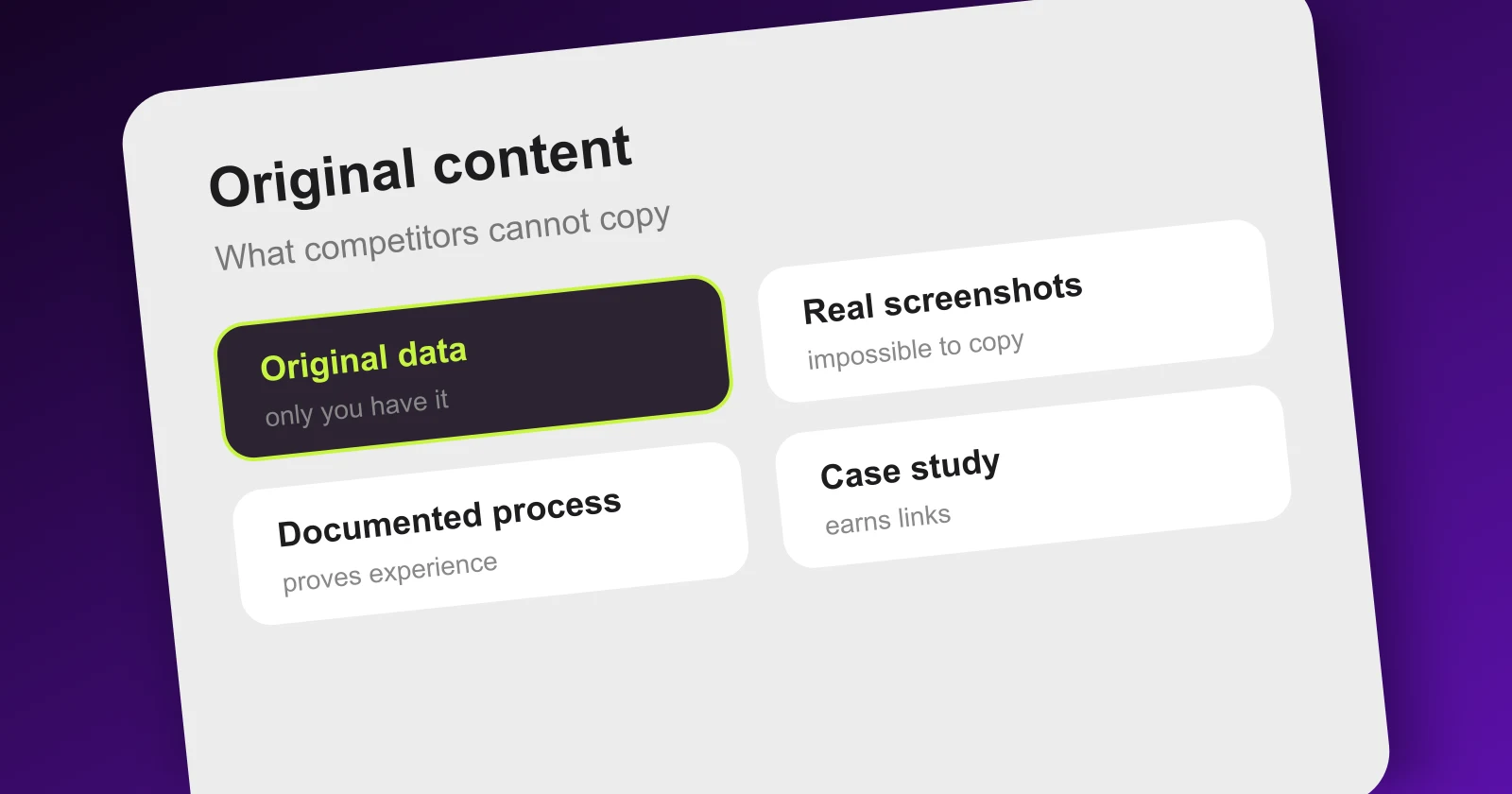
Original data is the single most linkable asset there is. A statistic others want to cite pulls links for years with no outreach.
Do this: look at what you can measure that others cannot, product usage, survey results, tested outcomes, and publish it as a clear stat or small study. One original number can out-earn ten rewritten posts.
2. Turn results into a case study
A documented before-and-after with real figures is more persuasive and more citable than any claim. It proves experience instead of asserting it.
Do this: write up a real result with the starting point, what you did, and the measured outcome. Honest, specific numbers beat round marketing figures every time.
3. Cite and date every figure
Data is only trusted if its source is clear. Undated, unsourced numbers get ignored by readers, Google and AI engines alike.
Do this: attribute each statistic, link to the primary source, and date it ("as of 2026"). This is exactly the trust signal that makes a page quotable, see how to rank in AI search.
Document with images
4. Use original screenshots, not stock photos
A stock image adds nothing a reader cannot find anywhere. An original screenshot of your process or product is unique, useful and impossible to copy.
Do this: screenshot the actual thing you are describing, your dashboard, the setting, the result, and annotate it. Every real screenshot is content no competitor's page has.
5. Draw the process as a diagram
A diagram explains in one glance what a paragraph struggles to, and it is a distinct, linkable asset in its own right.
Do this: turn any multi-step concept into a simple labeled diagram. Diagrams get embedded and linked from other sites, which earns you backlinks passively.
6. Label images so Google and AI can read them
Google cannot see what an image shows, it reads the file name, alt text and caption. An original image with no labels wastes half its value.
Do this: use descriptive file names and alt text that state what the image shows, and compress to WebP so it does not slow the page. See the site speed guide.
Document your process
7. Write down the exact steps you actually take
Documented process is inherently unique and answers the precise how-to questions people search. It is also the easiest original content to produce, you are recording, not inventing.
Do this: for anything you do repeatedly, write the real steps in order, with the specifics competitors leave out. Specificity is what makes it unrankable-by-anyone-else.
8. Show the mistakes and edge cases
Generic guides describe the happy path. Documenting what goes wrong, and how you handle it, proves first-hand experience no rewrite can fake.
Do this: add the pitfalls, the exceptions, and what you would do differently. This is exactly the experience signal Google's E-E-A-T rewards, see what E-E-A-T is.
9. Turn process into a reusable template or tool
The most linkable form of a documented process is one others can use directly: a checklist, template or calculator.
Do this: package a process as a downloadable template or a small tool. Meeeters' free tools are an example of process turned into a linkable asset, background in linkable assets.
Turn documentation into rankings
10. Map original assets to the pages that need them most
Depth is not needed everywhere equally. Your competitive money pages benefit most from original data and process; thin informational pages benefit least.
Do this: run a free SEO analysis and use Improve my site to see which pages are highest priority, then invest your original assets there first, not evenly across the site.
11. Publish at a pace you can sustain
Original content is more work per piece, so production, not ideas, becomes the bottleneck. A documented asset that never ships earns nothing.
Do this: use Meeeters' automated SEO content to draft around your original data and process, then publish straight to your WordPress, Webflow or Shopify CMS, so documenting scales instead of stalling.
12. Let original assets earn the links
Original data, diagrams and tools are what other sites actually link to. But even the best asset needs a push to be discovered by the sites that would cite it.
Do this: promote your linkable assets and earn the first relevant links through Meeeters' non-reciprocal network, so your original content gets the editorial links that turn depth into rankings, without buying or swapping.
Why this matters
Interchangeable content is a slow, expensive way to lose. It costs the same hours to write as original content but ranks nowhere, earns no links, and gives AI engines no reason to cite you over the source you rewrote. Meanwhile the one moat competitors cannot copy, your data, your screenshots, your real process, sits undocumented in your head and your tools. Documenting it does triple duty at once: it makes pages that rank, assets that earn links, and E-E-A-T signals that build authority. It is the rare SEO work where writing down what you already do is the whole strategy.
Meeeters vs the content mill
Most content tools optimize for volume: feed a keyword, get a rewrite of the top results, publish, repeat. That produces exactly the interchangeable content that does not rank or earn links. Meeeters points the effort where it pays: it shows which pages deserve original depth, helps you draft around your own data and process rather than a scrape of competitors, publishes to your CMS, and then earns the editorial links your original assets need to actually rank. It treats content and authority as one job, because for ranking they are.
Turn what you do into content that ranks
Start here: analyze your site to see which pages need real depth most. Document your data, images and process into those pages, then earn the editorial links that turn original content into rankings and citations.
Frequently asked questions
Quick answers to the questions people ask most about this topic.
Google is trying to surface the most useful, credible source, not the tenth rewrite of it. Original data, images and first-hand process signal experience and expertise (part of E-E-A-T), earn backlinks, and give both Google and AI engines a reason to prefer and cite your page over interchangeable ones.
Anything you produce first-hand, such as your own data and results, screenshots of your product or process, diagrams, case studies, tested findings, and documented step-by-step methods. The test is whether a competitor could copy it without doing the work, if not, it is original.
Documented process is naturally unique, demonstrates real experience (a core E-E-A-T signal), answers the specific how-to questions people search, and produces linkable, quotable assets. It also scales, since you are writing down what you already do rather than inventing content.
Yes. Original screenshots and diagrams cannot be found elsewhere, so they make your page distinct, they earn image-search traffic and links, and they signal first-hand experience. Stock images add nothing Google or a reader cannot get anywhere else.

I built Meeeters to make link building safe and simple: real, relevant backlinks with no reciprocal footprint and no black-hat shortcuts.