Semrush Alternatives in 2026: What You Can Replace It With (and What You Already Own)

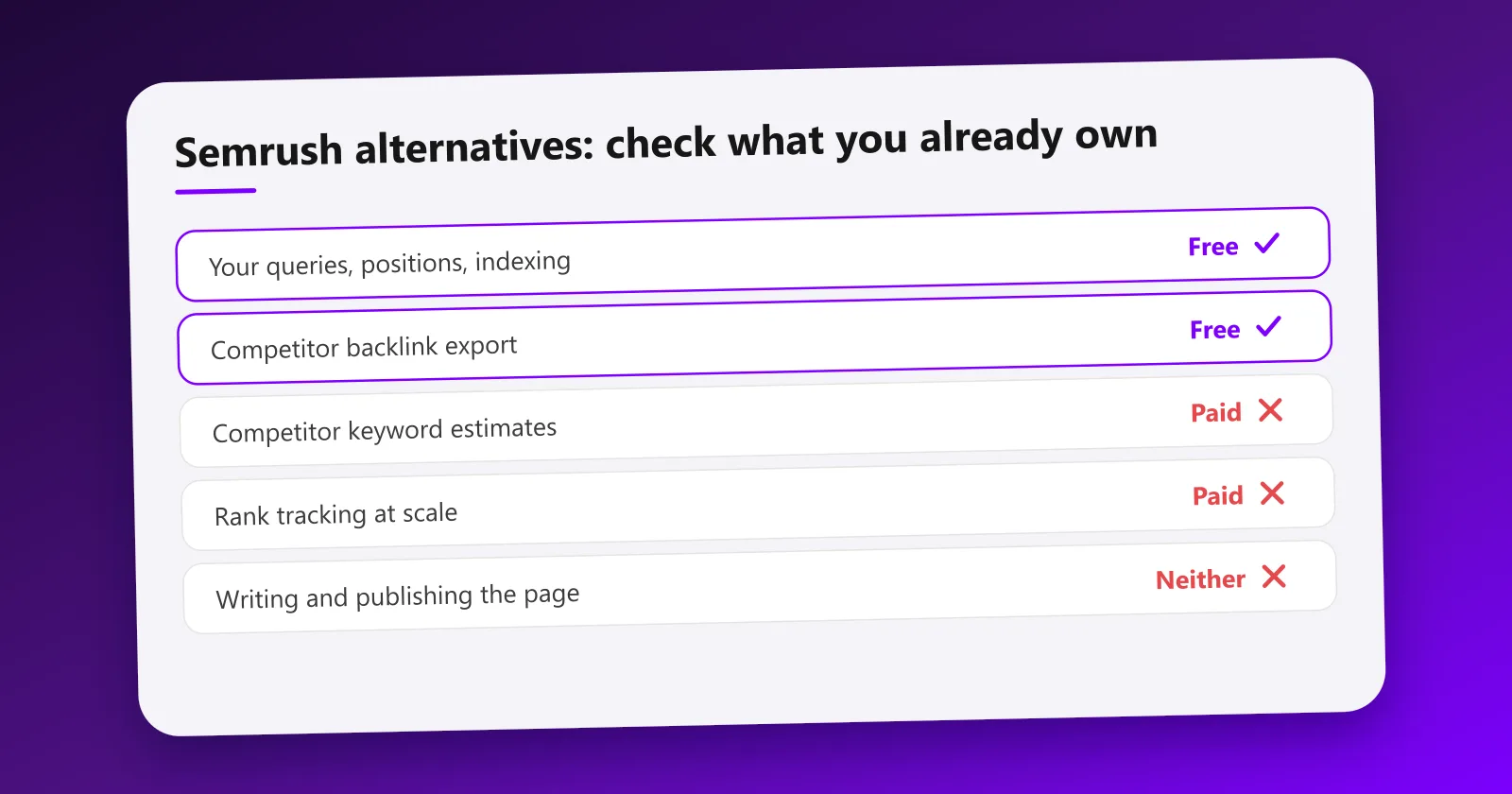
Short answer: before you compare alternatives, check what you already own. A large share of what people pay Semrush for is available free, and more accurate, in tools already connected to their site.
That reframing matters because the usual list of alternatives compares subscriptions against each other and quietly assumes you need one.
Start with what you already have
Google Search Console reports your actual queries, impressions, positions, clicks and indexing status. Not an estimate of them. For your own site, this is not a downgrade from Semrush, it is the source of truth that Semrush is modelling. If you have never worked through it properly, the Search Console guide covers what each report is for.
Bing Webmaster Tools is the one most people miss: it lets you view and export competitor backlinks for free. That single feature replaces one of the most common reasons for keeping a paid subscription.
Google Analytics covers what happens after the click, which no SEO suite does well anyway.
Set those three up and the paid gap shrinks to two things: competitor keyword estimates, and rank tracking at scale.
The paid alternatives worth naming
SE Ranking. The closest thing to a like-for-like replacement at a much lower price. Keyword research, rank tracking, competitor overview and audits in one place. Give up: depth of the backlink index compared to the biggest tools.
Mangools. Cheaper still, and noticeably easier to use. Good keyword and SERP analysis for a single site or a small portfolio. Give up: bulk work, large-scale tracking and enterprise reporting.
A DataForSEO-based setup. You pay per API call instead of a monthly seat, which is dramatically cheaper for occasional heavy pulls. Give up: the interface. This suits people who are comfortable wiring data into a spreadsheet or a script, and it is how a lot of tools you already pay for get their data in the first place.
Ahrefs. Not cheaper, but different: if the reason you keep Semrush is backlinks specifically, this is the swap rather than a saving.
The honest numbers problem
Price is the stated reason people leave. It is rarely the real one.
The real one surfaces the first time someone compares a third-party traffic estimate for their own site against their Search Console data and finds the two do not agree. Every keyword volume and traffic figure in any of these tools, Semrush included, is a model. The model is useful for comparing two competitors against each other, because the error is at least consistent. It is not useful as a fact you quote in a client report.
This is worth internalising before you switch, because the alternative you pick will have the same limitation, usually with a smaller dataset behind it. You are not buying accuracy at a lower price. You are buying a similar estimate, cheaper, and deciding to trust measured data for your own site instead.
What none of them replace
Every tool in this list, at every price, produces information. None of them writes the page, fixes the internal link, or acquires the backlink.
That is the actual bottleneck for most small sites, and it is why cancelling a research subscription rarely hurts as much as people fear. If nobody on the team had time to act on the last three monthly reports, a cheaper report is not the fix.
Meeeters sits on the other side of that line deliberately: it is not a Semrush alternative and does not try to be, because it replaces the execution rather than the research. If your problem is that you do not know what to do, keep a research tool. If your problem is that you know and it never gets done, the subscription is not what is missing.
How to actually switch
- Connect Search Console and Analytics properly, and give them two weeks of data.
- Add Bing Webmaster Tools for the competitor backlink export.
- List the reports you genuinely opened in Semrush last month. Most people find one or two.
- Pick the cheapest tool that covers those, or buy a single month when you need a competitor snapshot instead of holding a subscription all year.
If you want the wider stack rather than a straight swap, the six-tool stack covers what each tool is for and the order to add them in.
Not sure what your site actually needs before you pay for anything? Run the free SEO analysis: it reports your real authority, your quick wins and the pages worth writing, without a subscription.
Frequently asked questions
Quick answers to the questions people ask most about this topic.
It depends which job you are replacing. For your own site's performance, Google Search Console is not an alternative but an upgrade, since it reports measured data rather than estimates. For competitor backlinks, Bing Webmaster Tools exports them free. For competitor keywords and rank tracking on a budget, SE Ranking and Mangools cover most of the workflow, and a DataForSEO-based setup goes furthest per dollar if you are comfortable with an API bill instead of a subscription.
For your own site, yes, and it is the same data Google uses: Search Console for queries, positions, clicks and indexing, plus Analytics for what happens after the click. For competitor work the free options are narrower, but Bing Webmaster Tools does let you view and export competitor backlinks at no cost. What no free tool gives you is reliable competitor keyword volume at scale.
Because third-party keyword volumes and traffic figures are modelled estimates, not measurements. The gap becomes obvious the moment you compare a Semrush traffic estimate for your own site against your Search Console data. That does not make the tool useless, since directional comparison between competitors is still informative, but treating those numbers as facts is the mistake.
For a single site, largely yes. Search Console covers queries, positions, indexing and page-level performance, and Analytics covers behaviour. What you lose is competitor visibility and bulk keyword research. Many small teams accept that trade, then buy a single month of a paid tool when they need a competitor snapshot rather than keeping a subscription running all year.
It is worth it if you genuinely use competitor research and multi-site tracking every week, which is mostly agencies and larger in-house teams. It stops being worth it when the subscription exists so that somebody can generate a monthly report nobody acts on. That is the most common reason it gets cancelled, ahead of price.

I built Meeeters to make link building safe and simple: real, relevant backlinks with no reciprocal footprint and no black-hat shortcuts.