How Many Internal Links Per Page? The Dilution Question, Answered Properly

The question shows up constantly in some form: I have fifteen internal links on this page, am I diluting the value of each one?
The honest answer has two halves, and most articles only give you one of them.
The mechanical half: yes, it splits
A page passes authority through its links, and that authority is shared among them. Two links each carry a larger share than ten. This is not controversial and it has been true for as long as link-based ranking has existed.
So in the strict sense, adding a fifteenth link does reduce what the other fourteen carry.
The practical half: it almost never decides anything
Here is what that mechanical fact leaves out. The difference between a link's share at eight links and at fifteen is small. The difference between linking to a page that matches your anchor and linking to one that does not is enormous.
You are optimizing the wrong variable. A page with fifteen well-targeted links routinely outperforms the same page with six badly targeted ones, because relevance carries more weight than the arithmetic of the split. Counting links feels like optimization because it produces a number, and numbers feel like control. It is the SEO equivalent of rearranging furniture.
There is one case where the count genuinely matters: a page with hundreds of links, such as an unfiltered archive or a footer that lists every page on the site. At that scale the share per link becomes negligible and the page stops passing meaningful signal to anything. If you are asking whether fifteen is too many, you are nowhere near that.
What actually degrades as the count rises
Something real does break down as you add links, it is just not the arithmetic.
Relevance falls off. The first three links on any page are obvious: the reader clearly needs those pages. By the twelfth, you are reaching. You are linking because you decided the page should have twelve links, which is exactly backwards.
Reader trust erodes. A reader who clicks two links and lands on pages that did not deliver what the anchor promised stops clicking. You have then trained your audience to ignore the mechanism you were trying to strengthen.
Anchors get worse. Under a quota, anchors drift toward repeated keyword phrases, because writing a natural anchor for a link you did not need is hard. That pattern is visible and it is the part that genuinely looks manipulative.
The page gets harder to read. Every link is a small interruption. Enough of them turn a paragraph into a decision tree.
The rule that replaces counting
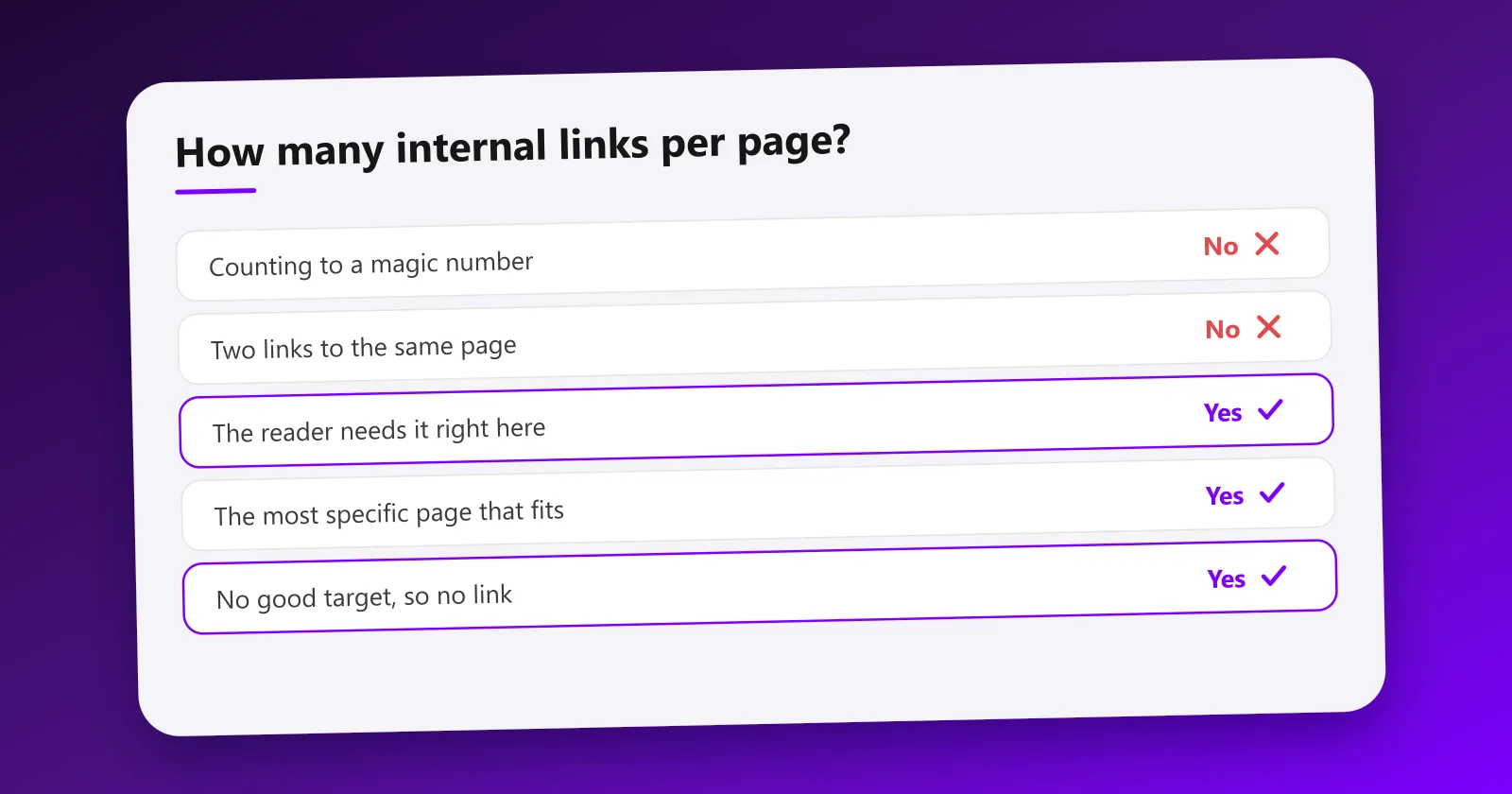
One test, applied per link: does the reader need this page, right here, at this exact sentence?
If yes, link, and it does not matter whether it is the third or the fourteenth. If no, do not link, and it does not matter that the page only has two so far.
Three corollaries that cover almost every case in practice:
- Never link twice to the same page from one article. The second link adds nothing and splits your own signal about which anchor describes that page.
- Point at the most specific page that fits. Linking to a category index when a precise page exists wastes the link and disappoints the reader.
- If no page fits, write the sentence without a link. An approximate link is worse than no link, because it costs you trust and passes signal to a page that does not deserve it.
Navigation and in-body links are different questions
Most of the confusion around this topic comes from adding two different things together.
Your header, footer and sidebar repeat on every page. Because they are everywhere, they distribute authority broadly and evenly, which is useful for making sure everything gets crawled and reachable, and close to useless for telling Google that this particular page is about this particular topic.
In-body contextual links are the opposite. They appear once, in a specific context, with an anchor written for that context. They are the ones that carry topical meaning and the ones this whole question is really about.
When someone says a page has fifty links and asks whether that is too many, the answer usually is that thirty-eight of them are navigation and are not the thing to worry about.
Where the count should actually vary
Rather than a universal number, let the page type decide:
- A hub or pillar page exists to distribute readers across a cluster, so a high link count is the point rather than a problem.
- A deep article typically needs a handful of contextual links: the prerequisite concept, the logical next step, the related question the reader is about to have.
- A landing page should have very few, because every link is an exit from a page whose job is to convert.
For how those page types fit together at the site level, site architecture vs internal linking covers the distinction, and what is a semantic silo explains why keeping links inside a topic cluster concentrates authority instead of leaking it.
The bottom line
Dilution is real and it is rarely your bottleneck. If you are choosing between agonizing over whether fifteen links is too many and checking whether each of those fifteen points at a page that genuinely helps the reader at that moment, the second is where the results are.
Stop counting. Start justifying each link individually. The count will land where it should on its own.
Meeeters places internal links inside the silo automatically, choosing only from pages that are actually live on your site, which removes both the guesswork and the risk of linking to a page that does not exist. Run the free SEO analysis to see your current internal link structure.
Frequently asked questions
Quick answers to the questions people ask most about this topic.
There is no correct number, and any specific figure you read is someone's habit rather than a rule. For a long article, somewhere between three and ten contextual in-body links is typical, but the count follows from the content rather than the reverse. If a page genuinely needs twenty links because it is a hub, twenty is right.
In the mechanical sense, yes: the authority a page passes is shared among its outgoing links, so more links means a smaller share each. In practice this rarely decides anything, because the difference between a link's share at eight links and at twelve is far smaller than the difference between linking to the right page and the wrong one.
They exist and they are crawled, but they behave differently from in-body links. Navigation repeats on every page, so it distributes authority evenly across the site rather than concentrating it anywhere. In-body links are the ones that carry topical meaning, and they are the ones worth thinking about.
Not through the count itself. It hurts when the links stop being useful: irrelevant targets, repeated links to the same page, keyword-stuffed anchors, or a wall of links a reader scrolls past. Those signal a page built for crawlers, and they cost you on the reader side long before they cost you on the ranking side.
Your navigation already does that on every page, so an extra in-body link to the homepage adds nothing. Spend the link on a page that is harder to reach instead, which is usually a deep page three or four clicks from the entry point.

I built Meeeters to make link building safe and simple: real, relevant backlinks with no reciprocal footprint and no black-hat shortcuts. Questions about your site? Write to me directly.
Email us