Link Exchanges and Google Rules: What the Spam Policies Actually Say

If you are looking for free backlinks, link exchanges come up quickly, and so does the question of what Google thinks of them. This guide quotes Google's spam policies word for word, so you can judge any method yourself, including ours. If you want to see how Meeeters works on your own site, create a free account.
What Google's spam policies say
Google defines link spam as "the practice of creating links to or from a site primarily for the purpose of manipulating search rankings". Among the examples it gives, several concern exchanges directly:
- "Excessive link exchanges ("Link to me and I'll link to you") or partner pages exclusively for the sake of cross-linking"
- "Using automated programs or services to create links to your site"
- "Requiring a link as part of a Terms of Service, contract, or similar arrangement"
- "Links with optimized anchor text in articles, guest posts, or press releases distributed on other sites"
Buying links is covered too. A paid link is acceptable when it carries rel="nofollow" or rel="sponsored", which tells Google not to count it as a vote.
What the policies do not say
They do not say that two sites can never link to each other. Related businesses cite each other, bloggers link to friends, partners mention partners. The words that carry the policy are "excessive", "exclusively for the sake of cross-linking" and "primarily for the purpose of manipulating search rankings". The question is why the link exists.
They also do not promise anything about detection. Google can lower a site's rankings for violations, and it can also ignore links it does not trust. That is why a claim that some links are invisible to Google describes marketing, not the policy.
The patterns the policy describes
Some setups match the policy text almost word for word:
- Direct swaps. Site A links to B because B links to A.
- Partner pages. A page listing dozens of "partners" that all link back.
- Links as a condition. Getting something only if you link back.
- Automated placement. Software that publishes links without a person deciding.
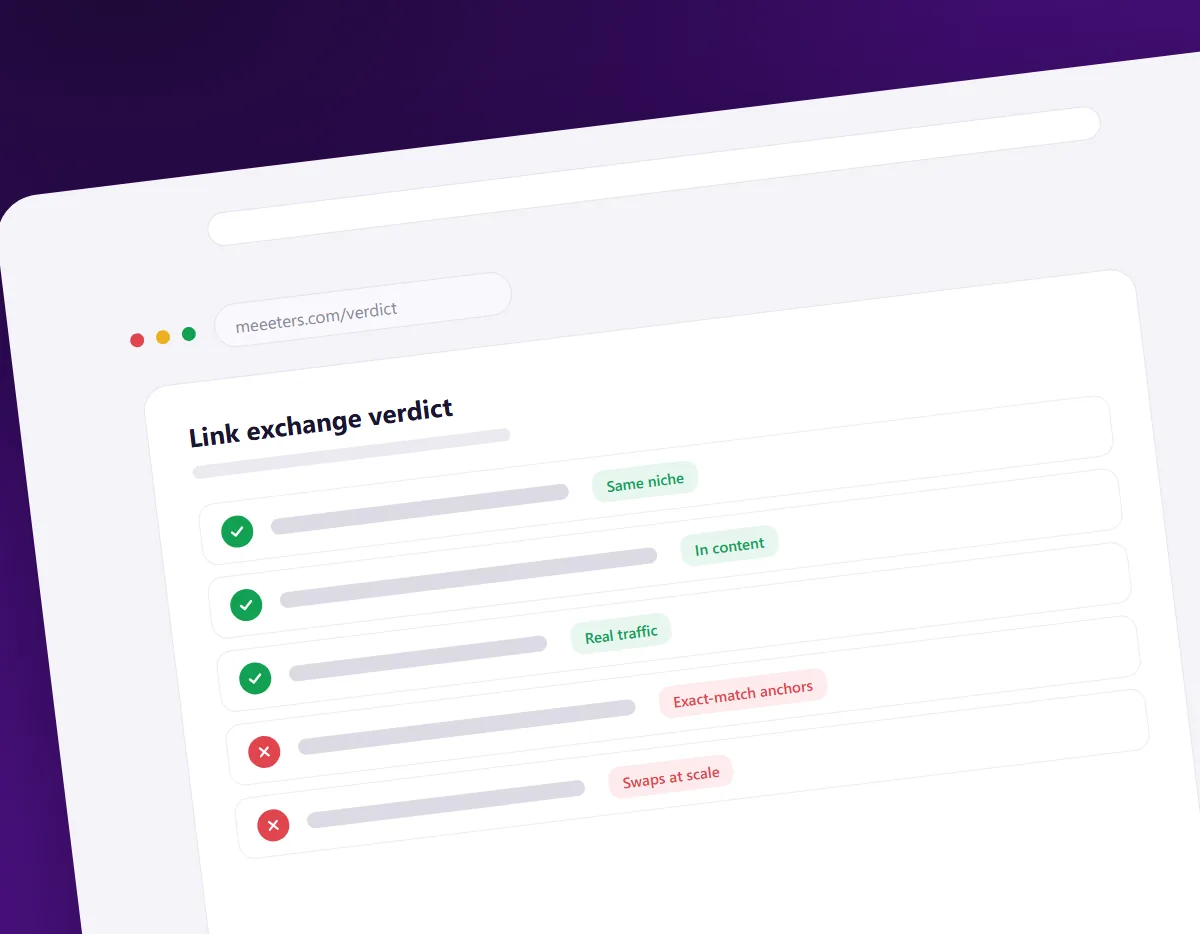
- The same anchor everywhere. One commercial keyword repeated across every placed link.
Three-way schemes, where A links to B, B to C and C back to A, are often sold as a fix for direct swaps. Changing the shape does not change the intent, and Google reads intent.
Meeeters is an organised exchange
We would rather say it plainly. Meeeters runs on give and take: each month you get up to 3 links to place inside your own articles, toward members matched on your theme and language, and every link seen live earns you one from a different site. Receiving links depends on placing yours. That is an exchange, organised by software, and it is the kind of arrangement the policy on excessive exchanges is about.
What we can tell you is how it is built, so you can judge it against the text above:
- Volume is capped. Each site places at most 3 links a month.
- Links sit in real articles. Each link goes into an editorial article drafted from your own pages and published on your site, in a paragraph about a related subject.
- Niche relevance. Sites are matched on theme and language, with a minimum overlap in topic.
- Never A and B both ways. Two sites are never paired in both directions, and loops between three sites are blocked too.
- Plain anchors by default. The brand, the brand with a descriptor, or a descriptive phrase.
- Links are checked. Each link is checked on the live page and only counts if it is there and dofollow.
- A person places each link. Nothing is published automatically on your site.
None of this makes a link immune from Google's judgement, and we do not claim it does. Whether to take part is your call, with the policy text in front of you.
The short version
Google's policy targets links created to game rankings, and excessive exchanges are named. Pick methods by what they do: relevant sites, real articles, plain anchors, small volumes and no two sites linking to each other, and treat any promise that a method is beyond Google's reach as a red flag.
Frequently asked questions
Quick answers to the questions people ask most about this topic.
Google's spam policies name excessive link exchanges as link spam. Sites that violate the policies can rank lower or drop out of results, and Google can also simply ignore the links. Occasional links between related sites are not what the policy targets.
A few reciprocal links between related sites happen naturally on the web. What the policies target is exchanging links as a system, where the reason for the link is the link in return.
Nobody can promise that. Any service that claims its links are invisible to Google is making a promise it cannot keep. Judge a method by what it does, not by what it claims Google will miss.
Yes, an organised one, and we say so. You place links toward members in your niche, and the links you place are what earn you links from other sites. Two sites never link to each other, each site places at most 3 links a month, and every link sits in an article written for readers. That does not put it outside Google's policy on exchanges.

I built Meeeters to make link building simple and honest: real backlinks from sites in your niche, placed inside real articles, and checked on the live page.