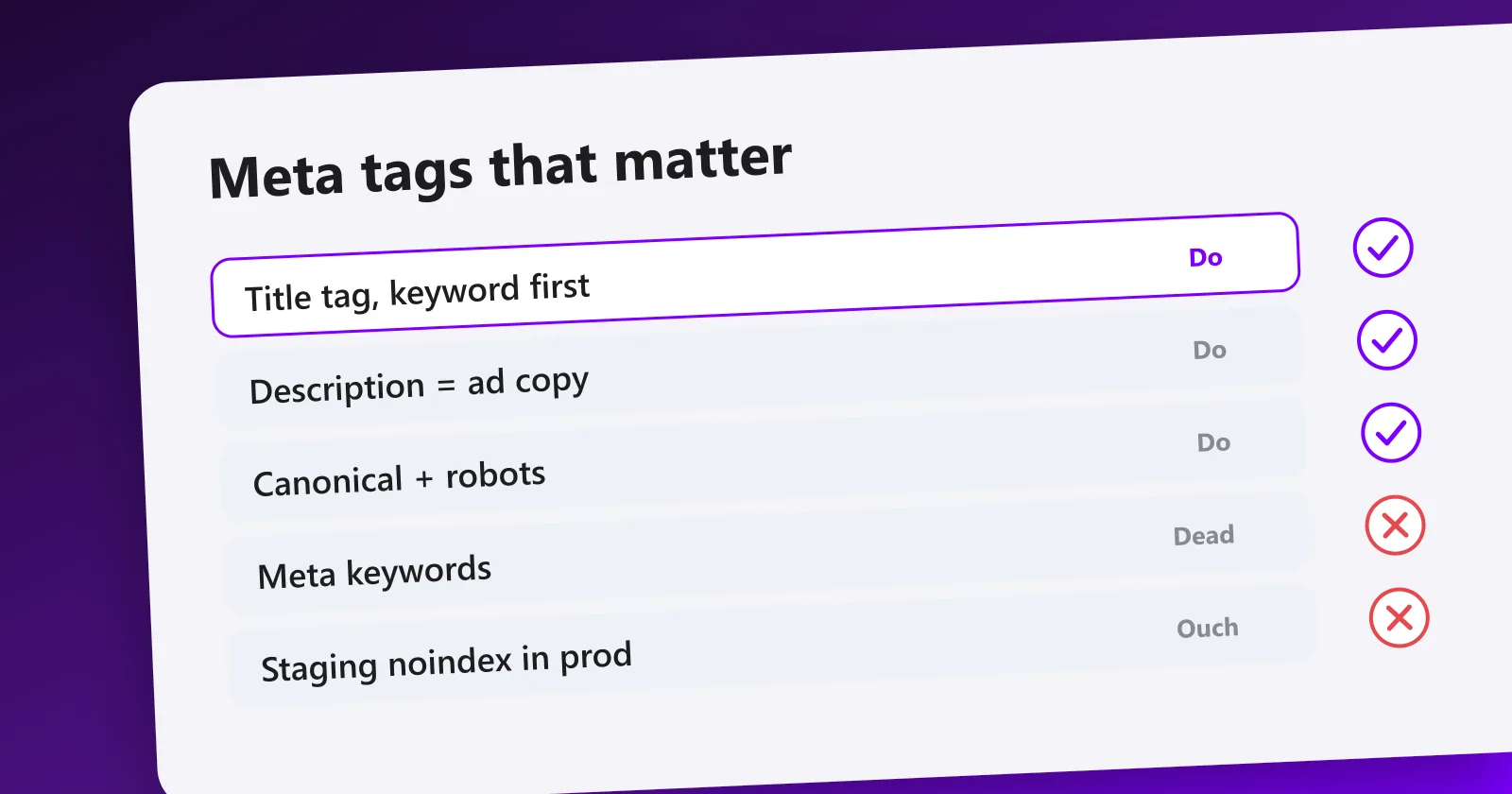
Meta Tags for SEO: The Ones That Matter in 2026

Meta tags are where SEO folklore goes to survive. Half the advice online dates from 2012, and sites still ship meta keywords lists while forgetting a canonical. Here is the 2026 short list: five tags that earn their place, and the rest you can stop worrying about.
1. Title tag: the only meta tag that directly affects rankings
The title tag is what Google reads first and what searchers see in blue. Rules that hold in 2026:
- Put the target keyword near the front: "Meta Tags for SEO: What Still Matters" beats "What Still Matters: A Guide to Tags for Meta SEO".
- Stay under about 60 characters so it does not get cut.
- One page, one intent, one title. If you need two keywords in a title, you probably need two pages.
<title>Meta Tags for SEO: What Still Matters in 2026</title>
2. Meta description: your ad copy, not your ranking
The description does not affect rankings. It affects the click, which is why it matters anyway. Write it like ad copy: the concrete promise of the page in about 150 characters, with the keyword once (it gets bolded in results).
<meta name="description" content="Which meta tags actually affect rankings and clicks in 2026, with copy-paste examples." />
Google rewrites descriptions it does not like. Yours gets used more often when it genuinely matches the page.
3. Canonical: one URL per piece of content
Duplicate URLs (tracking parameters, www vs non-www, trailing slashes) split your authority. The canonical tag names the official version:
<link rel="canonical" href="https://www.example.com/meta-tags-for-seo" />
Every page should have one, even if it points to itself.
4. Robots: the emergency brake
<meta name="robots" content="noindex"> removes a page from Google. Use it on thin pages, internal search results, and paginated junk. The classic self-inflicted wound is shipping a staging noindex to production: if your traffic drops to zero overnight, check this tag first, then run a proper SEO audit if the drop survives it.
5. Open Graph and Twitter cards: previews everywhere
OG tags decide how your page looks when shared on social, in chat apps, and increasingly in AI assistants that render link previews:
<meta property="og:title" content="Meta Tags for SEO: What Still Matters in 2026" />
<meta property="og:description" content="The five tags worth your time, with examples." />
<meta property="og:image" content="https://www.example.com/og/meta-tags.png" />
A page without an OG image renders as a grey rectangle. That costs real clicks.
Tags you can stop worrying about
- Meta keywords: ignored by Google since 2009.
- Meta author, generator, revisit-after: no ranking effect.
- Meta refresh redirects: use proper 301s instead.
The 2026 additions worth knowing
AI crawlers read your signals more literally than humans do. Two habits pay off: a clear, answer-first first paragraph (the text most AI answers quote, and the reason every page on this site opens with a TL;DR), and schema markup (FAQ, Article, Breadcrumb) alongside your meta tags. Schema is not a meta tag, but it does the job meta keywords never did: telling machines what the page is. If you want the full picture on ranking in AI answers, start with generative engine optimization.
Quick audit checklist
- Every page has a unique title under 60 characters with its keyword near the front.
- Every page has a hand-written description around 150 characters.
- Every page has a canonical.
- No accidental noindex in production.
- OG title, description and image render correctly in a link preview checker.
Run that on your top 20 pages and you have done more than most sites ever do about meta tags. Checking all five automatically, every month, is part of what an automated SEO audit covers.
Frequently asked questions
Quick answers to the questions people ask most about this topic.
No, Google confirmed long ago they are not a ranking factor. They affect the click-through rate, which is why they are still worth writing by hand: your description is your ad copy in the results page.
Google has ignored it since 2009. Its only modern effect is showing your keyword list to competitors who view your source code.
AI assistants lean on your title, description, Open Graph tags for previews, and above all a clear answer-first opening paragraph, which is the text most AI answers quote.

I built Meeeters to make link building safe and simple: real, relevant backlinks with no reciprocal footprint and no black-hat shortcuts.
Related searches, answered
What people actually type before landing here, with the short answer and where to read more.
- SEO tags
- Only three still carry weight: title, meta description for click-through, and canonical for duplicates.The full on-page checklist ›
- SEO meta tags
- Google rewrites titles roughly half the time, usually when yours does not match the query on the page.Writing titles that hold ›
- Are meta keywords still relevant?
- No. Google dropped the meta keywords tag as a signal in 2009 and it has been ignored ever since.Tips that still move rankings ›
- Meta description length
- Write for the truncation point, around 155 characters, and put the promise before it.What an audit checks ›
- Which meta tags help AI search?
- None directly. AI engines read the rendered content and structured data, not the meta block.Schema that matters for AI ›