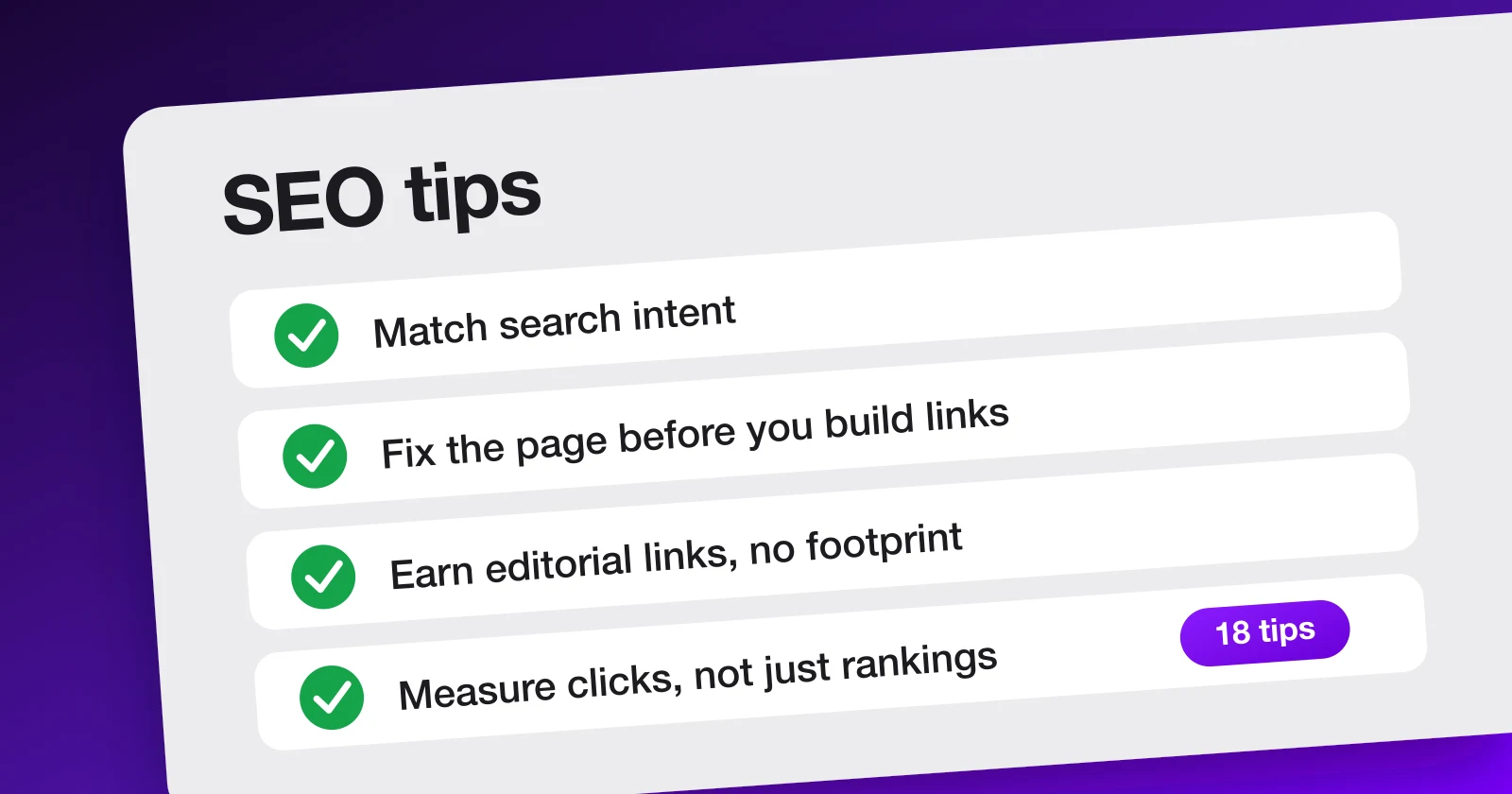
18 SEO Tips That Actually Move Rankings (With the Exact Steps)

Most "SEO tips" lists are the same twenty bullet points rewritten forever: "write good content", "use keywords", "get backlinks". True, and useless, because they never tell you the exact next step or what to do first.
This list is built the other way. Every tip is a concrete action with the steps to do it, and the whole thing is ordered by leverage: intent, then the page, then the technical layer, then authority. Work down it in that order. A backlink cannot rescue a page that answers the wrong question, and a schema tweak will not save a page nobody links to.
Start with the fundamentals
1. Match search intent before you write a word
Type your target keyword into Google and read the top ten results as data. Are they listicles, step-by-step guides, comparisons, tools or product pages? That format is the intent Google has already validated.
Do this: search your keyword, note the dominant format in the top 5, and match it. If everyone ranks a guide and you publish a sales page, you have lost before you start. This one check saves more wasted content than anything else on this list.
2. Audit your site before you touch anything
You cannot fix what you have not measured. Before optimizing a single page, get an honest read on where you stand: how strong your domain is, what topic Google thinks you cover, and which pages it actually sees.
Do this: run a free SEO analysis of your site. Meeeters returns your site strength (your real domain authority, as a simple gauge), your main topic, the number of pages Google indexes, and a short list of quick wins. Now every tip below has a target instead of a guess.
3. Answer the query in the first 100 words
State the direct answer immediately, then expand. Readers reward it, Google rewards it, and AI answer engines can only quote a page that resolves the question fast.
Do this: put a one or two sentence answer right under your H1, before any preamble. Then expand into the detail. Burying the answer under 400 words of throat-clearing is the most common self-inflicted ranking wound.
4. Fix the pages you are missing, not just the ones you have
Ranking gaps are usually missing pages, not broken ones. The fastest content wins are the pages your topic clearly needs and you have not written yet.
Do this: in the Meeeters dashboard, open Improve my site. The audit lists the highest-priority pages to create, each with a plain reason why it matters for your topic. Write those first, in the format that already ranks (tip 1).
5. Strengthen your internal links
Internal links pass authority through your site and help Google understand which pages matter. Most sites leak authority simply because their best pages are not linked to each other.
Do this: map your content into clusters, a pillar page plus supporting articles that link back to it. The Meeeters audit shows your site structure and clusters so you can see the orphans. Full method in our internal linking guide.
6. Refresh content that is losing rankings
Rankings decay. A page that ranked last year drops as fresher results appear, and updating it is often higher ROI than writing something new.
Do this: in Google Search Console, compare the last 6 months to the previous period, sort pages by clicks lost, and refresh the biggest droppers. Meeeters can generate an updated draft for you and publish it straight to your CMS. Details in how to update old content.
7. Write title tags and meta descriptions that earn the click
The title tag is still one of the strongest on-page signals, and the meta description drives click-through rate even though it is not a ranking factor.
Do this: keep titles under 60 characters with the keyword near the front and a reason to click. Write a ~150 character meta description that states the promise of the page. The full 15-point on-page pass is in our on-page SEO checklist.
Clear the technical blockers
8. Make sure the page is actually indexable
Plenty of pages never rank for one boring reason: Google cannot or will not index them.
Do this: confirm the page is not blocked in robots.txt, carries no stray noindex, and has a clean canonical. Then check it is in Google Search Console. If a page is missing entirely, start with why a site is not showing on Google.
9. Fix Core Web Vitals, for conversions as much as rankings
Speed is a light ranking signal and a heavy conversion signal. A fast page ranks a little better and converts a lot better.
Do this: compress images to WebP, cut unused JavaScript, lazy-load below the fold, and test on a real phone since Google indexes the mobile version. More in the site speed guide.
10. Use FAQ and schema to win long-tail and snippets
FAQ sections help you rank for question queries, and accurate schema can win richer results and featured snippets.
Do this: add an FAQ block answering the real "People also ask" questions for your keyword, and mark it up with FAQ schema. Keep it accurate; marking up content that is not on the page can backfire.
Close the authority gap (where most sites are stuck)
On-page and technical work decide whether you can rank. On competitive keywords, backlinks decide whether you do. This is the layer most people either skip or do dangerously, so slow down here. It is also the one part of SEO you cannot finish alone at your desk, which is exactly why it stays unsolved.
11. Fix the page before you build a single link
Links multiply what is already there. A clean, intent-matched page turns every new backlink into movement; a broken page wastes them.
Do this: only start link building on a page that passes tips 1 to 10. That is the whole reason authority comes last in this order, not first.
12. Prioritize relevant referring domains, not raw link count
Ten links from ten relevant sites beat fifty from one irrelevant one. Google weighs the diversity and relevance of domains pointing at you. See referring domains vs backlinks.
Do this: in Meeeters, the site deck scores each prospect on site strength and same audience, so you chase links from sites that actually share your readers instead of random high-DR pages with no topical fit.
13. Get dofollow links from vetted sites in your niche
Direct swaps ("you link to me, I link to you") are the oldest scheme in the book and the easiest for Google to spot. A page of reciprocal pairs is a classic footprint, which is the trap reciprocal links fall into.
Do this: let Meeeters find you dofollow backlinks in your niche, from network members that are scanned and eligible. Every link sits in real editorial content on a site with real traffic, and it is verified live and dofollow. No reciprocal links, no PBNs or spammy sites. More on the alternatives in how Meeeters works and safe link exchange.
14. Keep your anchor text profile natural
Pointing fifty exact-match anchors at one page is a spam signal. A healthy profile is mostly branded and natural-language anchors, with exact-match used sparingly.
Do this: use the anchor text generator to plan a varied mix, and check the ratios in anchor text for link exchanges.
15. Know how many links you actually need
Chasing a round number wastes money. The number of backlinks to rank depends on the keyword and who you are up against.
Do this: estimate it with the backlinks-to-rank tool, then build at a steady pace rather than a spike. Background in how many backlinks to rank.
16. Publish and distribute content at scale
Content earns links, but only if it ships. The bottleneck for most teams is production, not ideas.
Do this: use Meeeters' SEO automation to draft articles from your audit's page list, then publish directly through the WordPress, Webflow or Shopify integrations, no copy-paste.
Win the new surface: AI search
17. Make your pages quotable so AI engines cite them
AI answer engines lift a sentence or two to answer a question, and they favor pages that are quotable and come from trusted sites.
Do this: write self-contained, factual statements right after each heading so they make sense out of context, and keep a clean FAQ block. The full playbook is in how to rank in AI search and how to get recommended by AI.
Measure what matters
18. Track rankings, clicks and conversions, in that order of honesty
A ranking is vanity until it produces clicks, and clicks are noise until they convert. Watch all three, but judge your SEO by the bottom of that chain.
Do this: connect Google Search Console to your Meeeters dashboard to see queries, clicks and your link progress in one place, and be patient: on-page moves in days, authority compounds over months. See how long SEO takes.
The tip most lists leave out
Read the eighteen again. Seventeen are things you can do alone at your desk. The eighteenth, authority, is the one you cannot, and it is usually the real bottleneck. Once your page matches intent and is clean, the thing between you and page one is almost always links, and links come from other sites choosing to point at you.
You control how you go after them. Buying links buys footprints and risk. Reciprocal swaps leave a pattern Google reads in seconds. Meeeters finds you dofollow backlinks in your niche, from network members that are scanned and eligible, in real editorial content on sites with real traffic. No reciprocal links, no PBNs or spammy sites, which is the entire reason Meeeters exists.
Start where tip 2 said: run a free SEO analysis to see your site strength and your quick wins. Then work down this list, and when links become the bottleneck, earn them through the network instead of buying your way into a penalty.
Frequently asked questions
Quick answers to the questions people ask most about this topic.
Match search intent. Look at what already ranks for your keyword and give Google the same format, list, guide, comparison or tool. Every other tip is wasted on a page that answers the wrong question.
On-page and technical fixes can move rankings in days to a few weeks. Content depth and backlinks compound over 3 to 6 months. Anything promising page one in a week is selling you a penalty.
On-page and technical work decide whether you can rank. On competitive keywords, backlinks usually decide whether you do. Fix the page first so every link you earn actually moves it, then close the authority gap.
Run an SEO audit. Meeeters analyzes your site, scores your site strength, shows the pages Google already sees and lists the highest-priority pages to create or improve, so you are not guessing.

I built Meeeters to make link building safe and simple: real, relevant backlinks with no reciprocal footprint and no black-hat shortcuts.