How to Speed Up Google Indexing (And Why Google Chooses What to Index)

Two things frustrate every site owner: new pages take forever to show up in Google, and some pages never show up at all. Both come from the same reality, Google does not index the web automatically. It crawls on a budget and makes a decision about whether each page is worth storing.
Understand why that is, and speeding up indexing stops being a mystery. It becomes three jobs: make pages easy to discover, easy to crawl, and worth indexing. Here is why indexing takes time, why Google chooses what to keep, and how to get your pages in faster.
Why indexing takes time and why Google chooses
1. Google crawls on a budget, and yours depends on trust
Google cannot crawl the whole web constantly, so it allocates crawl attention. Trusted, frequently-updated, well-linked sites get crawled often; new or weak sites get crawled rarely.
Do this: treat crawl frequency as earned. The authority, internal linking and freshness work below all increase how often Google comes back. See your starting point with a free SEO analysis, which shows how many pages Google indexes.
2. Google indexes only what it judges worth storing
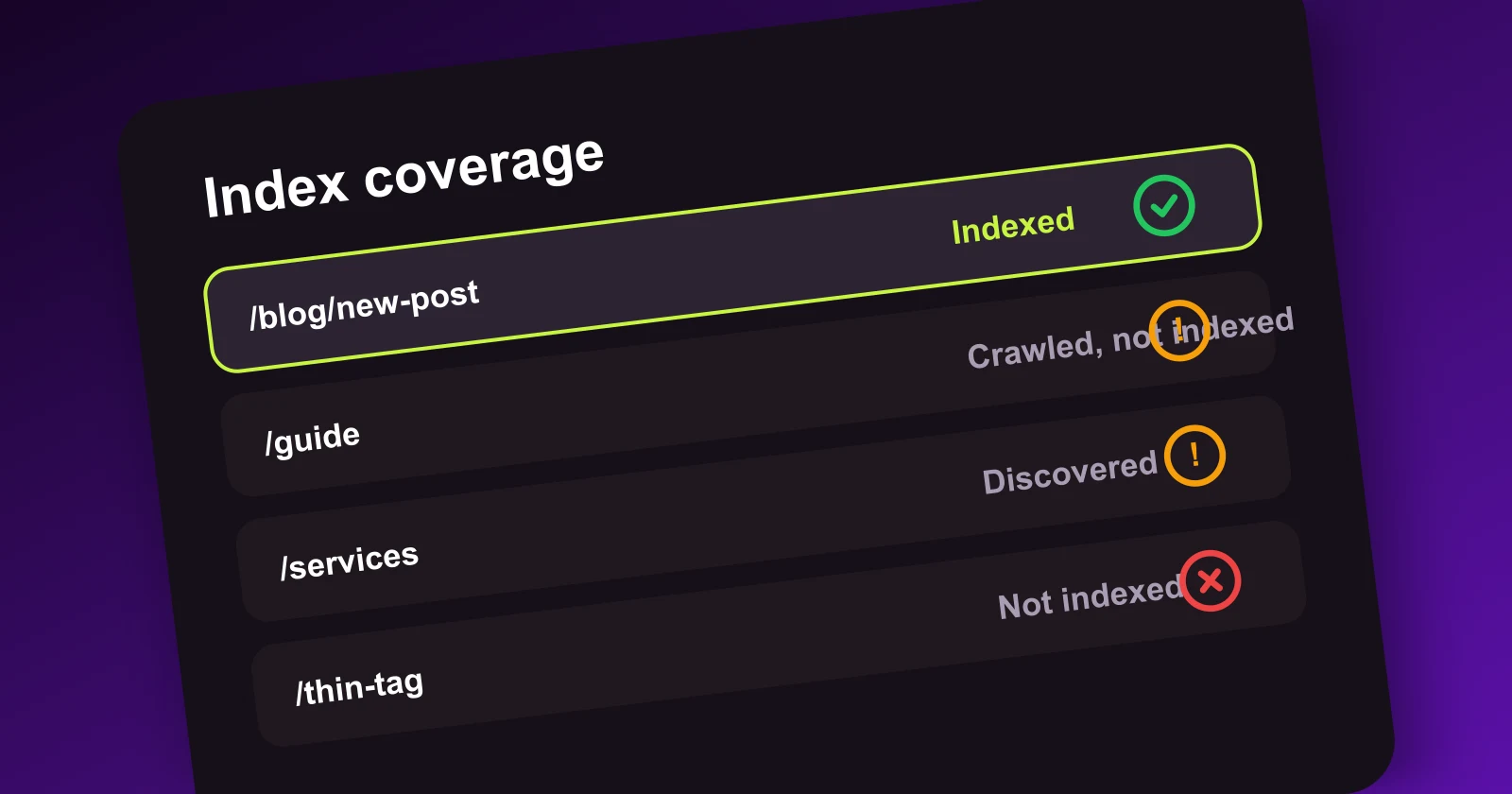
Crawling is not indexing. Google reads a page, then decides whether it is unique and useful enough to keep. Thin, duplicate or low-value pages get "Crawled - currently not indexed".
Do this: in Google Search Console, open the Pages report and read the exclusion reasons. "Crawled/Discovered - currently not indexed" is Google telling you the page is not worth it yet, a quality signal, not a bug.
3. New sites face a trust delay
A brand-new domain has no track record, so Google is cautious and slow to crawl and index it. This is normal, not a penalty.
Do this: on a new site, focus on getting a few strong pages indexed and earning early authority rather than publishing 50 pages at once. Guidance in SEO for new websites.
Make pages easy to discover
4. Link new pages from pages Google already crawls
Google finds pages by following links. A page linked from your frequently-crawled homepage gets discovered far faster than an orphan.
Do this: link every new page from your homepage or a strong pillar page the day you publish. Fix orphan pages, they may never be discovered. Method in the internal linking guide.
5. Keep a clean, current XML sitemap
The sitemap is a direct list of the URLs you want indexed. A stale or missing sitemap slows discovery.
Do this: generate an XML sitemap, keep it current, and submit it in Search Console. Make sure it lists only indexable, canonical URLs, not redirects or noindex pages.
6. Request indexing for priority pages
Search Console lets you ask Google to crawl a specific URL sooner. It does not guarantee indexing, but it speeds up the crawl.
Do this: use URL Inspection then "Request indexing" for important new or updated pages. Use it for priority pages, not in bulk, and do not spam it, it will not overturn a quality decision.
Make pages easy to crawl
7. Remove accidental blocks
The most common reason a page never indexes is a self-inflicted block: a stray noindex, a robots.txt disallow, or a canonical pointing elsewhere.
Do this: check each page for noindex tags, robots.txt disallows, and a self-referencing canonical. If a page is missing entirely, run through why a site is not showing on Google.
8. Make the page fast and light
Crawl budget is spent per page. Slow, heavy pages waste it, so Google crawls fewer of your URLs per visit.
Do this: compress images to WebP, cut unused JavaScript, and speed up server response. A faster site gets more pages crawled per visit. See the site speed guide.
9. Avoid duplicate and near-duplicate pages
Duplicates split crawl budget and get skipped at indexing. Thin tag pages, parameter URLs and boilerplate variants all bleed crawl attention.
Do this: consolidate near-duplicates, canonicalize parameter URLs, and noindex low-value auto-generated pages so Google spends its budget on pages that matter.
Make pages worth indexing
10. Give each page a real reason to exist
Google skips pages that add nothing new. The surest fix for "crawled, not indexed" is making the page genuinely more useful than what already ranks.
Do this: ensure each page answers a real query fully, with something original, data, examples, depth, that thin competitors lack. See document with original content.
11. Build the site authority that raises crawl priority
Everything about crawl frequency and indexing generosity scales with how much Google trusts your site. Authority is largely earned through links.
Do this: check your site strength in the free SEO analysis, then earn relevant editorial links to raise it. Meeeters' non-reciprocal network gets you real links without the footprint of buying or swapping. More authority means faster, deeper crawling.
12. Keep publishing and updating on a steady cadence
Sites that change regularly get crawled more often. A dormant site trains Google to visit rarely.
Do this: publish and refresh content on a consistent schedule. Meeeters can draft and publish to your CMS to keep the cadence up, and updating old content, see how to update old content, signals freshness that pulls crawlers back.
Why this matters
An unindexed page earns nothing, no rankings, no traffic, no matter how good it is. Slow indexing quietly caps your entire SEO program: you publish, wait weeks, and half of it never gets stored. Worse, "crawled - currently not indexed" at scale is Google telling you it does not think your pages are worth keeping, a verdict on quality and authority that no amount of "request indexing" will overturn. Fixing discovery, crawlability and worthiness does not just speed up one page, it raises the ceiling on how much of everything you publish ever counts.
Meeeters vs the manual approach
The usual routine is refreshing the Search Console coverage report and re-requesting indexing on stubborn URLs, treating a symptom while the cause, weak authority and thin pages, goes untouched. Standalone crawlers show you technical blocks but not why Google judges your pages unworthy. Meeeters shows how many of your pages Google actually indexes, flags the structural reasons (orphans, weak clusters, low site strength), tells you which pages deserve to exist, and then raises the authority that makes Google crawl you more often in the first place. It treats the cause, not the coverage report.
Get more of your pages indexed
Start here: analyze your site to see how many pages Google actually indexes and where the gaps are. Fix discovery and crawlability with the steps above, then raise your site strength so Google crawls you more often and indexes more of what you publish.
Frequently asked questions
Quick answers to the questions people ask most about this topic.
Google crawls the web on a limited budget and prioritizes sites it trusts and crawls often. New or low-authority sites get crawled less frequently, and Google also delays or skips indexing pages it judges thin, duplicate or low-value. Time plus authority plus page quality all factor in.
Link to it from pages Google already crawls often, include it in your sitemap, keep it fast and free of noindex or canonical issues, make it genuinely useful, and request indexing via Search Console's URL Inspection. On a strong, well-linked site, new pages often index within days.
Google does not index everything it crawls. It skips pages it considers duplicate, thin, low-value or too similar to existing content ("Crawled - currently not indexed" or "Discovered - currently not indexed"). Indexing is a quality decision, not automatic.
No. It asks Google to crawl the URL sooner, but Google still decides whether the page is worth indexing. If a page keeps getting skipped, the fix is usually page quality, internal links or site authority, not another request.

I built Meeeters to make link building safe and simple: real, relevant backlinks with no reciprocal footprint and no black-hat shortcuts.